
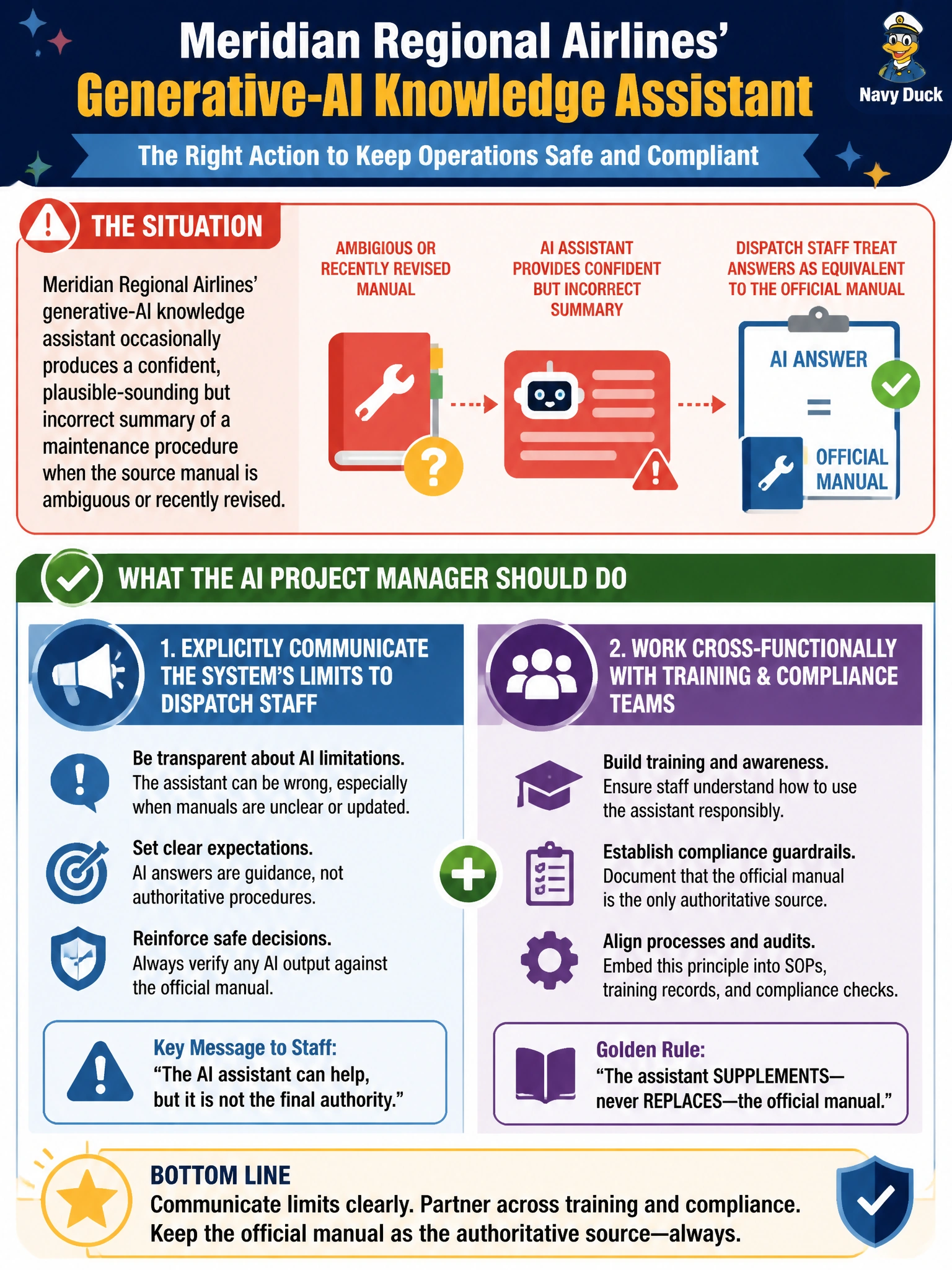
Meridian Regional Airlines' generative-AI knowledge assistant occasionally produces a confident, plausible-sounding but incorrect summary of a maintenance procedure when the source manual is ambiguous or recently revised. Dispatch staff have started treating the assistant's answers as equivalent to the official manual. What should the AI project manager do to address this?
Select an answer to reveal the explanation.
Short Explanation
The fix isn't chasing a mythical zero-error model or unplugging a genuinely useful tool — it's making sure everyone using it knows what it is and isn't. Recognizing AI's limits and getting training and compliance in the room to set that expectation is exactly the PM move here.
Full Explanation
The correct answer recognizes the limits of the technology and responds with cross-functional collaboration: explicitly communicating to dispatch staff that the assistant supplements rather than replaces the official manual, and working with training and compliance teams to institutionalize that distinction. Recognizing the limits of AI technology and communicating them appropriately, alongside developing cross-functional collaboration for regulatory and operational challenges, are both named Trustworthy AI tasks, and this scenario needs exactly that pairing — a technical limitation (occasional plausible-but-wrong output) paired with an organizational fix (setting the right expectation with the people who rely on it, in a safety-relevant dispatch context). Disabling the assistant until it produces zero incorrect output holds generative AI to a standard the technology does not currently meet for any deployment, discarding a genuinely useful accelerator over a limitation that can be managed rather than eliminated. Instructing the team to retrain until errors never occur again sets an unrealistic technical target and ignores that the real risk here is a process gap — staff treating an aid as an authority — not purely a model-accuracy gap that retraining alone would close. Taking no action is the most dangerous option in a regulated, safety-critical maintenance-and-dispatch context: an unaddressed over-reliance on an imperfect tool for procedures with real safety consequences is precisely the kind of unmanaged risk Trustworthy AI practice exists to catch and correct.