
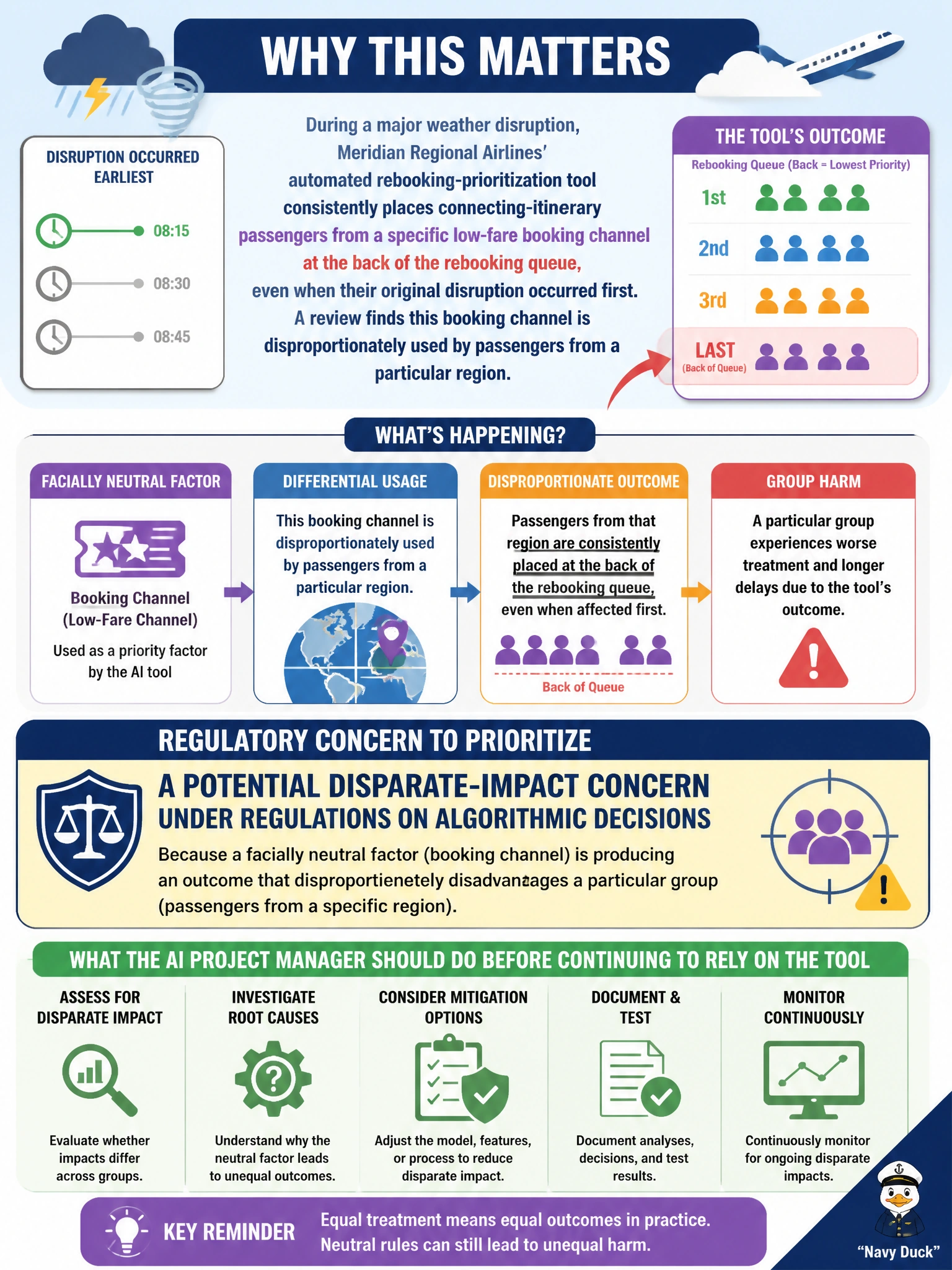
During a major weather disruption, Meridian Regional Airlines' automated rebooking-prioritization tool consistently places connecting-itinerary passengers from a specific low-fare booking channel at the back of the rebooking queue, even when their original disruption occurred first. A review finds this booking channel is disproportionately used by passengers from a particular region. What regulatory concern should the AI project manager treat as a priority before continuing to rely on this tool?
Select an answer to reveal the explanation.
Short Explanation
The tool never looks at region — but if a 'neutral' factor lands unevenly on one group anyway, regulators call that disparate impact, and intent doesn't get you out of it. This is exactly the kind of algorithmic-fairness trap the exam wants you to catch before it ships wider.
Full Explanation
The correct answer identifies this as a potential disparate-impact concern under regulations on algorithmic decisions: even though the tool's input, booking channel, is facially neutral and contains no demographic field, its effect disproportionately disadvantages passengers from a particular region, which is precisely the pattern that laws addressing algorithmic bias and fairness are designed to catch. Applying laws pertaining to AI ethics, bias, and fairness is a named Trustworthy AI task, and 'the input field isn't a protected characteristic' is not a defense against disparate-impact scrutiny — outcome, not just input, is what regulators and responsible-AI practice both examine. The first distractor is the exact misconception the question is testing: dismissing fairness concerns because the model doesn't directly use a demographic field ignores that a correlated proxy variable can reproduce the same disparate outcome without ever touching the sensitive attribute directly. A data-lineage documentation gap is a real but much narrower governance issue about tracing where a field originated; it does not address the substantive fairness problem in how the tool is currently prioritizing passengers. A model-versioning concern about being on an outdated release is also beside the point — updating to a newer vendor version would not, by itself, resolve a fairness issue rooted in which factor the tool weighs and how that factor correlates with a protected group.