
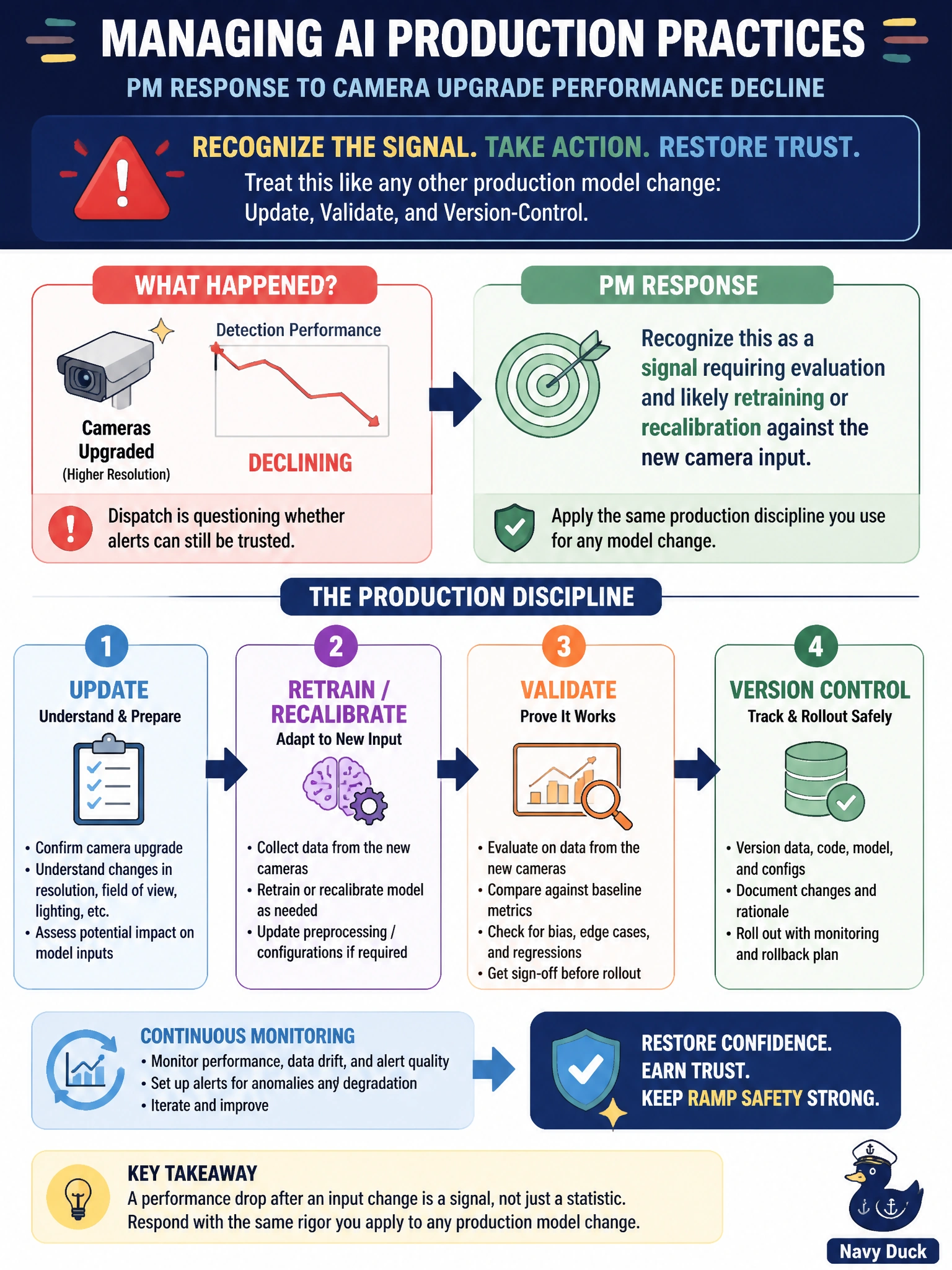
Meridian recently upgraded the cameras used by its ramp-safety computer-vision system to a higher-resolution model. Detection performance has since quietly declined, and dispatch is now questioning whether the alerts can still be trusted. What should the PM's response be, framed within Managing AI production practices?
Select an answer to reveal the explanation.
Short Explanation
A model trained on one camera's image characteristics can quietly stumble when the input changes underneath it — new lenses, new resolution, new color profile. That's not a mystery to shrug off, it's a cue to re-evaluate and retrain against the new reality, then roll it out the same disciplined way as any other update.
Full Explanation
A performance decline that coincides with a known input change — here, a camera hardware upgrade altering resolution and likely other image characteristics the model was never trained on — is a concrete, investigable Managing AI signal, not a mystery to be ignored. The correct response ties directly back to this domain's core practices: evaluate the model's performance against the new camera input, likely retrain or recalibrate it on data reflecting the new hardware, and push any resulting update through the same validation and version-control discipline used for any other production model change (staged rollout, rollback capability). Assuming the decline is unrelated and doing nothing ignores an obvious, identifiable cause and leaves a safety-relevant system degraded. Permanently shutting the system down is a disproportionate response to a specific, addressable input-mismatch problem rather than evidence the whole approach is unsound. Blaming ground crew reporting redirects attention away from a clear technical explanation (the camera change) without any investigation, which is not a defensible PM response when a more likely cause is sitting in plain sight.