
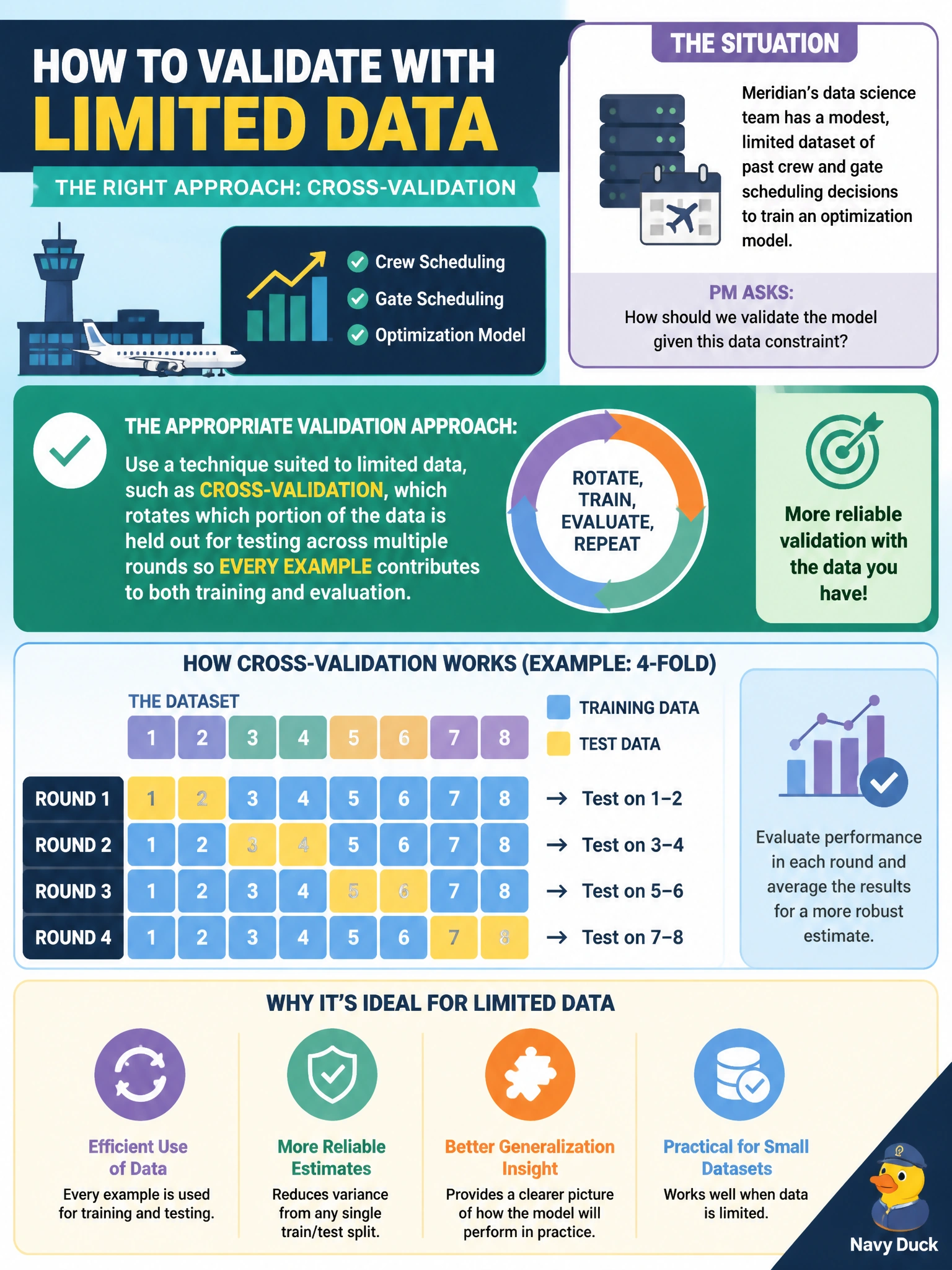
Meridian's data science team has a modest, limited dataset of past crew and gate scheduling decisions to train an optimization model. The PM asks how the team should validate the model given this data constraint. What is the appropriate validation approach?
Select an answer to reveal the explanation.
Short Explanation
With a small dataset you can't afford to burn a big chunk of it on a single held-out test set. Cross-validation lets every data point take a turn being the exam question and a turn being the study material, so you get a validation read without starving the model of training data.
Full Explanation
When training data is limited — a recurring, explicitly named CPMAI concern for Data Understanding and for evaluation — a single fixed train/test split can waste too much of the scarce data on either side. Cross-validation addresses this by partitioning the data into multiple folds and rotating which fold is held out for testing across several rounds, so every example is used for both training and validation over the process, yielding a more reliable performance estimate without permanently sacrificing a large chunk of already-scarce data. Skipping validation entirely because the dataset is small abandons the evaluation step altogether, which is a bigger risk than a small-data validation approach — some rigorous check on limited data is still far better than none. Using the entire dataset for both training and testing produces an inflated, unreliable performance estimate since the model is evaluated on data it has already seen. Waiting indefinitely for more data may not be feasible on a PM's timeline and ignores that CPMAI explicitly addresses working with limited data as a normal project condition to be optimized around, not a blocker requiring the project to stall.