
Before deploying the loyalty-program fraud-detection model to production, Meridian's PM wants a quality assurance checklist that goes beyond a single accuracy number. Which combination best reflects a thorough QA process?
Select an answer to reveal the explanation.
Short Explanation
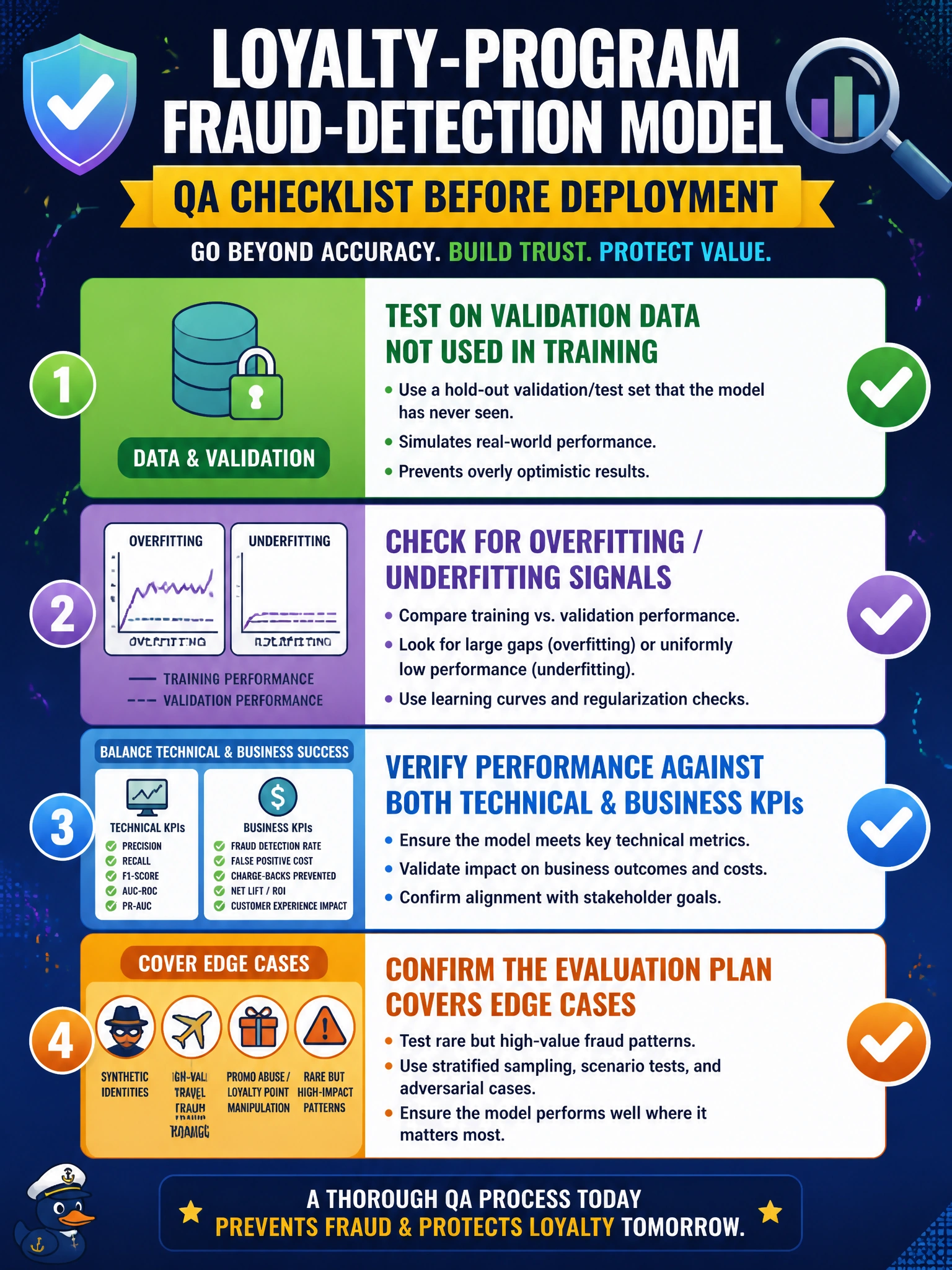
QA isn't a single checkbox — it's a stack of checks: does it generalize, is it neither too rigid nor too loose, does it move the business metric, and did you specifically go looking for the rare cases that matter most? Skip any one and you've shipped hope, not evidence.
Full Explanation
A thorough QA process for an AI model, per CPMAI's model-evaluation guidance, is multi-dimensional: validation on unseen data to test generalization, explicit checks for overfitting and underfitting, alignment checks against both technical KPIs (model-level metrics) and business KPIs (the fraud-loss or customer-trust outcome the project exists to improve), and deliberate attention to edge cases — for fraud detection, rare but high-value redemption schemes are exactly the failure mode a simple aggregate accuracy score can hide, since they are a small fraction of transactions but a large fraction of loss exposure. Confirming the model merely runs within a time budget checks operational readiness, not model quality — a fast, wrong model is still wrong. Trusting vendor marketing claims substitutes an unverified external assertion for the organization's own evaluation evidence, which is precisely what QA is meant to replace. Using the most recent published algorithm says nothing about how well that algorithm performs on Meridian's actual data and fraud patterns; algorithm novelty is not a quality assurance criterion.