
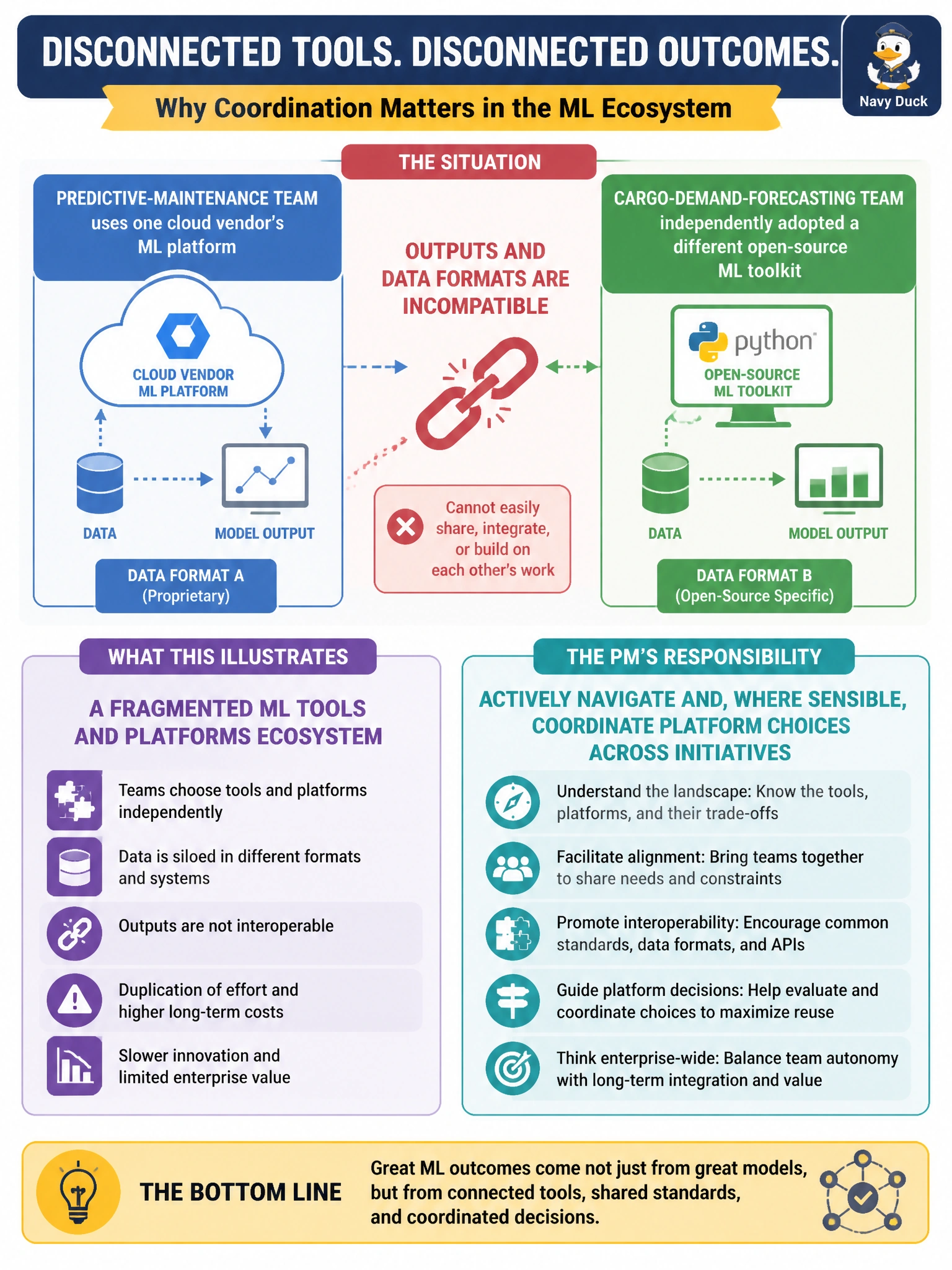
Meridian's predictive-maintenance team uses one cloud vendor's ML platform, while the cargo-demand-forecasting team independently adopted a different open-source ML toolkit, and the two teams' outputs and data formats are incompatible with each other. What does this situation illustrate, and what is the PM's responsibility?
Select an answer to reveal the explanation.
Short Explanation
Two teams, two toolkits, zero compatibility — that's platform fragmentation, and untangling it is squarely a PM's coordination job, not a shrug.
Full Explanation
This is exactly the fragmented ML platform ecosystem the exam content outline calls out — different teams landing on different, sometimes incompatible, tools by default — and navigating that fragmentation (assessing whether to standardize, bridge, or deliberately allow divergence where justified) is a named PM-level enabler, not something to leave entirely to individual data scientists. Calling this a data-drift problem is wrong — data drift refers to the statistical properties of incoming data shifting over time, not two teams using incompatible tooling and formats. Concluding both projects must be halted entirely overreacts — platform fragmentation is a real coordination risk to manage, not automatically a project-ending failure, and less disruptive fixes (format bridges, phased consolidation) are typically available. Claiming platform choice has no project-management implication is wrong and is precisely the assumption this exam content area exists to correct — incompatible tooling has real cost, integration, and maintenance consequences the PM must plan for.