
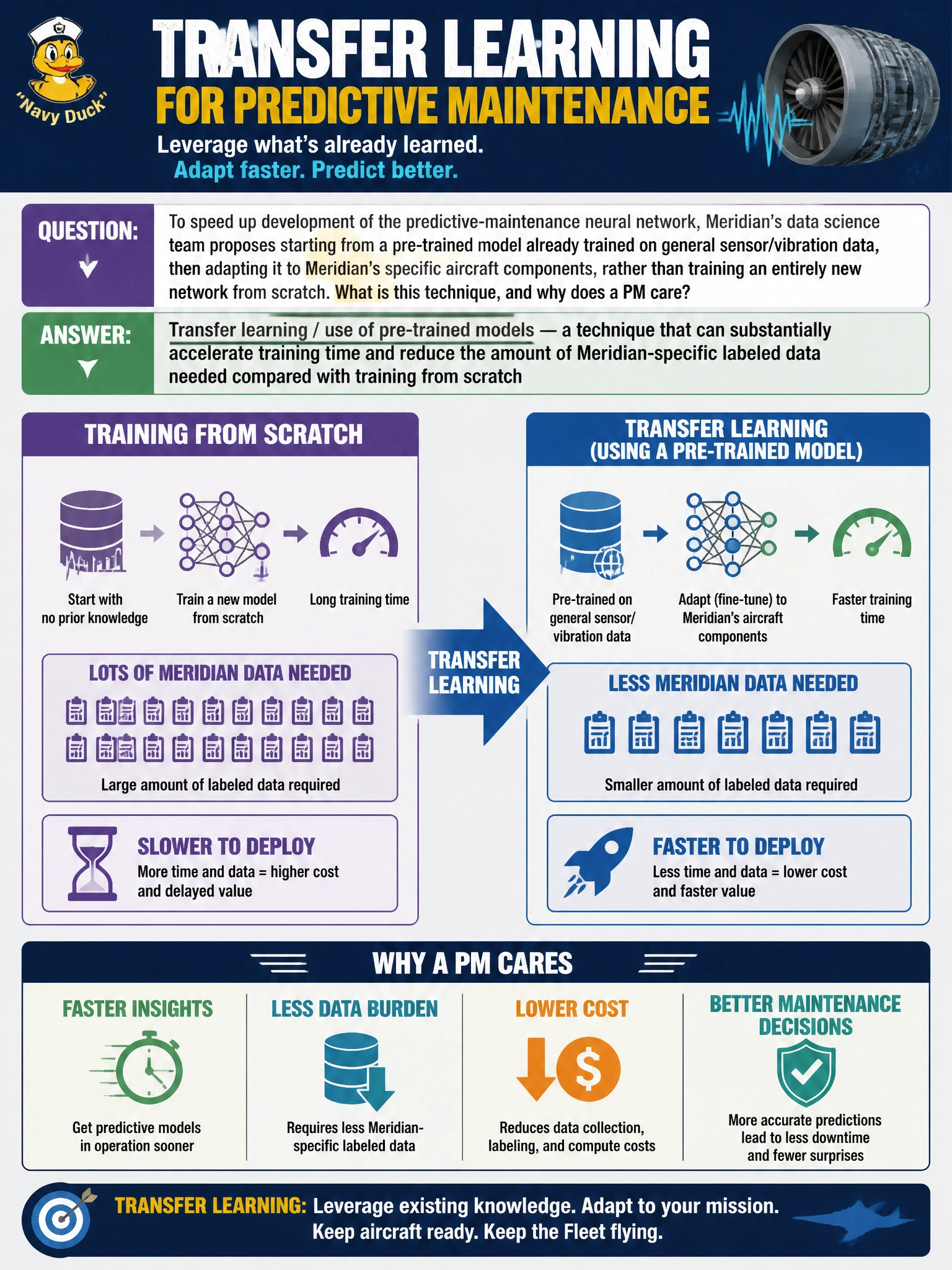
To speed up development of the predictive-maintenance neural network, Meridian's data science team proposes starting from a pre-trained model already trained on general sensor/vibration data, then adapting it to Meridian's specific aircraft components, rather than training an entirely new network from scratch. What is this technique, and why does a PM care?
Select an answer to reveal the explanation.
Short Explanation
Transfer learning is starting from someone else's rough draft instead of a blank page — way faster, and you need less of your own data to finish it.
Full Explanation
Starting from a pre-trained model and adapting it to a specific use case is transfer learning, a well-established technique to accelerate model training and reduce the labeled-data burden — directly relevant to a PM's timeline and budget, especially given Meridian's relatively limited maintenance-failure dataset discussed earlier. Calling this reinforcement learning is wrong — there's no agent-environment reward loop described; this is adapting an existing supervised model to a related task. Restricting data augmentation to "only image datasets" is wrong and too narrow — augmentation techniques exist for sensor/time-series data too, but more importantly that's not what's being described here, which is reuse of a pre-trained model, not synthetic data generation. Calling this ensemble modeling is wrong because the scenario doesn't describe combining a trained model's output with a rules engine's output — it describes adapting one existing model to a new but related task. Recognizing transfer learning as a training-acceleration technique helps a PM realistically compress a schedule when a suitable pre-trained starting point exists.