
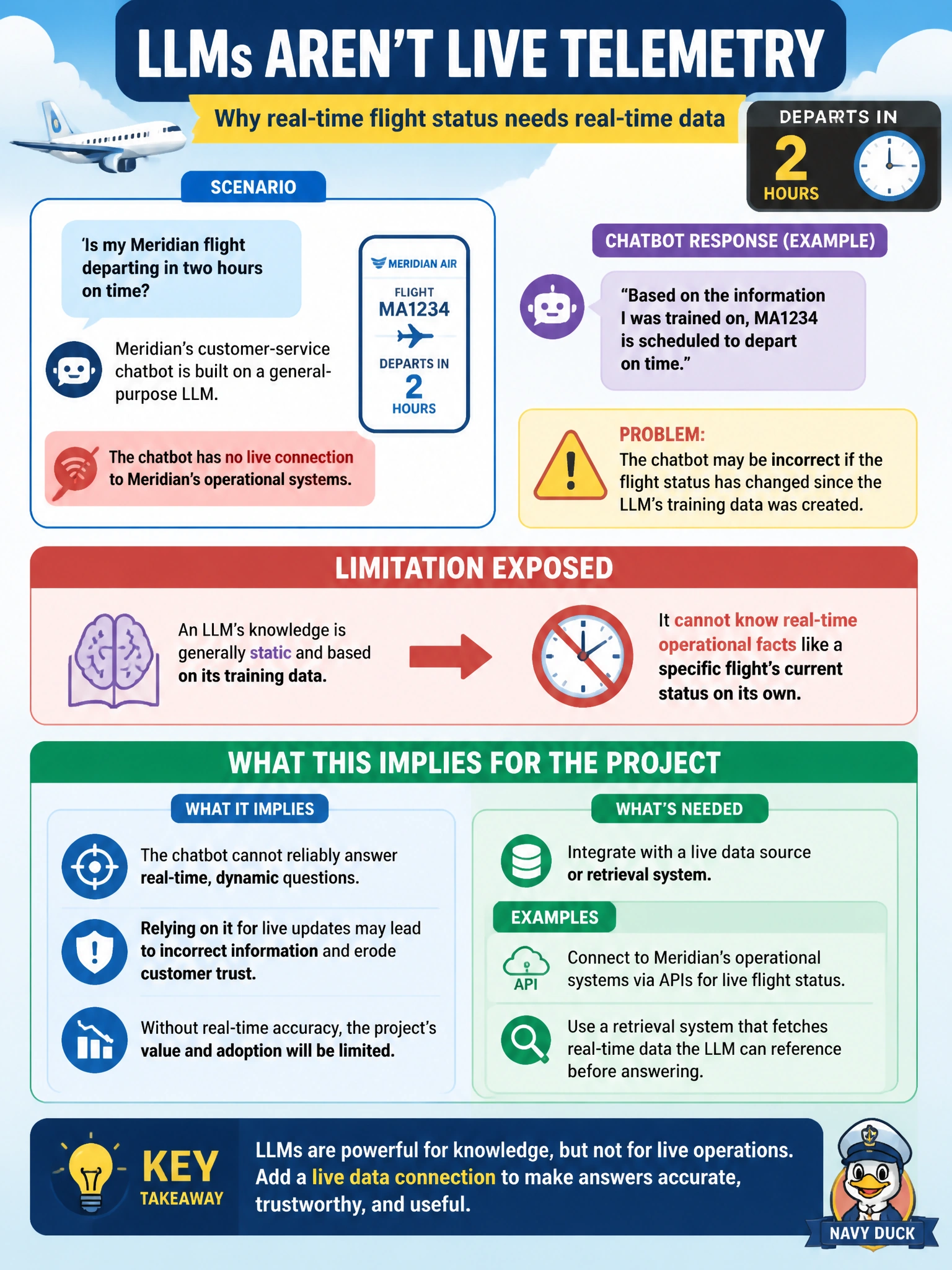
Meridian's customer-service chatbot, built on a general-purpose LLM, is asked by a passenger whether their specific flight departing in two hours is currently on time. The chatbot has no live connection to Meridian's operational systems. What limitation does this expose, and what does it imply for the project?
Select an answer to reveal the explanation.
Short Explanation
An LLM's knowledge is a snapshot from training day — ask it about right-now and it's guessing unless you wire it into live ops data.
Full Explanation
This exposes a genuine and well-known limitation: a general-purpose LLM's knowledge comes from its training data and does not include live, constantly-changing operational facts, so answering "is this specific flight on time right now" correctly requires integrating the assistant with a live data source (e.g., a retrieval or API connection to Meridian's operations systems), not relying on the LLM's training alone. Claiming LLMs have automatic real-time access to any company's systems by default is wrong — that access has to be deliberately engineered as an integration; the model doesn't inherently connect to Meridian's live operational data. Concluding generative AI is entirely unsuitable for customer service overreaches — the earlier rebooking/baggage-status use cases remain appropriate; the fix here is architectural (add live-data integration), not abandoning the technology. Having the chatbot present a guess as an authoritative confirmed status is the worst option of all — it risks giving a passenger confidently wrong information about a real, time-sensitive travel decision.