
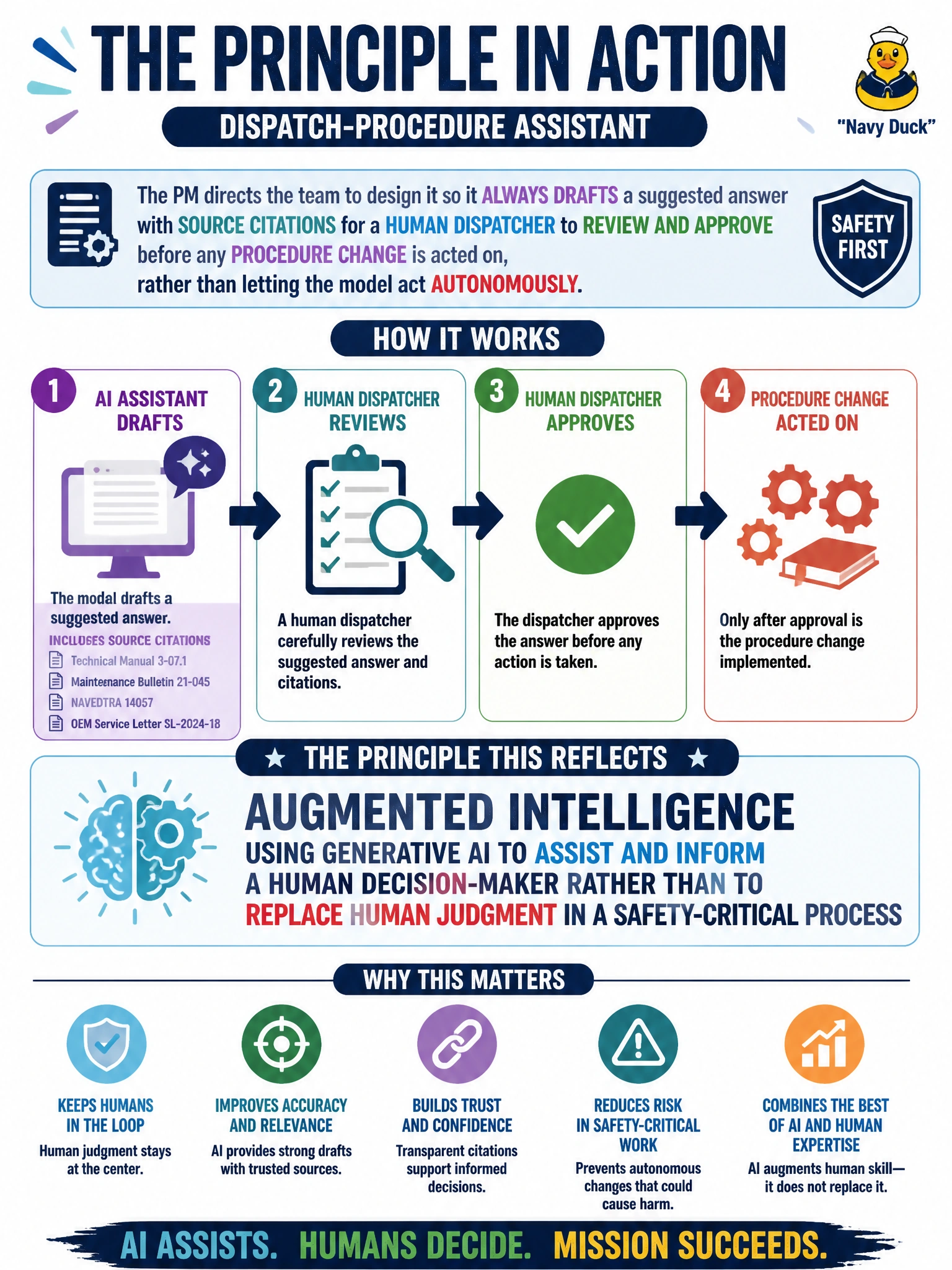
For the dispatch-procedure assistant, the PM directs the team to design it so it always drafts a suggested answer with source citations for a human dispatcher to review and approve before any procedure change is acted on, rather than letting the model act autonomously. What principle does this design reflect?
Select an answer to reveal the explanation.
Short Explanation
Human stays the decision-maker, AI just hands over a drafted answer with its sources — that's augmented intelligence, not autopilot.
Full Explanation
This reflects augmented intelligence — deliberately using AI to support and inform human decision-makers rather than to replace their judgment, which is especially appropriate for a safety-critical, regulated task like dispatch procedures where a human must remain accountable for the final call. Calling this "fully autonomous AI" is the opposite of what's described — the entire design point is that a human reviews and approves before any action, which is explicitly not autonomous operation. Calling it reinforcement learning is wrong because nothing here describes a sequential agent-environment reward loop; this is a single-turn generate-then-review workflow. Calling it ensemble modeling is wrong because the scenario doesn't describe combining multiple models' outputs into a citation — it describes a human-in-the-loop review step for a single generated answer. Naming this correctly as augmented intelligence matters for how the PM frames the project to regulators and unions concerned about automation replacing human judgment.