
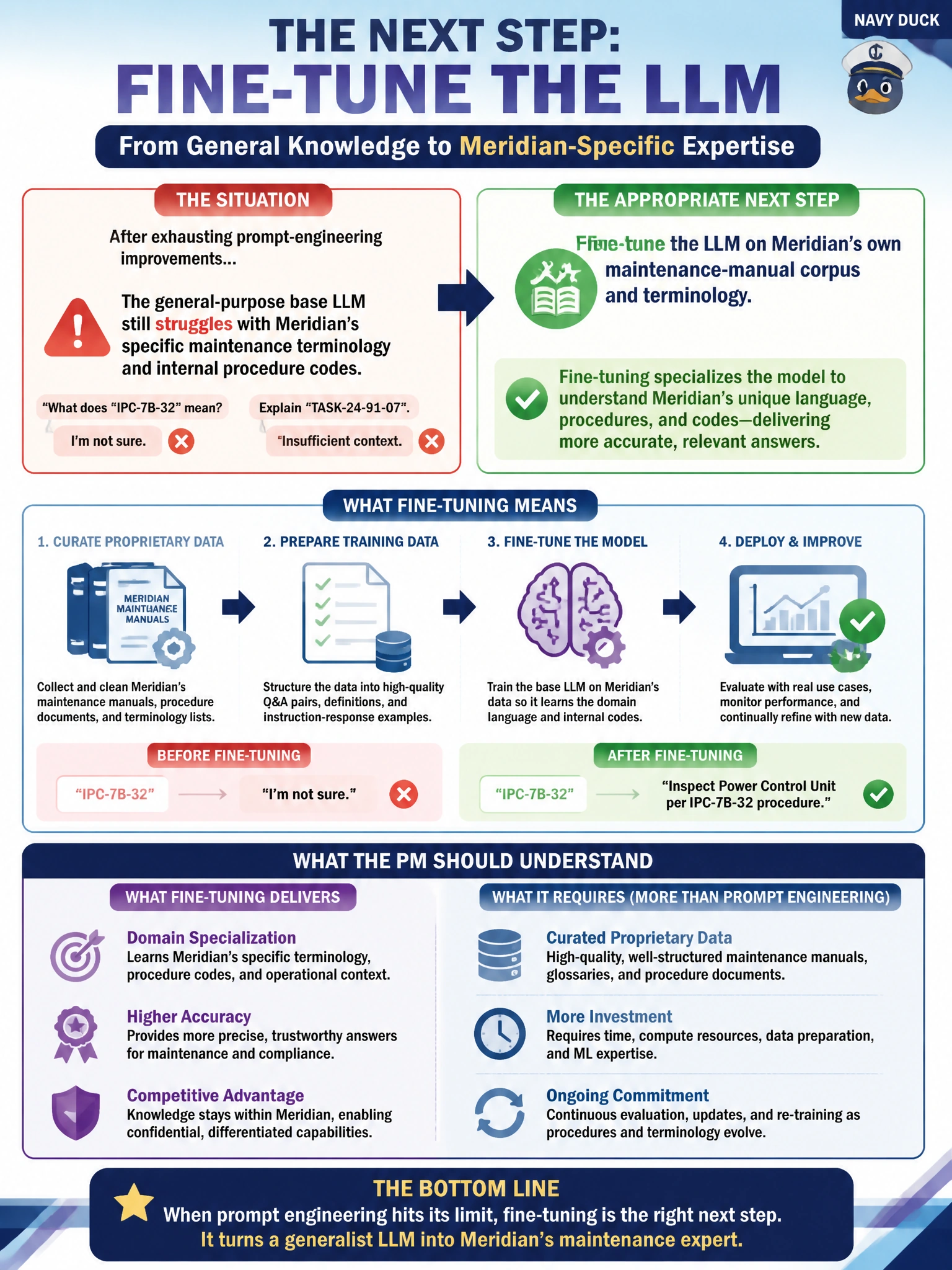
After exhausting prompt-engineering improvements, Meridian's data science team still finds the general-purpose base LLM struggles with the airline's specific maintenance terminology and internal procedure codes. What is the appropriate next step, and what should the PM understand about it?
Select an answer to reveal the explanation.
Short Explanation
Fine-tuning is teaching the model Meridian's own dialect after it already knows English — worth it once cheaper fixes run out of road.
Full Explanation
Fine-tuning — further training the base LLM on Meridian's own curated maintenance-terminology and procedure-code data — is the appropriate next step once prompt engineering alone can't close the domain-specific gap, and the PM should understand it requires more investment (curated data, compute, review) than prompt engineering but produces a model better specialized to Meridian's vocabulary. Claiming fine-tuning is never appropriate for an airline is wrong and contradicts the exam content outline's explicit inclusion of "implement fine-tuning of LLMs for specialized domains" as an in-scope PM competency. Permanently disabling the assistant instead of fine-tuning it is an overreaction that discards the earlier progress and value already demonstrated by the tool. Claiming fine-tuning removes the need for human review is wrong and dangerous — fine-tuning improves domain fit, it does not eliminate hallucination risk or the need for verification in a safety- and compliance-sensitive context like dispatch procedures.