
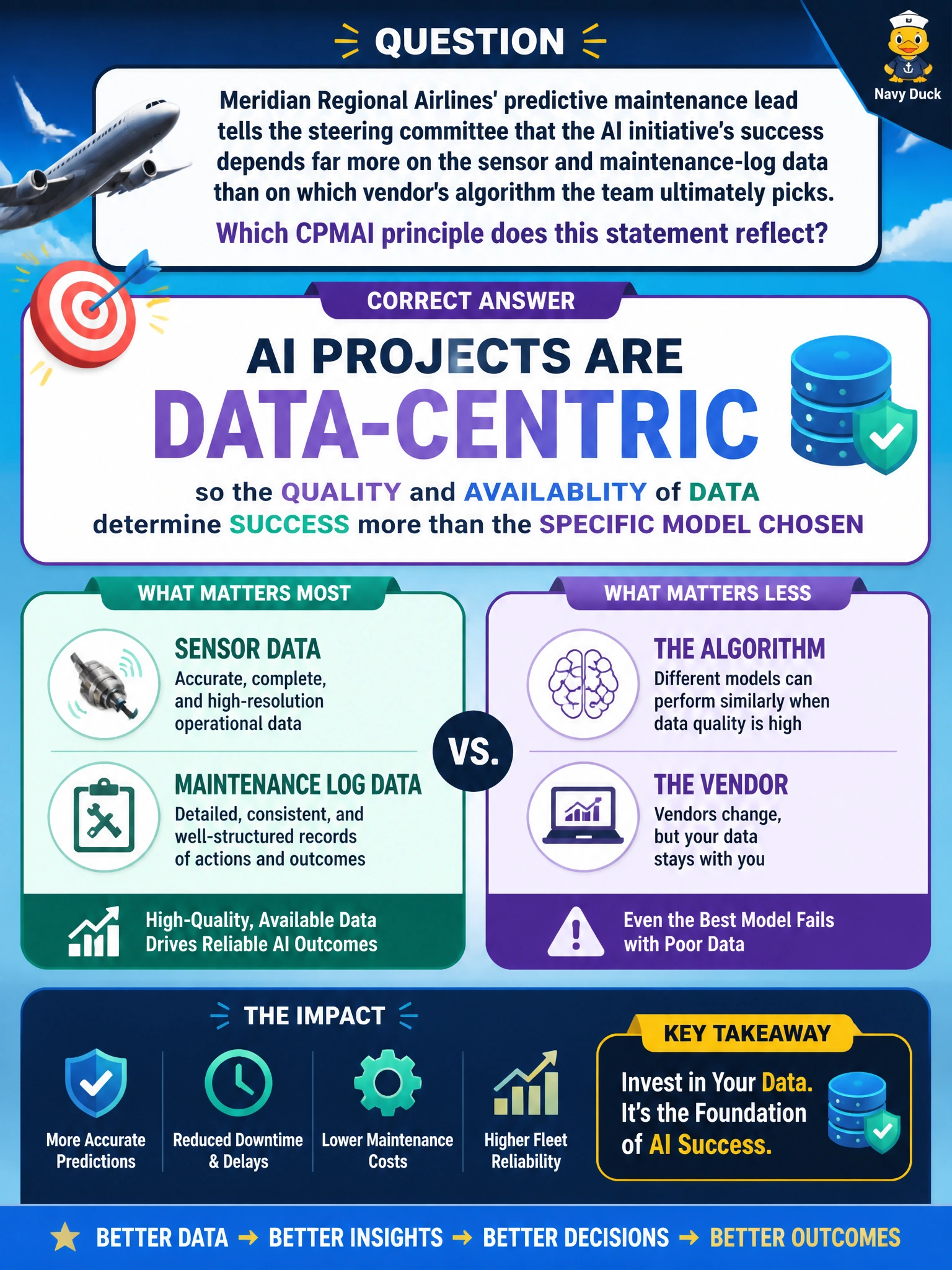
Meridian Regional Airlines' predictive maintenance lead tells the steering committee that the AI initiative's success depends far more on the sensor and maintenance-log data than on which vendor's algorithm the team ultimately picks. Which CPMAI principle does this statement reflect?
Select an answer to reveal the explanation.
Short Explanation
CPMAI's whole pitch is 'it's the data, not the algorithm.' Two teams can use the same model architecture and get wildly different results depending on whose training data is cleaner and more representative — that's the data-centric mindset the exam wants you to recognize.
Full Explanation
CPMAI is explicitly a data-centric methodology: the outline treats data quality and availability as the primary driver of AI project outcomes, not algorithm selection. A predictive-maintenance model trained on incomplete or mislabeled sensor logs will underperform regardless of which vendor's engine is behind it. Option A inverts the methodology's core premise — model-centric thinking is exactly the trap CPMAI warns against, since swapping algorithms rarely fixes a data problem. Option C is a distractor about vendor hype, a named AI-project-failure mode in Domain II, but it isn't what the statement describes here. Option D is irrelevant scope creep; PM certification has no bearing on data quality. The exam-worthy distinction: when a PM diagnoses a struggling AI project, the first place to look is the data pipeline and data quality, not the model architecture — this is one of the most frequently tested judgment calls across both Domain II and Domain IV.