
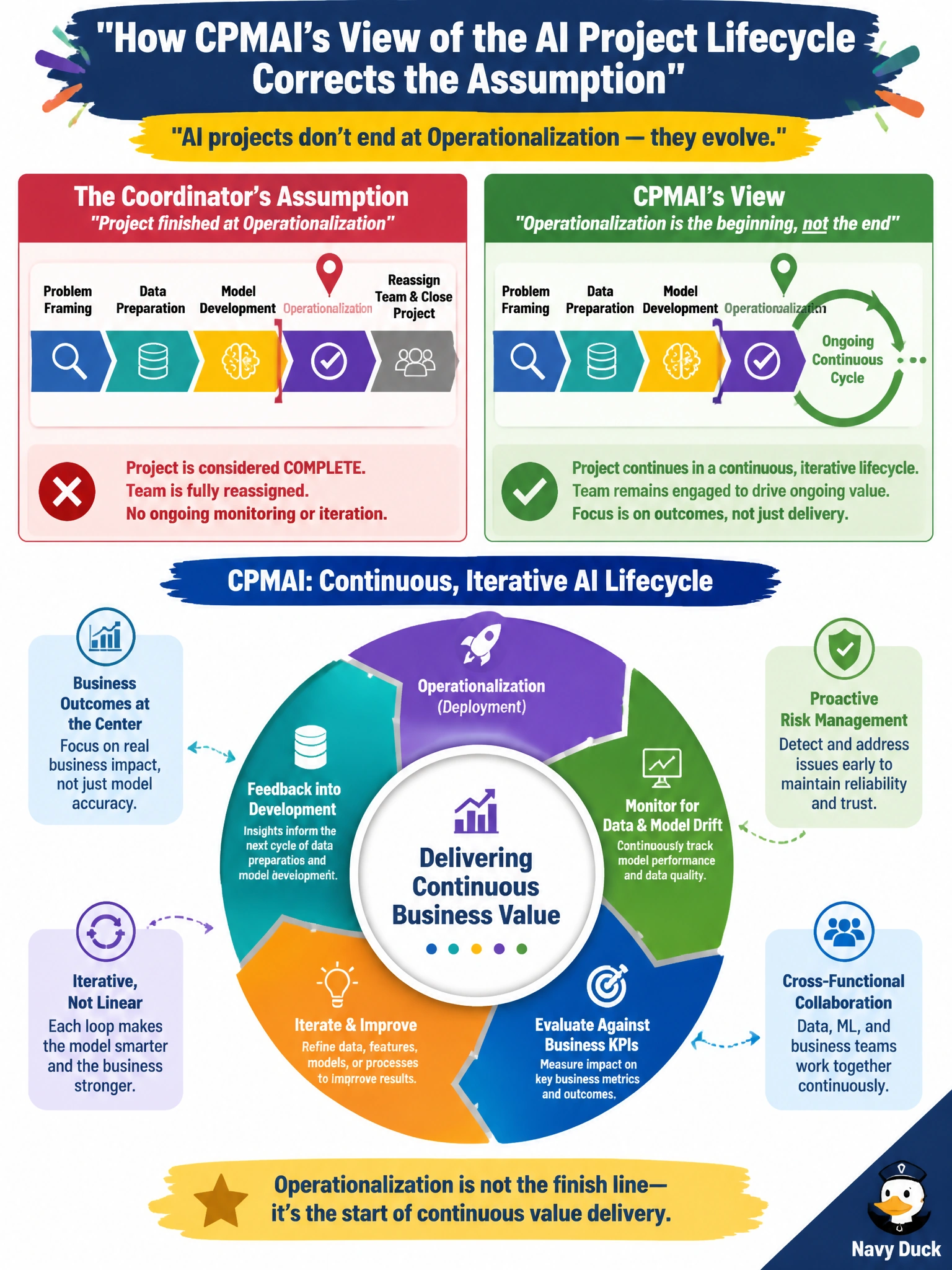
A newly hired project coordinator at Meridian assumes that once the demand-forecasting model reaches Operationalization, the CPMAI project is finished and the team can be fully reassigned. How does CPMAI's view of the AI project lifecycle correct this assumption?
Select an answer to reveal the explanation.
Short Explanation
Shipping isn't the finish line for an AI project the way it might be for a piece of software. CPMAI treats Operationalization as the start of an ongoing loop — watch for drift, check against business KPIs, iterate — because the world the model predicts keeps changing.
Full Explanation
CPMAI's foundational Task 1 explicitly calls for implementing continuous AI project lifecycles, distinguishing AI projects from traditional software delivery precisely on this point: an AI model's performance can decay after deployment as data and conditions change (drift), so Operationalization is the start of an ongoing monitoring-and-iteration cycle, not a closure event. For Meridian's demand-forecasting model, that means continuing to watch for data drift (changing market conditions) and model drift (a stale input-output relationship), continuing to check performance against business KPIs, and iterating as needed — activities that don't happen in a traditional 'ship it and move on' software project. Treating Operationalization as a hard project end, as the new coordinator assumes, is exactly the traditional-software mindset CPMAI's methodology exists to correct. Automatically restarting from Business Understanding regardless of performance is just as wrong in the opposite direction — restarting only makes sense when evaluation or monitoring findings actually call the business premise into question, not as a blanket rule after every deployment. And CPMAI does provide explicit guidance here — this is a named, core methodology concept, not something left undefined. The exam point: 'continuous lifecycle' is one of the concrete ways CPMAI answers 'why AI projects differ from traditional software projects.'