
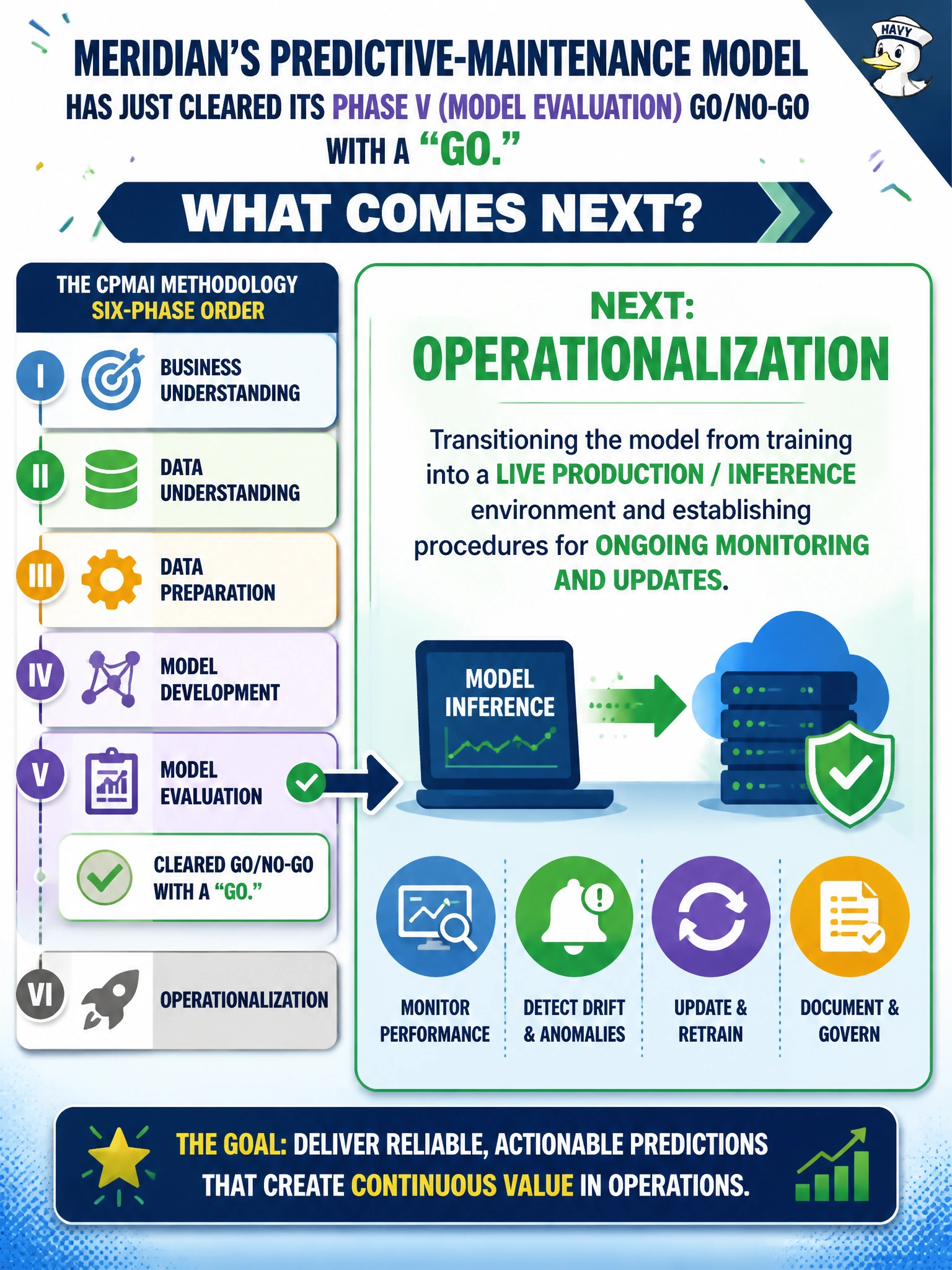
Meridian's predictive-maintenance model has just cleared its Phase V (Model Evaluation) Go/No-Go with a 'Go.' Correctly following the CPMAI methodology's six-phase order, what comes next?
Select an answer to reveal the explanation.
Short Explanation
A clean 'Go' at Model Evaluation means one thing next: Operationalization. That's the sixth and final phase — take the approved model live and put real monitoring around it.
Full Explanation
CPMAI's six phases run in a fixed order — Business Understanding, Data Understanding, Data Preparation, Model Development, Model Evaluation, Operationalization — and a successful Go decision at the Model Evaluation gate is precisely the signal to advance into Operationalization: transitioning the model from a training/testing context into live production inference, and establishing the procedures (monitoring, versioning, update cadence) needed to keep it healthy once it's serving real maintenance decisions. Returning to Business Understanding would only be appropriate if the evaluation had failed badly enough to call the whole project premise into question — not after a clean pass. Repeating Model Evaluation with the same criteria and data serves no purpose; iteration is reserved for cases where evaluation surfaced a specific problem to fix, and this scenario states the model already passed. Re-cleaning the training dataset misapplies a Data Preparation activity after the model has already been built, tested, and approved — there's no reason to revisit prepared data for a model that just cleared its evaluation gate. The exam point: know the fixed phase order cold, and recognize that a Go decision moves the project strictly forward to the next phase in that sequence, never sideways or backward without a stated reason.