
Which of the following best illustrates Meridian correctly executing the real-world activities of CPMAI's Phase V, Model Evaluation?
Select an answer to reveal the explanation.
Short Explanation
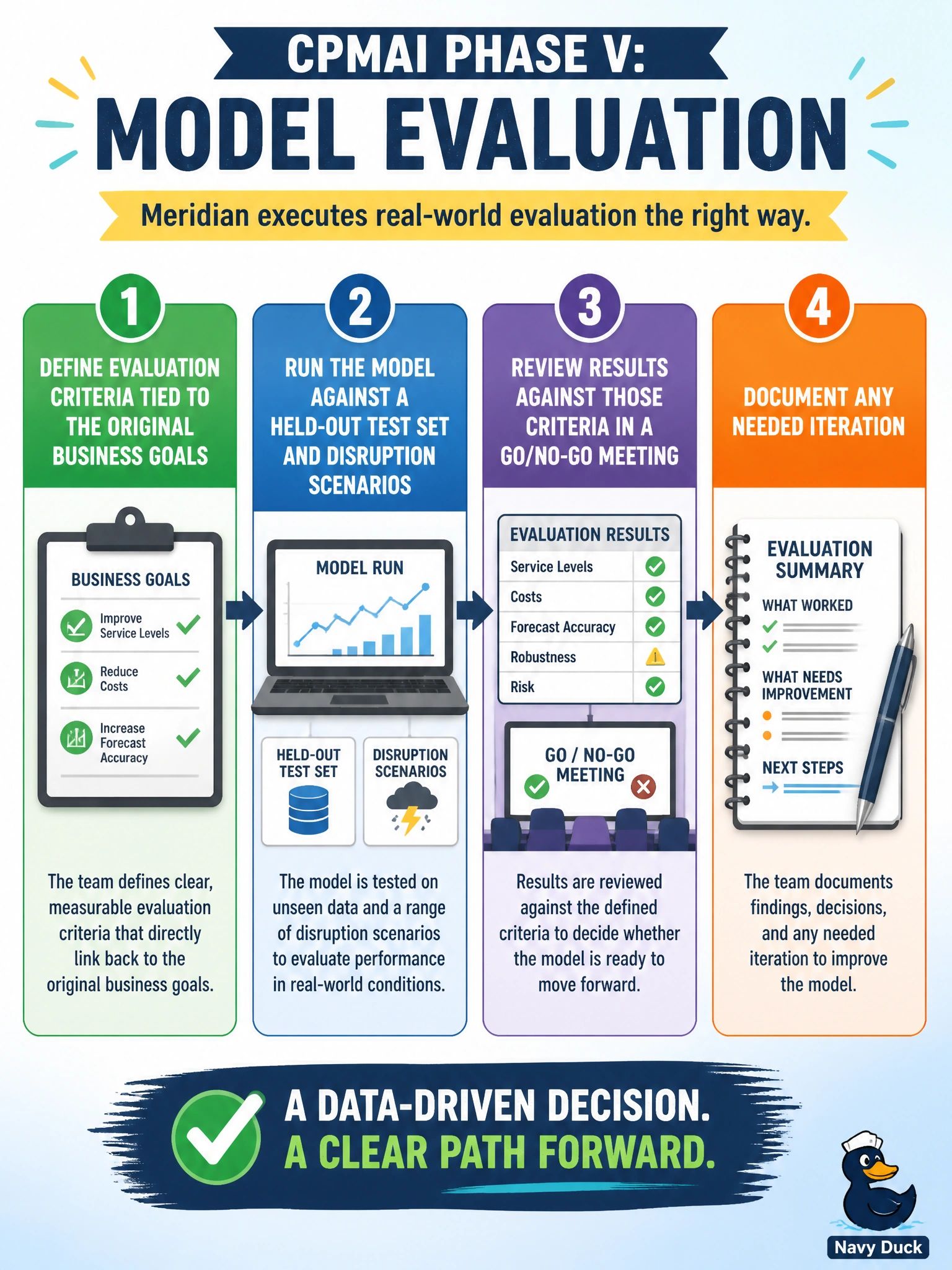
This is Model Evaluation in a nutshell — measure against the criteria you already agreed on, hold the Go/No-Go conversation, and write down what needs fixing before you move on. Not gathering requirements, not labeling data, not deploying.
Full Explanation
CPMAI's Phase V, Model Evaluation, centers on formulating evaluation criteria tied to business goals, running the model against a comprehensive test plan (including edge cases and disruption scenarios), holding a Go/No-Go review against those criteria, and documenting iteration needs — exactly what the correct option describes for Meridian's predictive maintenance effort. Labeling a fresh batch of training data is a Data Preparation (Phase III) activity, not evaluation — it happens earlier in the lifecycle to prepare inputs for model building. Gathering requirements from maintenance supervisors about failure-prone components is a Business Understanding (Phase I) or Data Understanding (Phase II) activity, establishing what the project should target before any model exists to evaluate. Migrating the finished model into production and standing up a monitoring dashboard describes Operationalization, the sixth CPMAI phase that follows a successful Model Evaluation Go/No-Go — it happens after evaluation approves the model, not as part of evaluation itself. The exam-relevant skill here is recognizing which concrete, described activities map to which named CPMAI phase, since PM-level questions frequently test phase recognition through a described scenario rather than a name.