
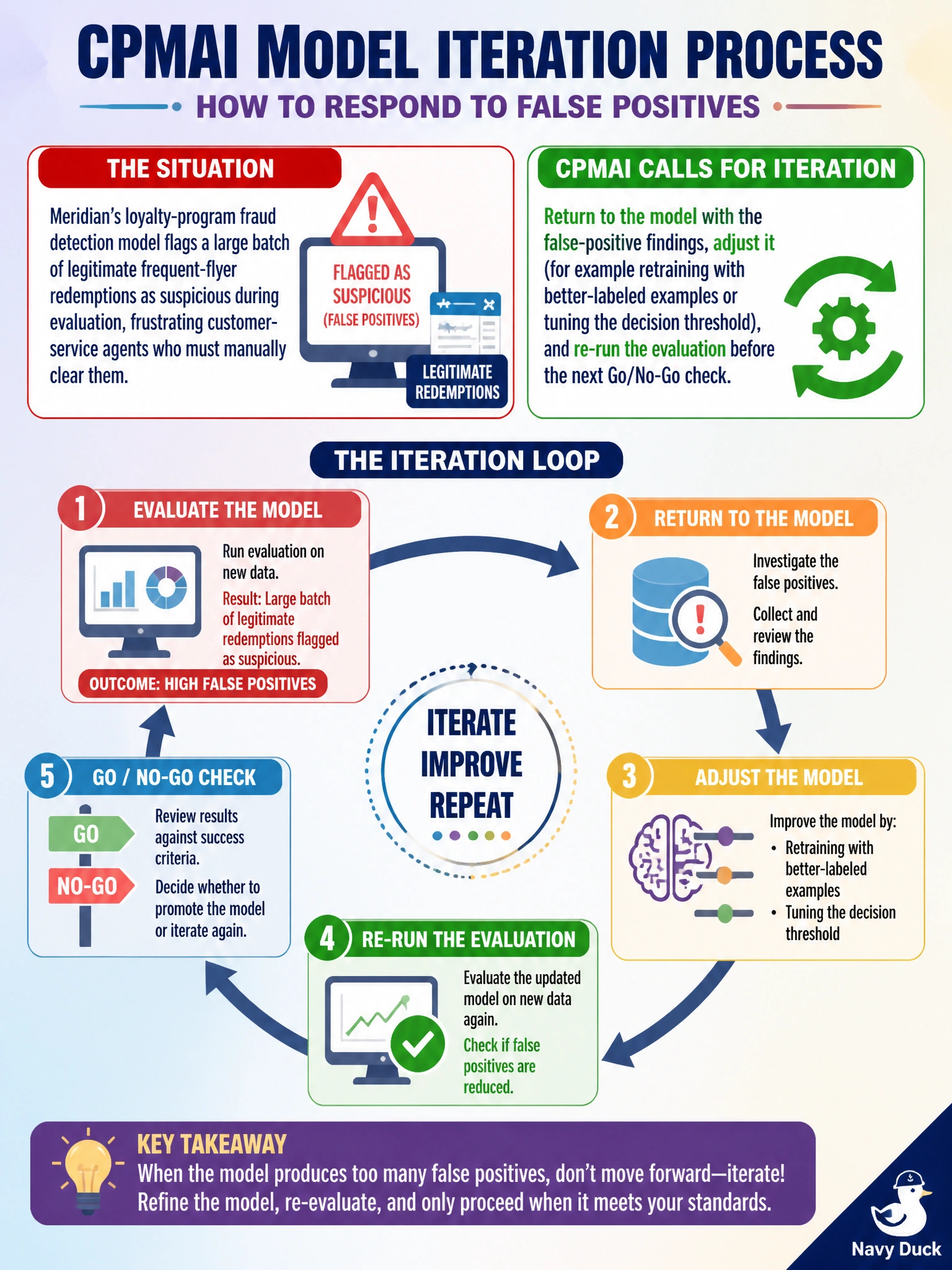
Meridian's loyalty-program fraud detection model flags a large batch of legitimate frequent-flyer redemptions as suspicious during evaluation, frustrating customer-service agents who must manually clear them. What does the CPMAI model iteration process call for at this point?
Select an answer to reveal the explanation.
Short Explanation
This is CPMAI's iteration loop doing its job. A high false-positive rate isn't a project killer or something to shrug off — it's a signal to go back, adjust, and re-test before you ask for the Go/No-Go again.
Full Explanation
Model iteration in CPMAI's Model Evaluation task is a structured, cyclical response to evaluation findings, not a one-and-done gate. When evaluation surfaces a specific, fixable problem like an elevated false-positive rate, the correct move is to feed that finding back into the model — retraining with better-labeled fraud/non-fraud examples, recalibrating the decision threshold, or adding features that distinguish legitimate redemption spikes from account takeover — and then re-run the evaluation before the model is presented for its next Go/No-Go decision. Shutting the whole initiative down is a drastic overreaction to a correctable, specific defect and abandons the point of iterative development. Ignoring the false positives because overall fraud catch-rate looks fine ignores a real business cost: every false positive burns customer-service time and damages loyal-member trust, both of which belong in the evaluation criteria. Publicly announcing an internal evaluation finding before any fix is unrelated to the technical iteration process and creates unnecessary reputational risk over what is, at this stage, an ordinary tuning problem. The exam point: iteration is CPMAI's designed mechanism for closing evaluation gaps, applied before re-testing and before the Go/No-Go, not after abandoning or ignoring the project.