
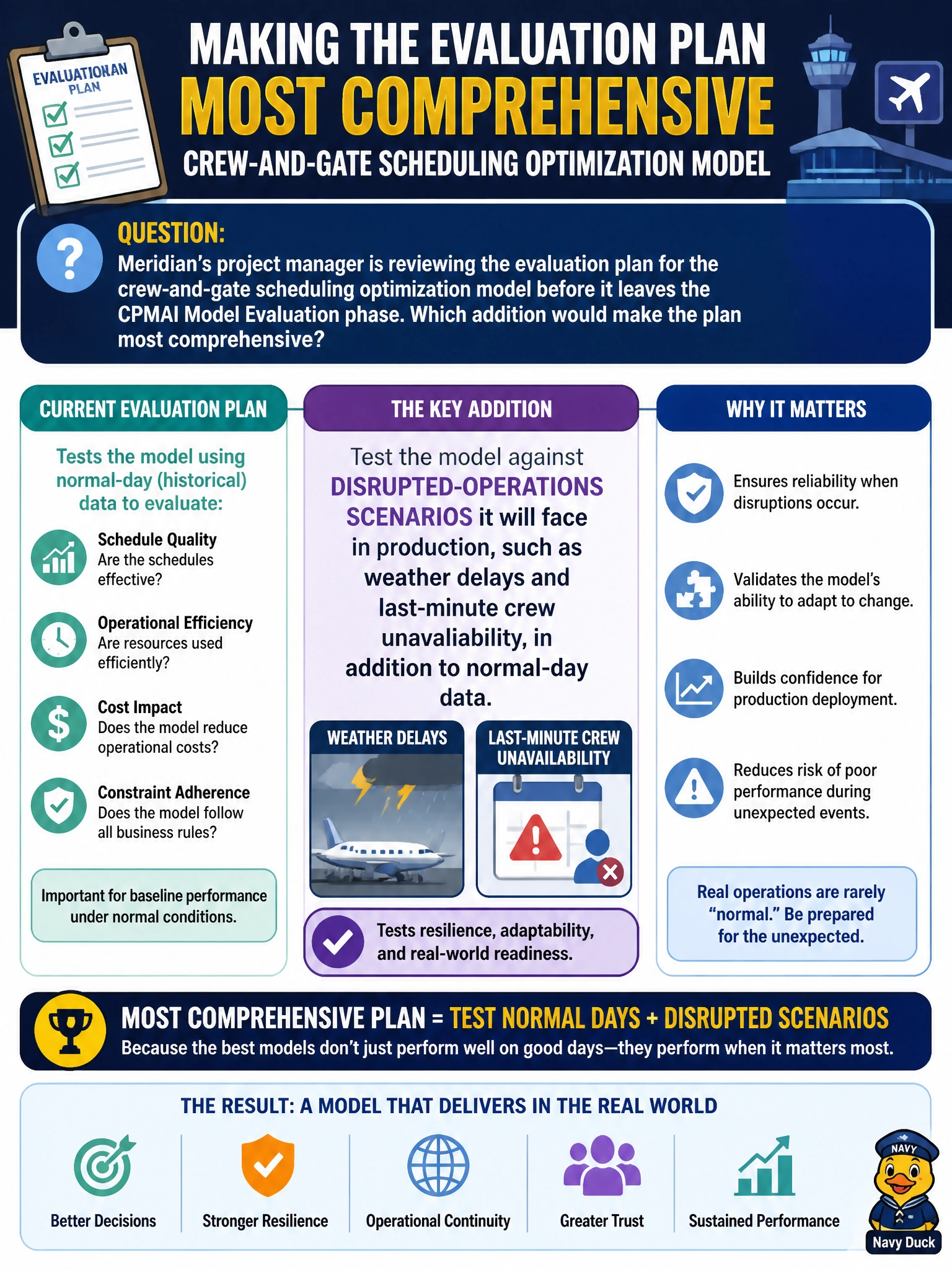
Meridian's project manager is reviewing the evaluation plan for the crew-and-gate scheduling optimization model before it leaves the CPMAI Model Evaluation phase. Which addition would make the plan most comprehensive?
Select an answer to reveal the explanation.
Short Explanation
Don't just grade the model on the easy days. A comprehensive evaluation plan throws the messy, real-world stuff at it too — weather delays, crew callouts, the situations that actually break schedules — before you trust it in production.
Full Explanation
A comprehensive CPMAI evaluation plan tests a model against the range of conditions it will actually meet in production, not only the conditions it was trained on. For a crew-and-gate scheduling model, that means deliberately including disrupted-operations cases — weather delays, last-minute crew unavailability, connecting-flight cascades — alongside normal-day schedules, because those edge cases are exactly where scheduling optimization tends to fail and where FAA duty-time violations are most likely to slip through undetected. Testing only against the training data measures memorization, not generalization, and will systematically overstate readiness. Relying on one scheduler's subjective opinion abandons the evaluation criteria and plan altogether — CPMAI calls for a designed, criteria-based evaluation, not an anecdotal gut check, though qualitative stakeholder input can supplement quantitative results. Testing only on the busiest hub ignores that Meridian operates a network of airports with different traffic patterns and constraints; a model validated on one hub's conditions may fail badly at a smaller station. The exam point: a good evaluation plan deliberately seeks out the hard, disruptive scenarios rather than confirming performance on the easy majority case.