
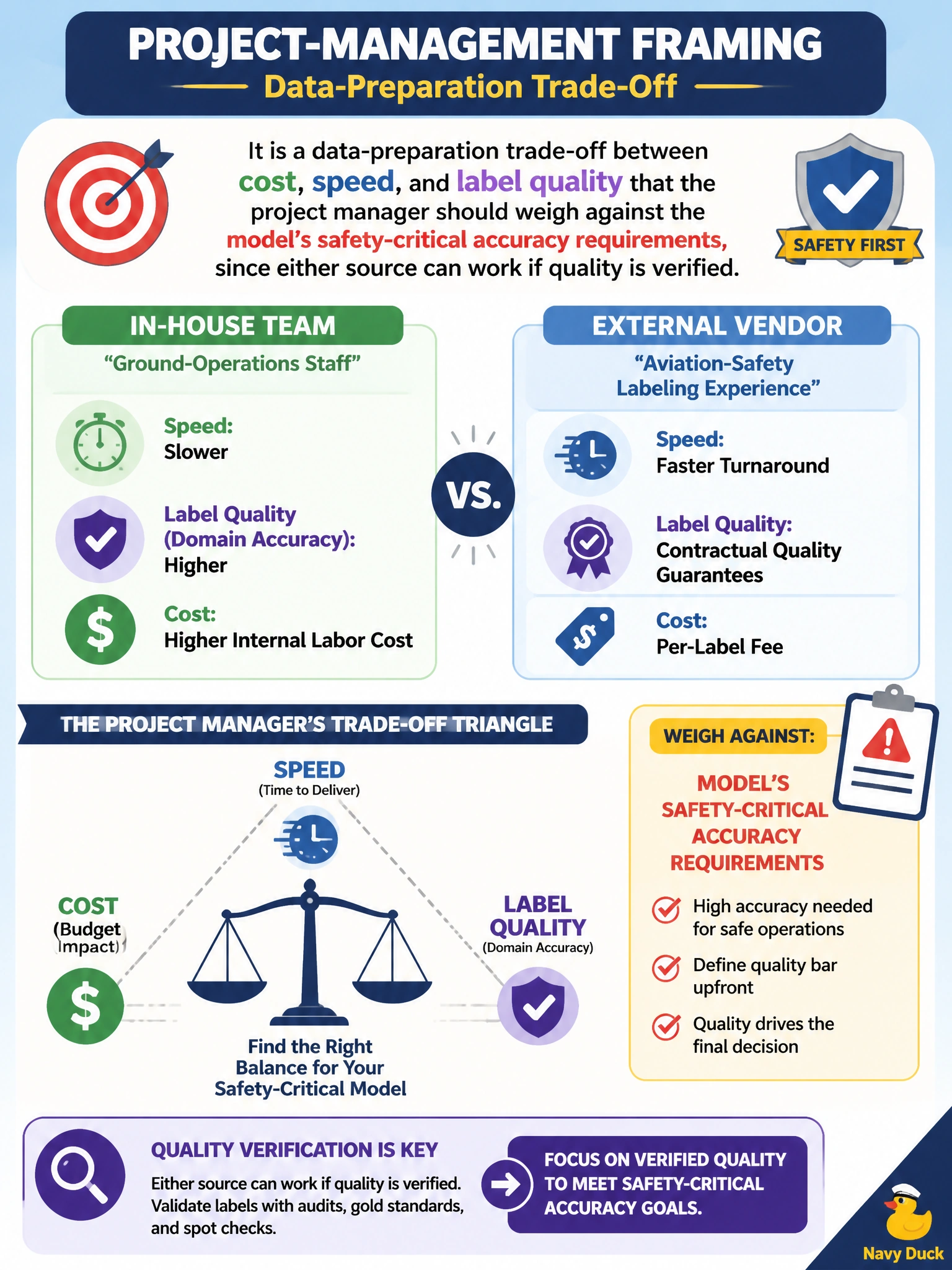
Meridian's project manager is choosing between an in-house team of ground-operations staff to label ramp-safety video (slower, higher domain accuracy, higher internal labor cost) and an external specialty vendor with aviation-safety labeling experience (faster turnaround, contractual quality guarantees, per-label fee). What is the correct project-management framing for this decision?
Select an answer to reveal the explanation.
Short Explanation
Neither option wins by default — it's a genuine trade-off (cost vs. speed vs. verified quality) the PM has to weigh against how much accuracy this safety-critical model actually needs, not a rule of thumb or a hand-off to purchasing.
Full Explanation
Determining data-labeling requirements is a project-management judgment call that weighs cost, turnaround time, and required label quality against the model's risk profile — for a safety-critical ramp-monitoring system, quality verification matters regardless of which source is chosen, so the PM should evaluate both options on their merits rather than assume either wins automatically. Treating it as a pure procurement decision handed off entirely to purchasing ignores that label quality directly determines model quality; the AI project team needs to stay involved in specifying and verifying quality standards even if procurement handles contracting mechanics. The option describing this as a trade-off "to decide," without stating that either source can be acceptable if verified, undersells the actual decision criteria compared to the fully correct option, which explicitly ties the choice to the safety-critical accuracy bar. Assuming in-house staff are inherently better labelers than any vendor is an unfounded blanket claim — a specialty vendor with genuine aviation-safety labeling experience and contractual quality guarantees can meet or exceed in-house accuracy, and CPMAI doesn't crown one sourcing model as universally superior; the right choice depends on the specific project's cost, timeline, and quality-verification needs.