
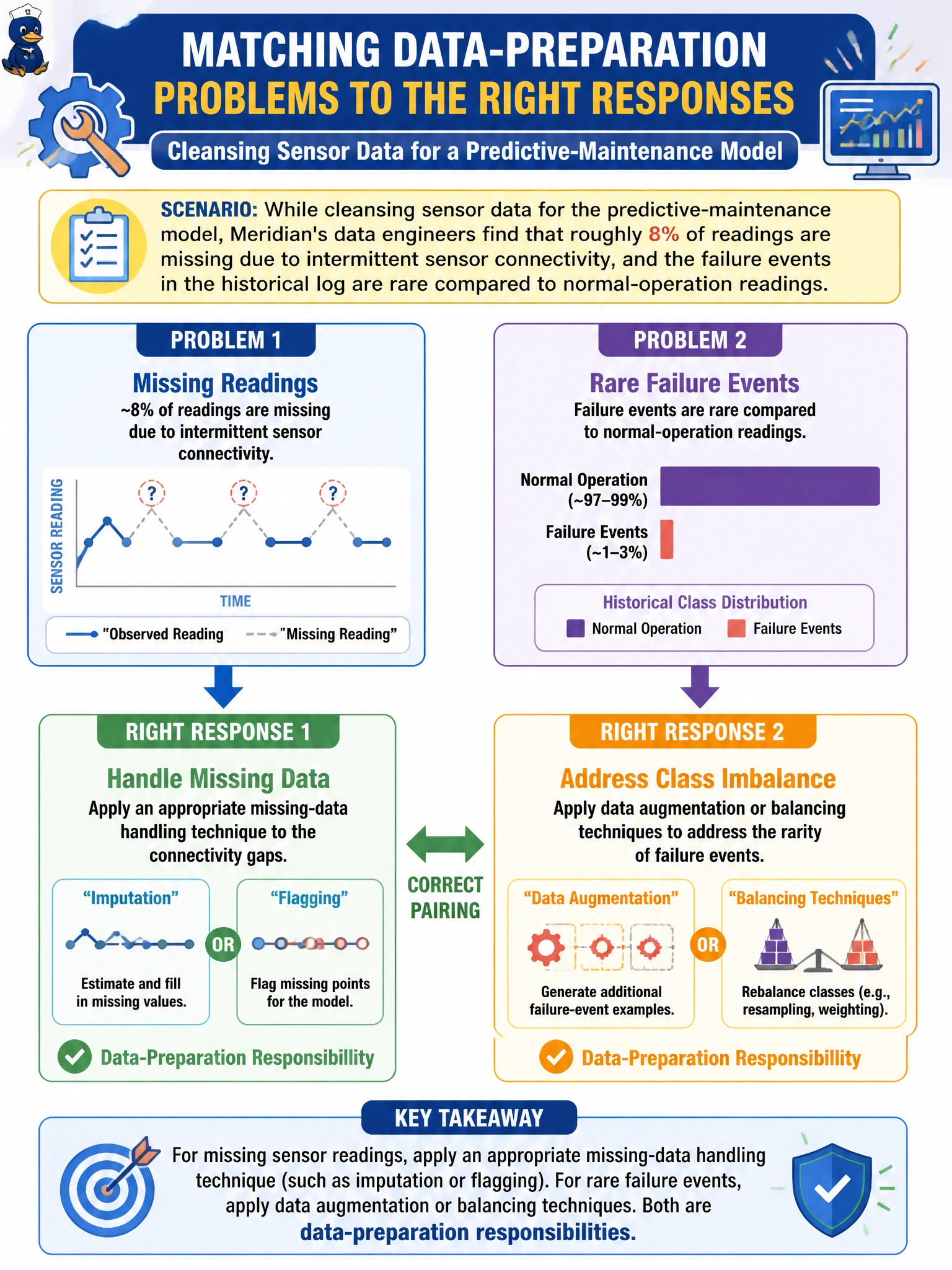
While cleansing sensor data for the predictive-maintenance model, Meridian's data engineers find that roughly 8% of readings are missing due to intermittent sensor connectivity, and the failure events in the historical log are rare compared to normal-operation readings. Which pairing correctly matches each problem to the right data-preparation response?
Select an answer to reveal the explanation.
Short Explanation
Two different data problems, two different fixes: patch the gaps left by flaky sensors (impute or flag them), and boost the scarce failure examples (augment or balance) so the model actually sees enough of what it's supposed to catch.
Full Explanation
Data cleansing and enhancement covers exactly these two situations, and each needs its own technique: missing readings from intermittent connectivity should be handled with an appropriate missing-data strategy such as imputation or explicit flagging, preserving as much signal as possible rather than discarding records outright; the rarity of failure events relative to normal operation is a class-imbalance problem best addressed with data augmentation or balancing techniques during Data Preparation, because a model trained on mostly-normal data will struggle to recognize the rare failures it exists to predict. Deleting every record with any missing value throws away a meaningful chunk of otherwise-usable data and dodges the augmentation the rare-event problem actually needs — and imbalance is a data-preparation and training concern, not something that surfaces only at Model Evaluation. Ignoring the missing data because 8% "seems low" is an arbitrary judgment without addressing root cause, and deleting rare failure events as outliers is actively harmful — those rare events are precisely the signal the model needs to learn. Generative-AI text summarization has no bearing on numeric sensor gaps, and increasing sensor frame rate going forward does nothing to fix the historical data imbalance already in hand — both pair the wrong tool to the wrong problem.