
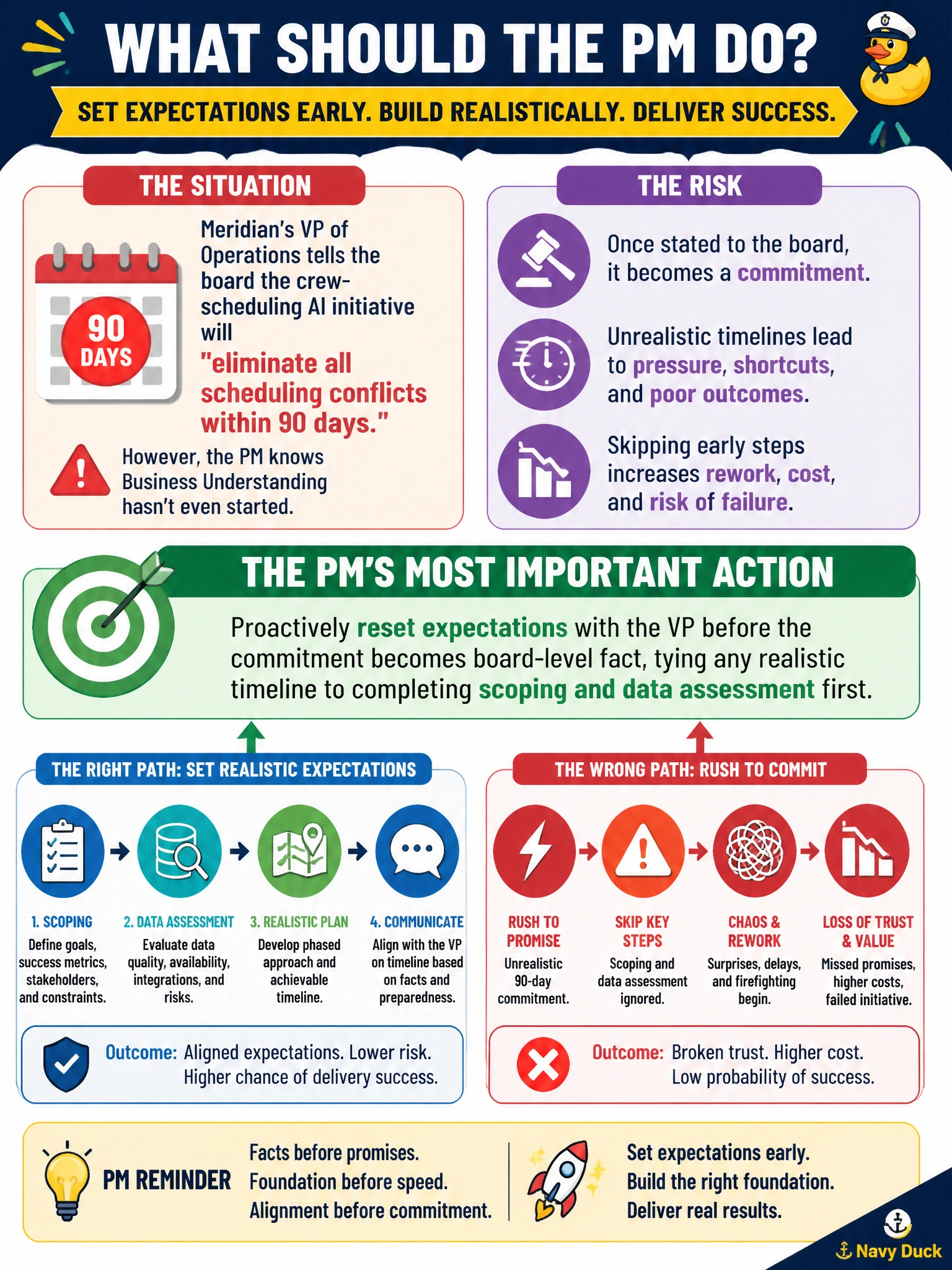
Meridian's VP of Operations tells the board the crew-scheduling AI initiative will "eliminate all scheduling conflicts within 90 days," even though the PM knows Business Understanding hasn't even started. What is the PM's most important action?
Select an answer to reveal the explanation.
Short Explanation
The board just heard a promise the project hasn't even started scoping yet. Someone has to walk that back fast and privately, before it hardens into an expectation everyone will later call a broken promise.
Full Explanation
Managing stakeholder expectations to prevent overpromising is a named CPMAI Task 1 enabler, and this scenario is close to a worst-case version of it: a sweeping, absolute, deadline-bound claim ('eliminate all conflicts,' '90 days') made before any scoping work has occurred. The PM's responsibility is to intervene early and directly with the VP — privately and promptly — to recalibrate the claim to something the project can actually be accountable for once Business Understanding defines a realistic scope, metrics, and timeline. Option B abdicates the PM's core responsibility; letting an unfounded claim stand guarantees a credibility problem later when reality falls short. Option C compounds the mistake by skipping the scoping and data-understanding work entirely in a doomed effort to hit an arbitrary date, which is exactly the kind of proof-of-concept-to-production shortcut CPMAI warns against. Option D is inappropriate and would create an unnecessary public conflict rather than addressing the expectation problem through the proper internal channel. This is squarely a stakeholder-management competency, tested throughout Domain II.