
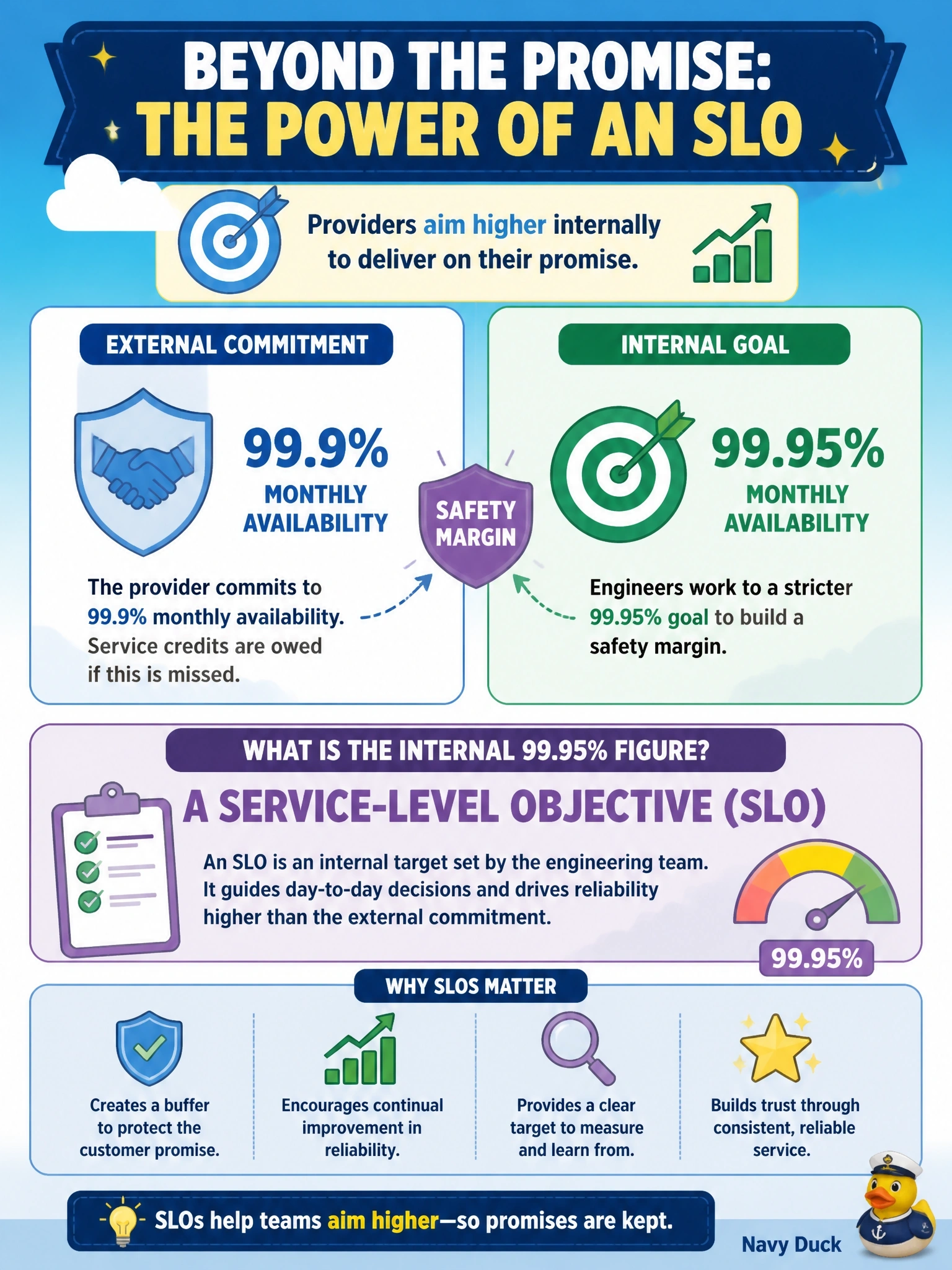
A cloud provider's contract commits to 99.9 percent monthly availability, with service credits owed if it is missed. Internally, the provider's engineering team works to a stricter 99.95 percent goal to leave a safety margin. What is the internal 99.95 percent figure?
Select an answer to reveal the explanation.
Short Explanation
Think of the SLA as the promise you'd get sued over and the SLO as the target you aim for so you never get close to breaking that promise. The 99.95 percent goal is internal and carries no penalty, so it's an SLO. The trap is calling every percentage an SLA just because it looks like uptime.
Full Explanation
A service-level agreement is the contractual commitment between provider and customer, defining measurable service levels and the remedies, such as service credits, owed when they are not met. A service-level objective is a specific target for a measurable characteristic of the service; it can appear inside an SLA, but here it is an internal goal the engineering team sets stricter than the contractual commitment so that normal variation does not breach the agreement. The internal 99.95 percent figure carries no customer remedy, which identifies it as an objective. The 99.9 percent commitment with service credits is the SLA, so labeling the stricter internal goal an SLA confuses the target with the contractual promise. A memorandum of understanding records a mutual intent or general understanding between parties and is usually not legally binding; it does not define measured availability targets. A master services agreement sets overarching legal and commercial terms for a relationship, such as liability, confidentiality, and payment, under which specific work orders or SLAs operate; it is not an availability metric. Exam caveat: customers should monitor delivered service against the SLA independently rather than relying only on provider reports. Operational check: compare the provider's monthly availability report with the customer's own monitoring data and track any credits owed.