
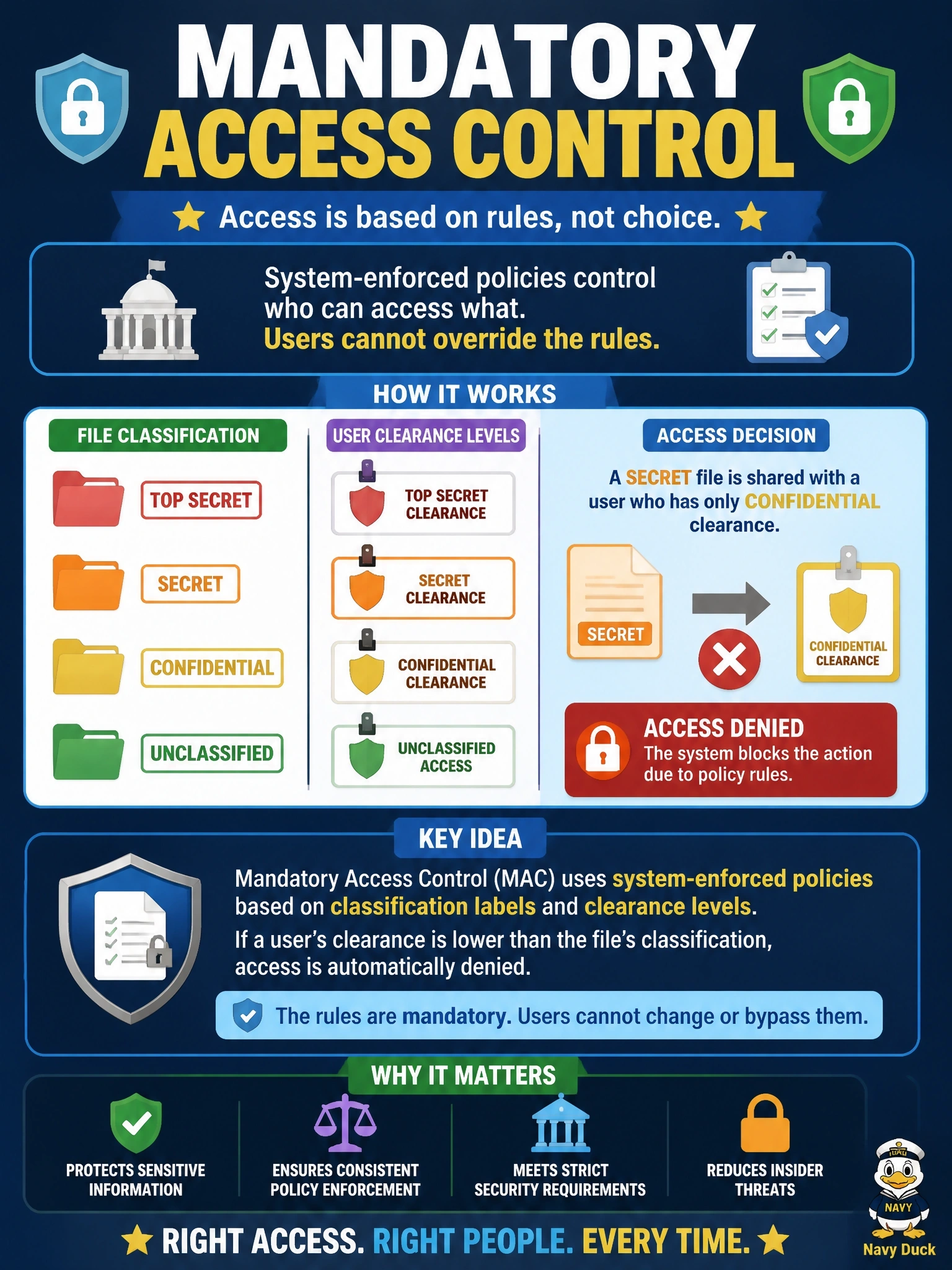
A government contractor's operating system assigns classification labels to files and clearance levels to users. A project lead who owns a secret-labeled file tries to share it with a colleague cleared only for confidential, and the system refuses. Which access control model is in use?
Select an answer to reveal the explanation.
Short Explanation
Here's the tell: the owner wanted to share and the system said no anyway. In mandatory access control, the labels rule and you can't override them just because you own the file. If owners got to decide, you'd be looking at discretionary.
Full Explanation
Mandatory access control (MAC) bases decisions on security labels assigned by the system or a security administrator: objects carry classification labels, subjects carry clearances, and access is granted only when the subject's clearance dominates the object's label according to policy. Individual users, including the owner of a file, cannot change labels or grant access that the policy forbids. The refusal to let an owner share a secret file with someone cleared only for confidential is the defining behavior of MAC. Discretionary access control (DAC) lets the owner of an object decide who may access it, typically through access control lists; under DAC, the project lead's share would have succeeded. Role-based access control grants permissions according to job roles; it does not use classification labels and clearances to compare sensitivity levels. Rule-based access control applies administrator-defined conditions, such as firewall rules or time and location constraints, uniformly to requests, but it is not the label-and-clearance model described. Exam caveat: security-enhanced operating system modules implement MAC-style policies on general-purpose systems, and labels plus clearances are the keywords to watch for. Operational check: attempt the same share as an administrator-labeled test and confirm the label check, not file ownership, governs the result.