
A network team must centralize event messages from routers and switches and also poll those devices for health statistics. Security policy requires that the polling protocol authenticate requests and encrypt its traffic. Which combination BEST meets these requirements?
Select an answer to reveal the explanation.
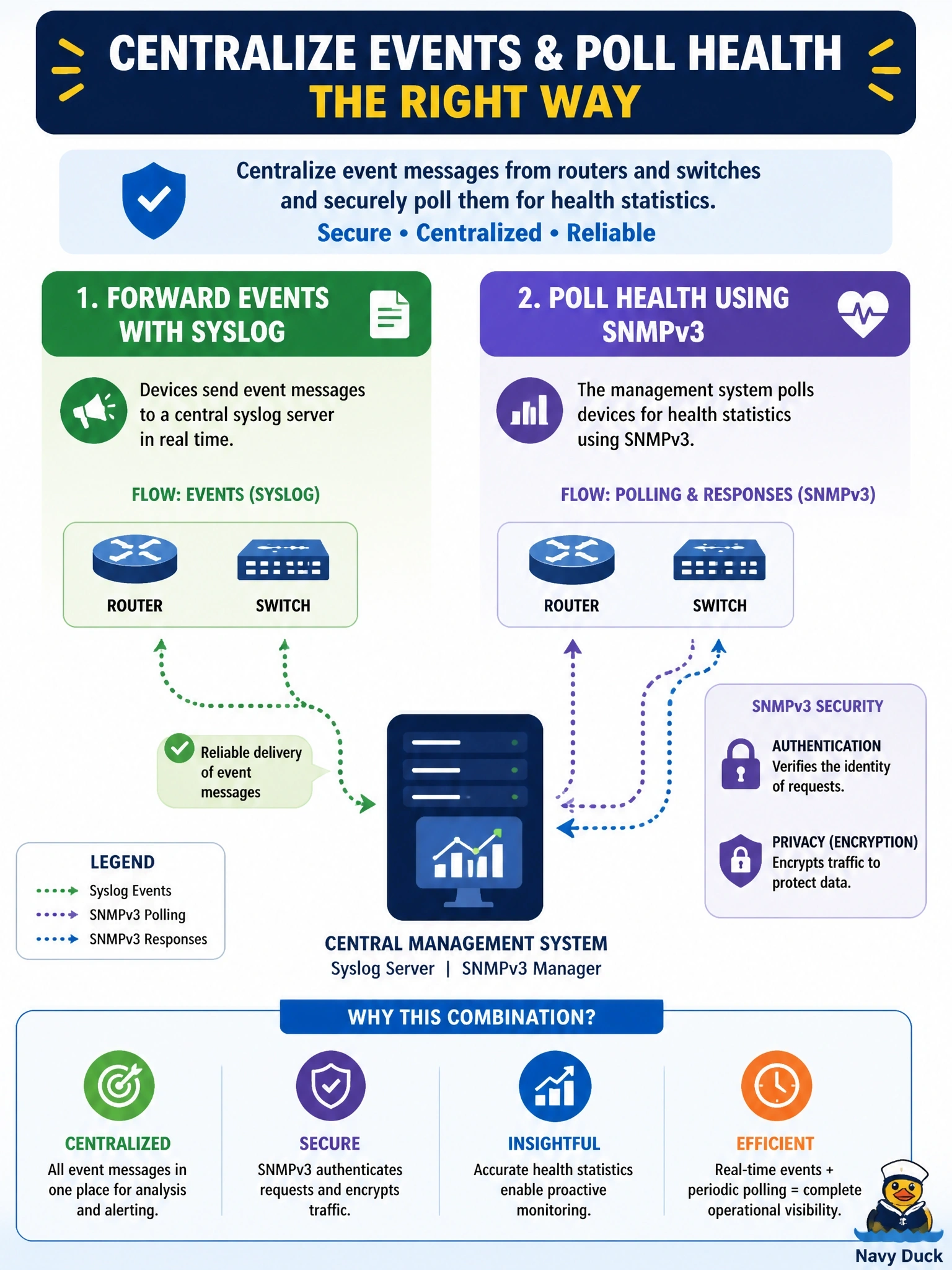
Short Explanation
Syslog is the device's diary; SNMP is the doctor taking its pulse. Only SNMPv3 can prove who's asking and scramble the conversation - v1 and v2c send community strings in cleartext. If you see 'community string' next to 'encrypt', that's your trap.
Full Explanation
Syslog is the standard way to forward event messages from network devices to a central collector, where they can be aggregated and correlated. Simple Network Management Protocol (SNMP) is used to poll device statistics such as interface counters, CPU load, and memory. SNMPv3 adds a user-based security model that authenticates requests and, with its privacy option, encrypts SNMP traffic, which is what the policy requires for polling. SNMPv2c traps can carry events, and community strings can authorize polling, but community strings are shared values sent in cleartext and provide neither real authentication nor encryption, so that combination fails the policy. NetFlow exports traffic metadata, not device event messages, and SCAP evaluates configuration compliance against benchmarks; neither collects routine health statistics. Syslog with SNMPv1 handles events correctly, but SNMPv1 shares the same cleartext community-string weakness as v2c, and read-only access does not change that. Exam caveat: classic syslog over UDP is also unencrypted; where log confidentiality matters, a TLS-protected syslog transport is used. Operational check: confirm devices accept only SNMPv3 users configured with authentication and privacy, disable v1 and v2c communities, and verify that the collector receives syslog from every device.