
An organization needs to monitor the health and security events of network appliances and printers whose vendors do not allow third-party software to be installed on them. Which monitoring approach fits these devices?
Select an answer to reveal the explanation.
Short Explanation
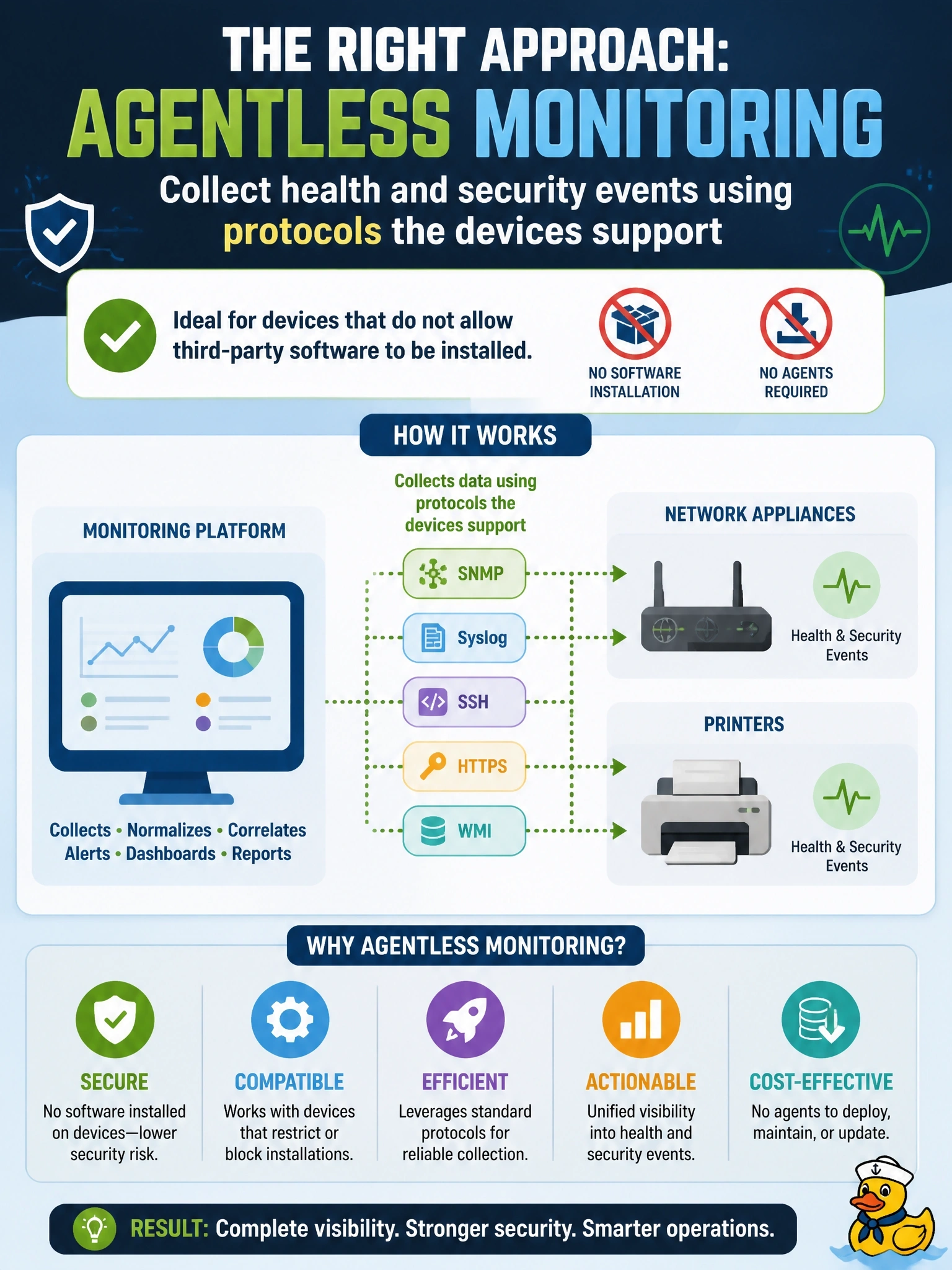
If you're not allowed to move in, you watch from the street. Agentless monitoring pulls data the device already offers - syslog, SNMP, APIs - without installing anything. Every other choice needs software on a box that won't take it.
Full Explanation
Monitoring tools fall into agent-based and agentless designs. Agent-based tools install software on the monitored system, which can collect rich local detail but requires the platform to support and permit that software. Agentless monitoring gathers information remotely using interfaces the device already exposes, such as syslog forwarding, SNMP polling, management APIs, or remote credentialed queries. For appliances and printers whose vendors prohibit third-party software, agentless collection is the practical way to gain visibility without voiding support or destabilizing firmware. A lightweight collector is still an agent, so it violates the same restriction regardless of its size. Endpoint detection and response depends on a sensor installed on the endpoint to observe processes and behavior; it cannot be placed on locked appliances. Host-based intrusion prevention likewise runs as software on the protected host, and installing it in firmware is precisely what the vendors forbid. Exam caveat: agentless monitoring usually yields less depth than an agent, so it is often paired with network-based detection for those devices. Operational check: confirm each device forwards logs or responds to authenticated polling, and verify in the monitoring platform that every appliance and printer reports within its expected interval.