
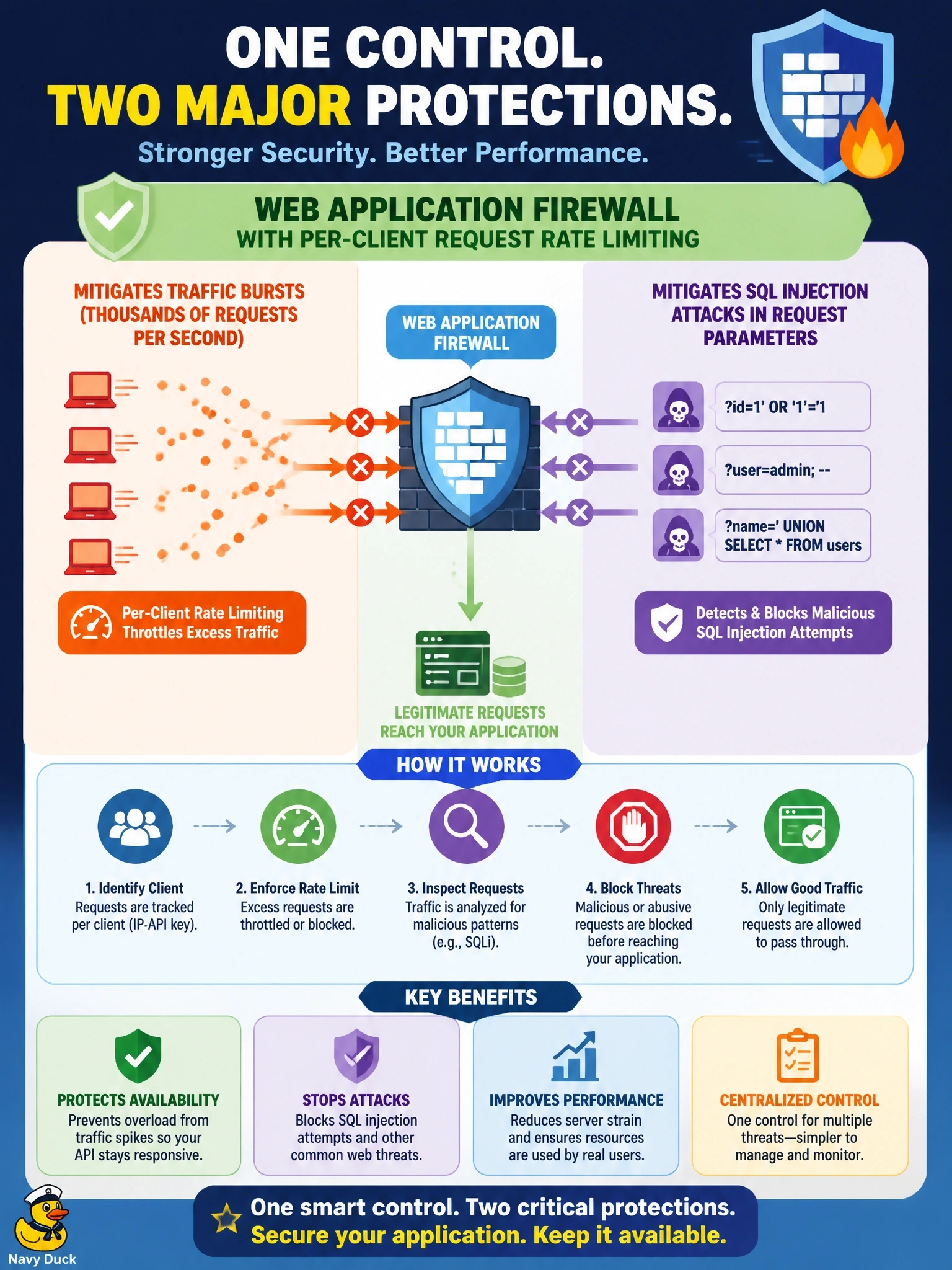
A public web API is being hit with sudden bursts of thousands of requests per second from a handful of clients, and the same application is also receiving SQL injection attempts in request parameters. Which single control best mitigates both problems?
Select an answer to reveal the explanation.
Short Explanation
You've got two problems: too many requests, and nasty requests. A WAF reads the actual HTTP requests to catch the injection, and rate limiting throttles the clients flooding you. A port-443 rule waves both straight through, because they're all perfectly good HTTPS.
Full Explanation
A web application firewall inspects HTTP and HTTPS requests at the application layer, so it can recognize and block injection payloads in parameters, headers and bodies before they reach the application. Most also support rate limiting, which caps how many requests a client, key or address may make in a time window and throttles or blocks clients that exceed it, addressing the request bursts. Together they cover both problems at one enforcement point in front of the API. A Layer 4 rule permitting TCP 443 restricts traffic by protocol and port, but both the bursts and the injection attempts arrive as valid HTTPS on port 443, so the rule allows them through untouched. A network intrusion detection system in passive mode can alert on known injection signatures, yet it does not block anything and offers no rate limiting, leaving both attacks to succeed. A content filtering proxy controls what internal users can browse on the web; it protects outbound browsing and does not sit in front of a public API receiving inbound traffic. Exam caveat: a web application firewall reduces risk but does not replace parameterized queries and input validation in the application itself. Operational check: send a controlled burst above the configured threshold and confirm throttling, then submit a harmless injection test string and confirm it is blocked and logged.