
A server room suffers frequent power interruptions and brownouts lasting from a few seconds to a few minutes, and each one causes servers to reboot. Long multi-hour outages are rare and are already covered by an on-site generator. Which addition best fixes the reboots?
Select an answer to reveal the explanation.
Short Explanation
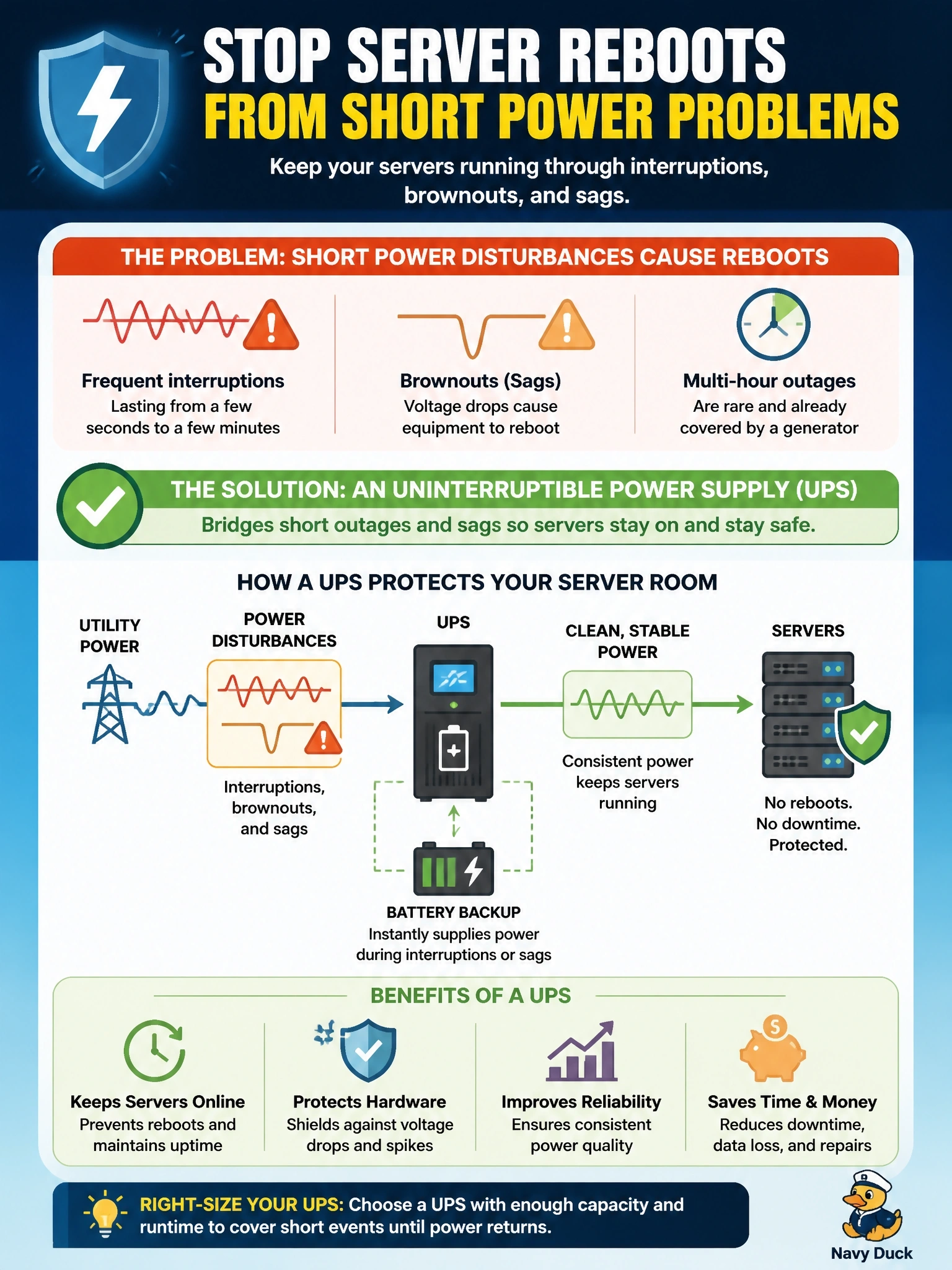
Think of a UPS as a bridge battery: it catches the drop instantly, so your servers never notice the hiccup. A generator needs time to spin up, a surge protector only stops spikes, and a second power supply plugged into the same dying feed doesn't help a bit. Short gaps and sags call for a UPS.
Full Explanation
An uninterruptible power supply holds batteries that take over within milliseconds when utility power drops or sags, and many models also condition voltage so brownouts do not reach the equipment. That combination keeps servers running through interruptions of seconds to minutes and bridges the gap until a generator stabilizes during longer outages. A surge protector clamps sudden overvoltage spikes, but it supplies no energy when voltage disappears or falls, so outages and brownouts would still reboot the servers. A redundant power supply gives each server a second internal unit, which protects against the failure of a power supply, yet if both units draw from the same failing feed, both lose power together. A larger generator with an automatic start still needs time to detect the outage, start and stabilize, so the servers would lose power during that window; generator capacity does not address the instantaneous gap. Exam caveat: UPS runtime is sized for bridging and orderly shutdown, not for hours of operation, which is why a UPS and a generator are typically used together. Operational check: confirm the servers draw from the UPS-protected circuit, simulate a utility cut during a maintenance window, verify the servers stay up, and check that UPS runtime exceeds the generator's start and transfer time.