
An online store running on cloud virtual machines is overwhelmed by traffic spikes during flash sales, while between events the extra capacity it keeps running sits idle and costs money. Which resilience approach best addresses both problems?
Select an answer to reveal the explanation.
Short Explanation
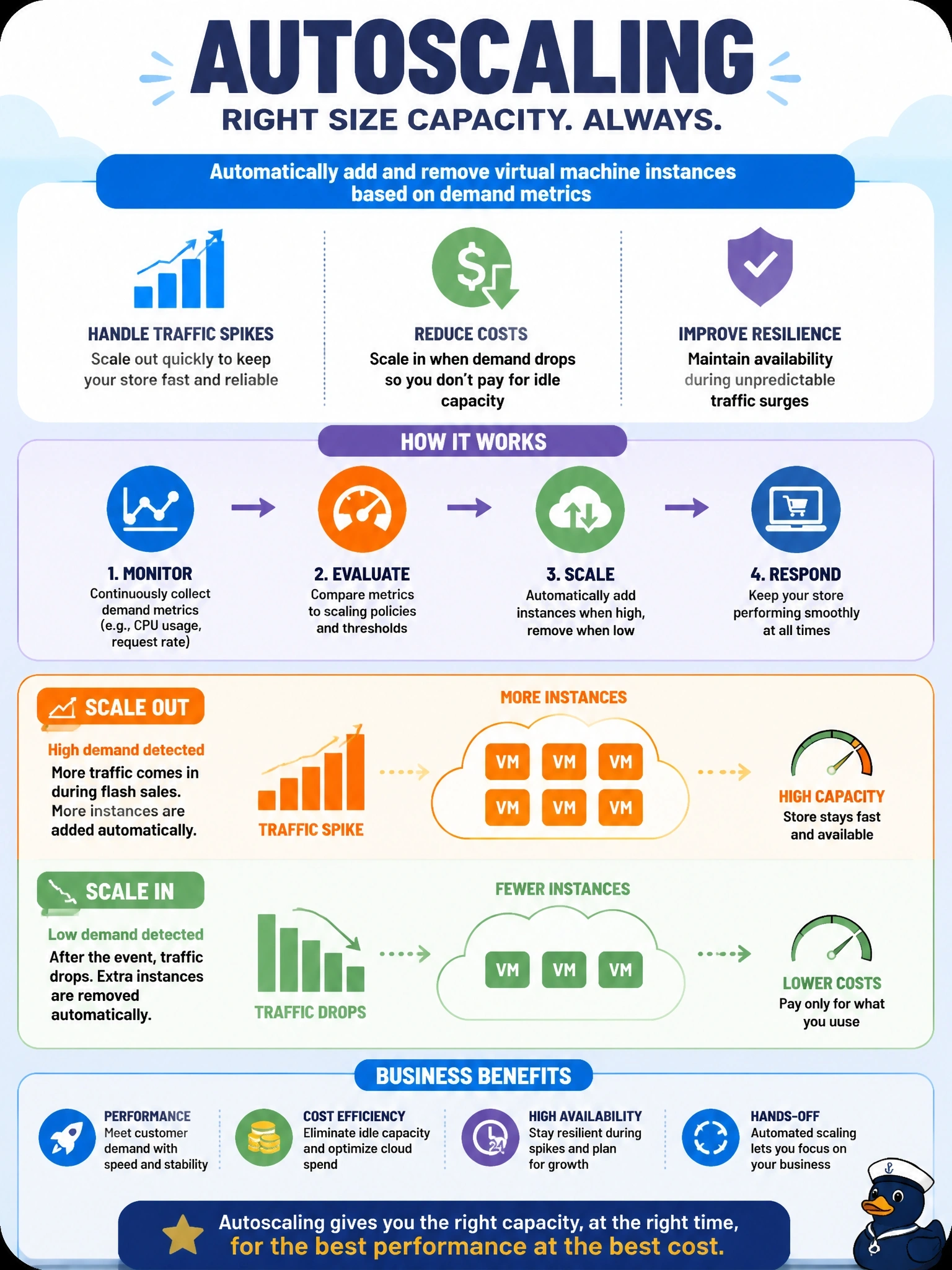
You want capacity like a stretchy waistband: bigger for the holiday feast, back to normal afterward. Autoscaling grows the pool when demand climbs and shrinks it when things calm down. The trap is buying a permanently bigger belt and paying for it all year.
Full Explanation
Autoscaling monitors demand metrics such as CPU utilization, request rate or queue depth and automatically adds instances when thresholds are crossed and removes them when demand falls. It keeps the store available during flash sales and stops paying for idle capacity between them, solving both problems the scenario names. An active-passive cluster of two larger servers provides failover if one node dies, but the passive node does not serve traffic, so the cluster still has a fixed ceiling during spikes and still costs money while idle. A hot site is a disaster recovery facility that takes over after the primary environment fails; it does not add capacity to a healthy primary under load and it carries its own continuous cost. Permanently upgrading every server to the largest size may survive the spikes, but it locks in the very idle spending the business wants to eliminate, and it still has a fixed ceiling if a sale is bigger than expected. Exam caveat: autoscaling depends on stateless or properly shared application state and on sensible scaling thresholds, and it is often paired with load balancing to direct traffic to new instances. Operational check: run a load test that simulates a sale, confirm new instances launch and join the load balancer, then confirm they terminate once load drops.