
Every production workload a company runs sits on a single hypervisor product, and a new advisory warns that one escape flaw in that hypervisor could let an attacker compromise all of the workloads at once. Which resilience strategy most directly removes this single point of failure?
Select an answer to reveal the explanation.
Short Explanation
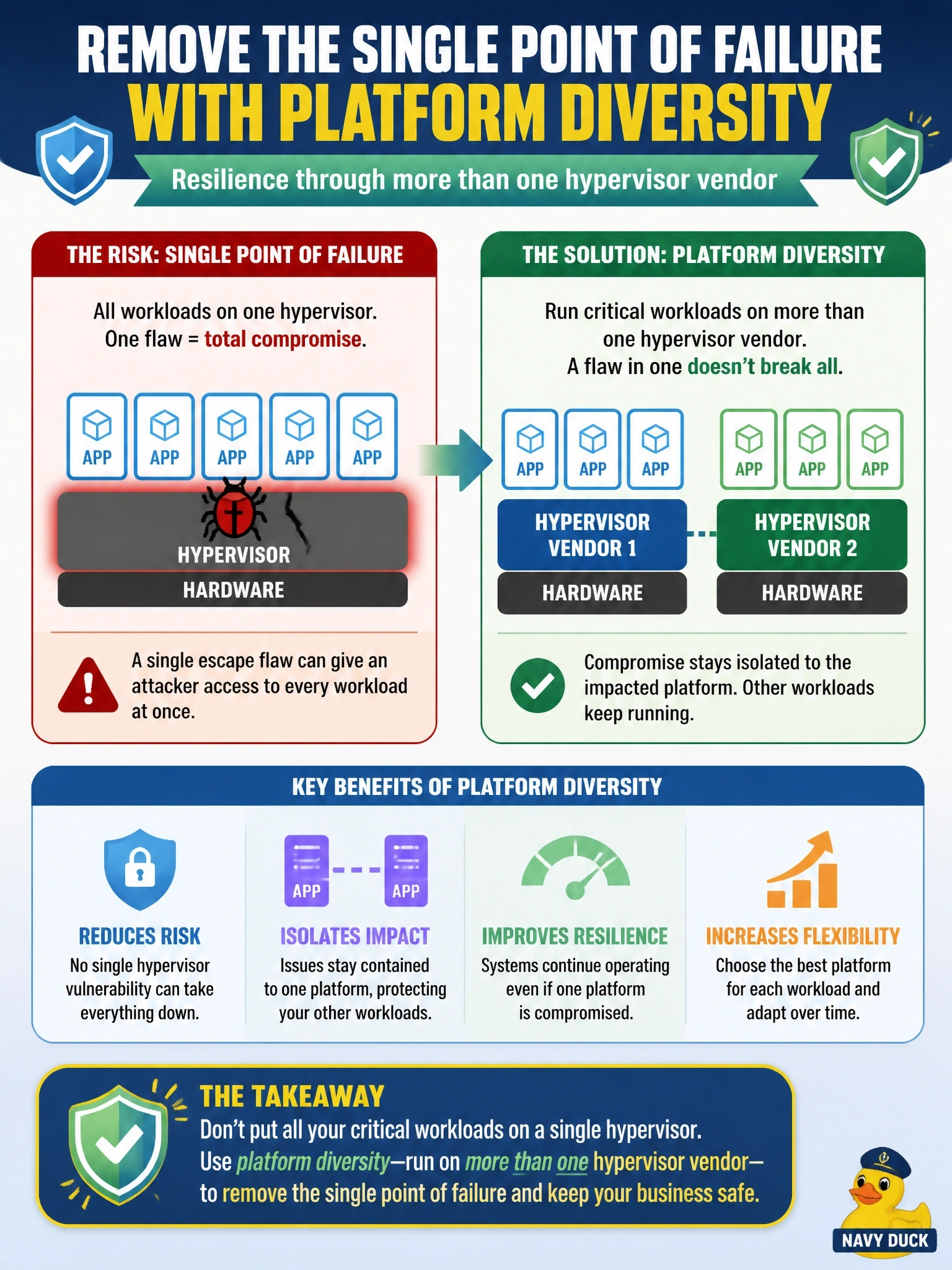
Don't put all your eggs in one basket, and especially not in one brand of basket. If every server shares the same hypervisor, one bug breaks them all. Platform diversity means a flaw in one vendor's code can't take down the workloads running on another.
Full Explanation
Platform diversity reduces common-mode failure by running critical systems on different vendors, hardware or virtualization platforms, so that a single vulnerability, defect or bad update cannot affect every workload simultaneously. Placing critical services on more than one hypervisor product means an escape flaw in one leaves the other environment unaffected, which directly addresses the advisory's concern. Clustering more hosts adds capacity and failover, but every node would share the same vulnerable hypervisor, so the attacker's single flaw would apply to the whole cluster. Autoscaling adds hosts in response to demand, which improves capacity resilience, yet the new hosts are clones of the vulnerable platform and widen rather than narrow the exposure. Load balancing distributes requests across virtual machines, but if all of those machines sit on the same hypervisor, spreading traffic does nothing about a flaw beneath all of them. Exam caveat: diversity adds operational cost and skills overhead, so organizations typically apply it to the most critical services rather than everything, and it complements patching rather than replacing it. Operational check: map which critical services run on which platform, confirm that redundant instances of each critical service exist on a second vendor's hypervisor, and test failover from one platform to the other.