
A firm needs its order system running at an alternate location within roughly a day of losing its primary data center. Leadership will not pay for continuous real-time replication, but it will fund standby hardware and network links that are kept ready. Which recovery site fits?
Select an answer to reveal the explanation.
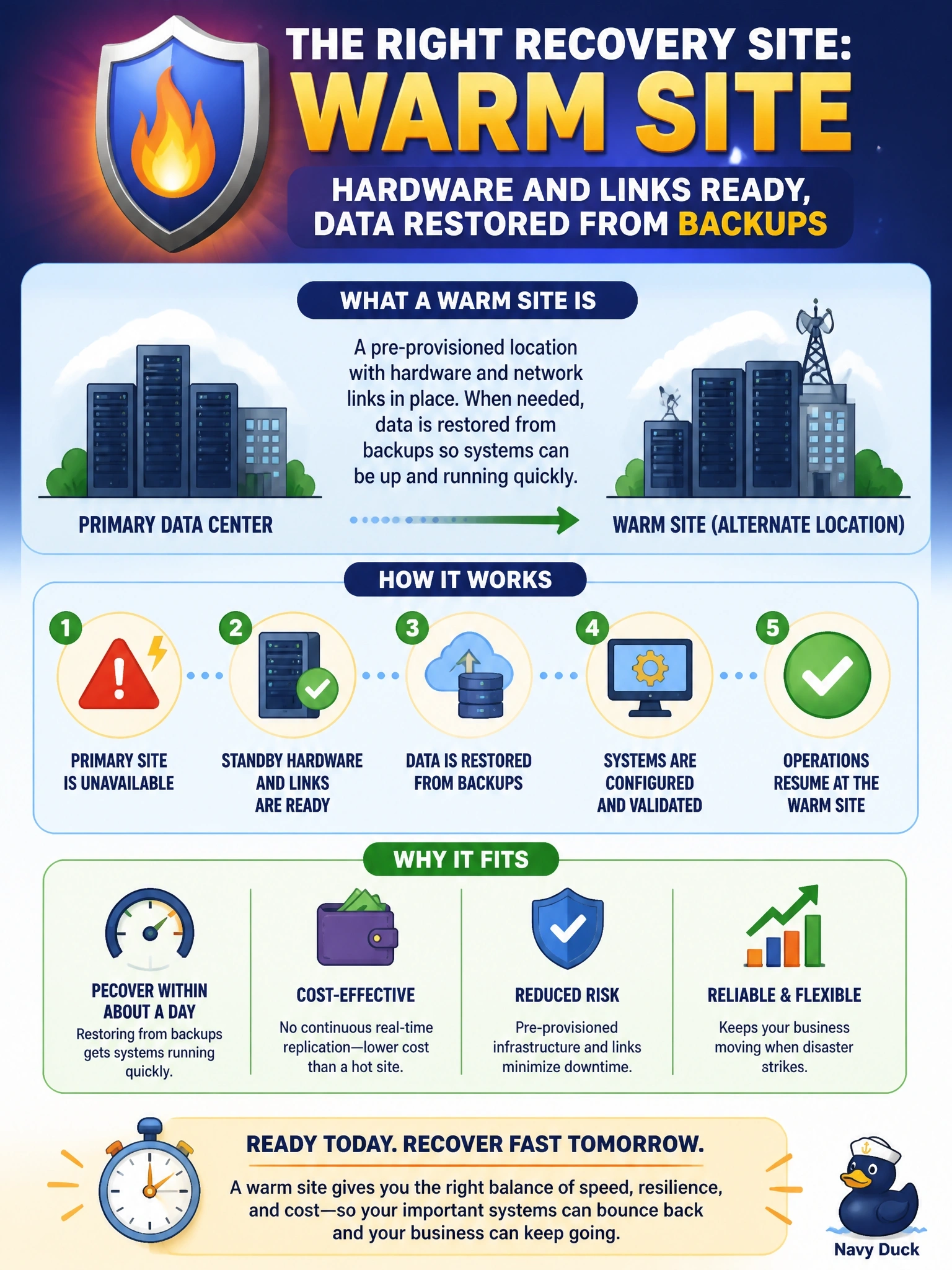
Short Explanation
Think of a warm site like a furnished apartment with the utilities on: you just bring your stuff, meaning last night's backups. A hot site is already lived in, which is what leadership won't pay for, and a cold site is an empty shell that takes far too long to fill.
Full Explanation
A warm site provides facilities, standby hardware and network connectivity that are already in place, but it does not hold continuously synchronized production data. Recovery means restoring the most recent backups onto the standby systems and bringing services up, which typically takes hours to about a day and fits both the stated time target and the funding limits. A hot site mirrors production with live or near-live replication so operations can move within minutes; it would meet the timeline, but it requires exactly the continuous real-time replication that leadership has refused to fund. A cold site supplies space, power and perhaps cabling, with equipment procured or shipped after the disaster, so standing up servers, networks and data commonly takes days to weeks, far beyond the requirement. Backup storage alone protects the data but provides nowhere to run the order system; compute, networking and configuration would all have to be built from scratch during the outage. Exam caveat: site choice balances recovery time objective against cost, and the scenario's constraints, not the fastest option, decide the answer. Operational check: run a recovery exercise at the warm site from the latest backup set, time it from declaration to service availability, and compare the result with the approximately one-day target.