
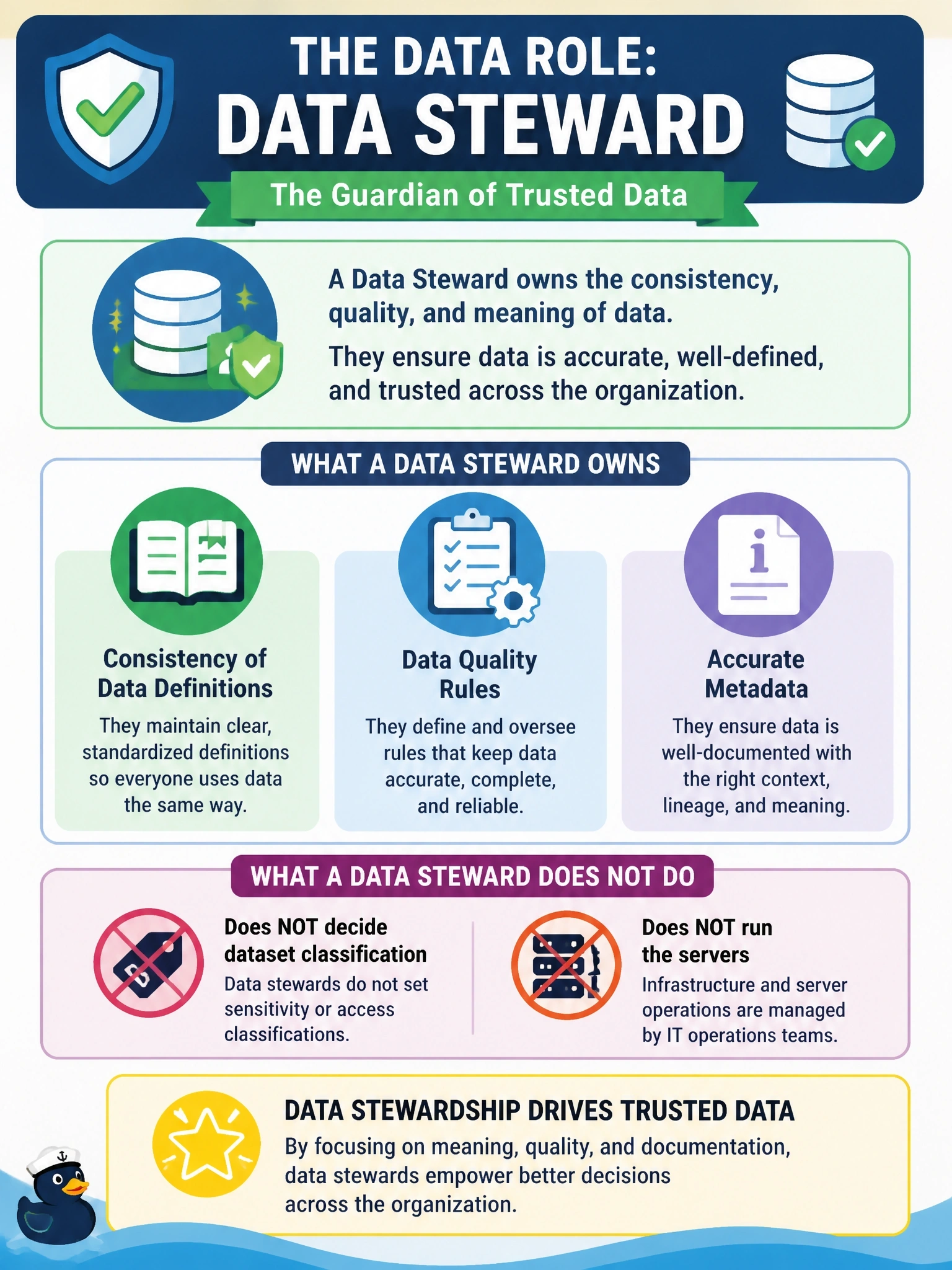
A company names an analyst in its marketing division to own the consistency of customer data definitions, data quality rules and accurate metadata for the customer dataset. She does not decide the dataset's classification and does not run the servers. Which data role has the company assigned?
Select an answer to reveal the explanation.
Short Explanation
Think of a librarian who keeps the catalog accurate and every book shelved where it belongs. She doesn't own the library and doesn't fix the building's wiring, but the collection is usable because of her. When you see quality, definitions and metadata, you're looking at a data steward.
Full Explanation
A data steward is responsible for the quality and usability of a dataset: maintaining consistent definitions, enforcing data quality rules, managing metadata and ensuring the data is fit for business use. The scenario assigns exactly those duties to the marketing analyst while explicitly excluding classification decisions and infrastructure operation. A data custodian implements technical controls such as backups, storage configuration and permissions; the stem says she does not run the servers, which rules that role out. A data owner is the accountable senior stakeholder who classifies data and approves access, and the stem states she does not decide classification. A data processor is a privacy-law role for a party that processes personal data on behalf of a controller, usually an external service provider, so it does not describe an internal employee charged with data quality. Exam caveat: steward and owner are often confused because both sit on the business side; the distinction is accountability and decisions for the owner versus quality and meaning for the steward. Operational check: confirm the data governance register lists the analyst as steward for the customer dataset, that data quality rules and metadata standards are documented under her name, and that classification and access approvals still route to the designated owner.