
A hospital will give an outside research team a copy of patient records so the team can study diagnoses and treatment outcomes, but the researchers must not be able to identify any individual patient, even with full access to the copy they receive. Which method best meets this requirement?
Select an answer to reveal the explanation.
Short Explanation
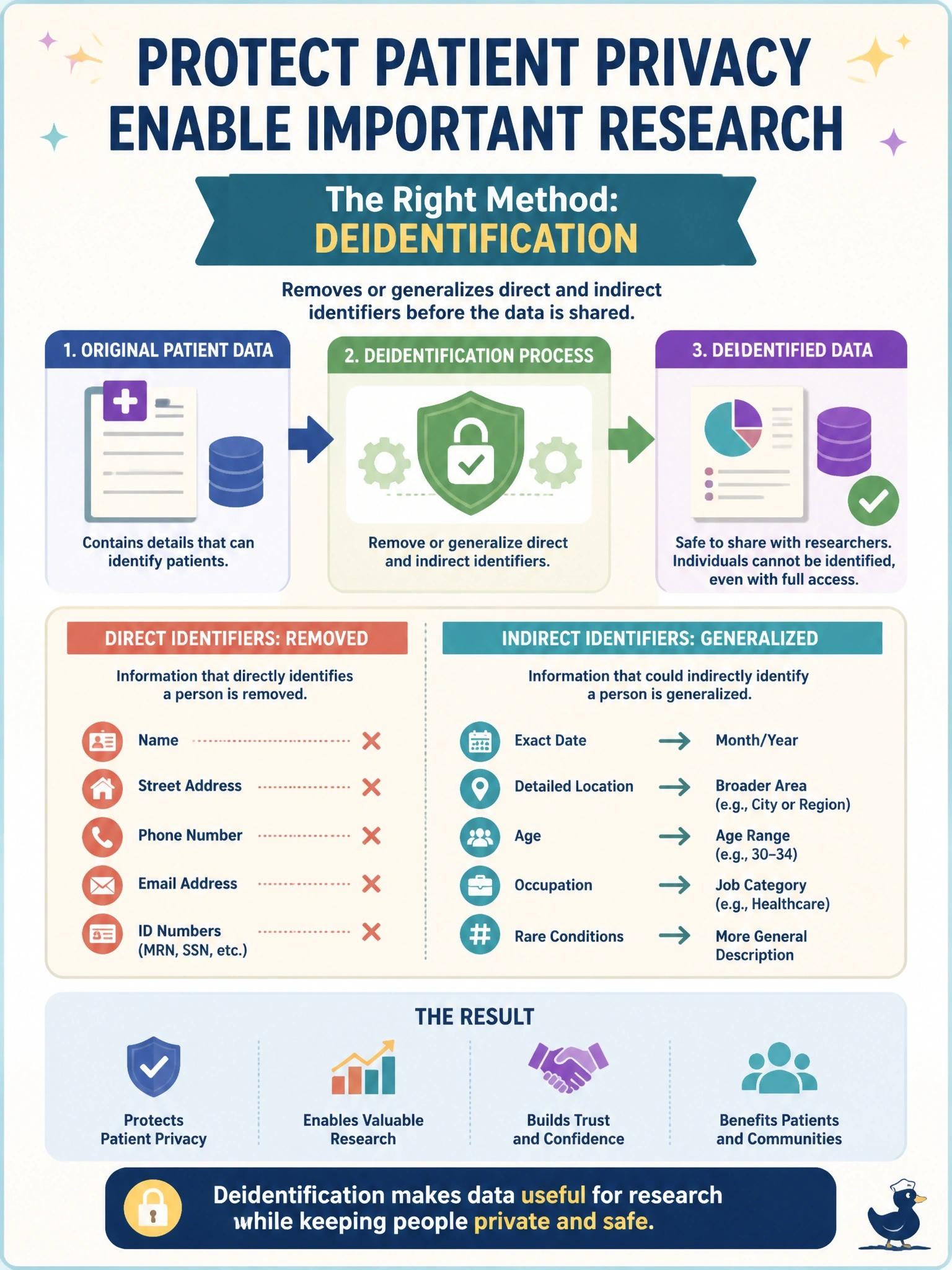
You're handing over the medical story, not the names. Deidentification strips out or blurs anything that points back to a person, so the data's still useful but anonymous. Encrypting it and handing over the key? That's just giving them the identities with extra steps.
Full Explanation
Deidentification removes direct identifiers such as names, record numbers and contact details, and reduces indirect identifiers such as exact birth dates, rare diagnoses combined with small locations, or admission dates that could be linked to other datasets. The resulting copy keeps the clinical attributes the researchers need while preventing them from tying any record to a specific patient, which is exactly the requirement for a released dataset. Encrypting the dataset protects it from outsiders, but once the research team holds the key they see every identifier in plaintext, so the stated requirement fails. Masking only the screens and reports the researchers use leaves the underlying copy fully identifiable; anyone with the full access the stem describes can query or export around the masked view. Hashing entire records produces digests that cannot be analyzed for diagnoses or outcomes, and hashing individual identifiers alone can be reversed by brute force when the input space is small, so it is neither useful nor reliably anonymous. Exam caveat: removing names alone is rarely sufficient, because combinations of quasi-identifiers can reidentify people. Operational check: review the released copy against the organization's deidentification standard, test whether any record can be linked to a known patient by combining remaining fields, and document the review before release.