
A payment platform replaces every stored card number with a random surrogate value that has no mathematical relationship to the original, and only a separately protected vault can map a surrogate back to the real number. Which data protection method is this?
Select an answer to reveal the explanation.
Short Explanation
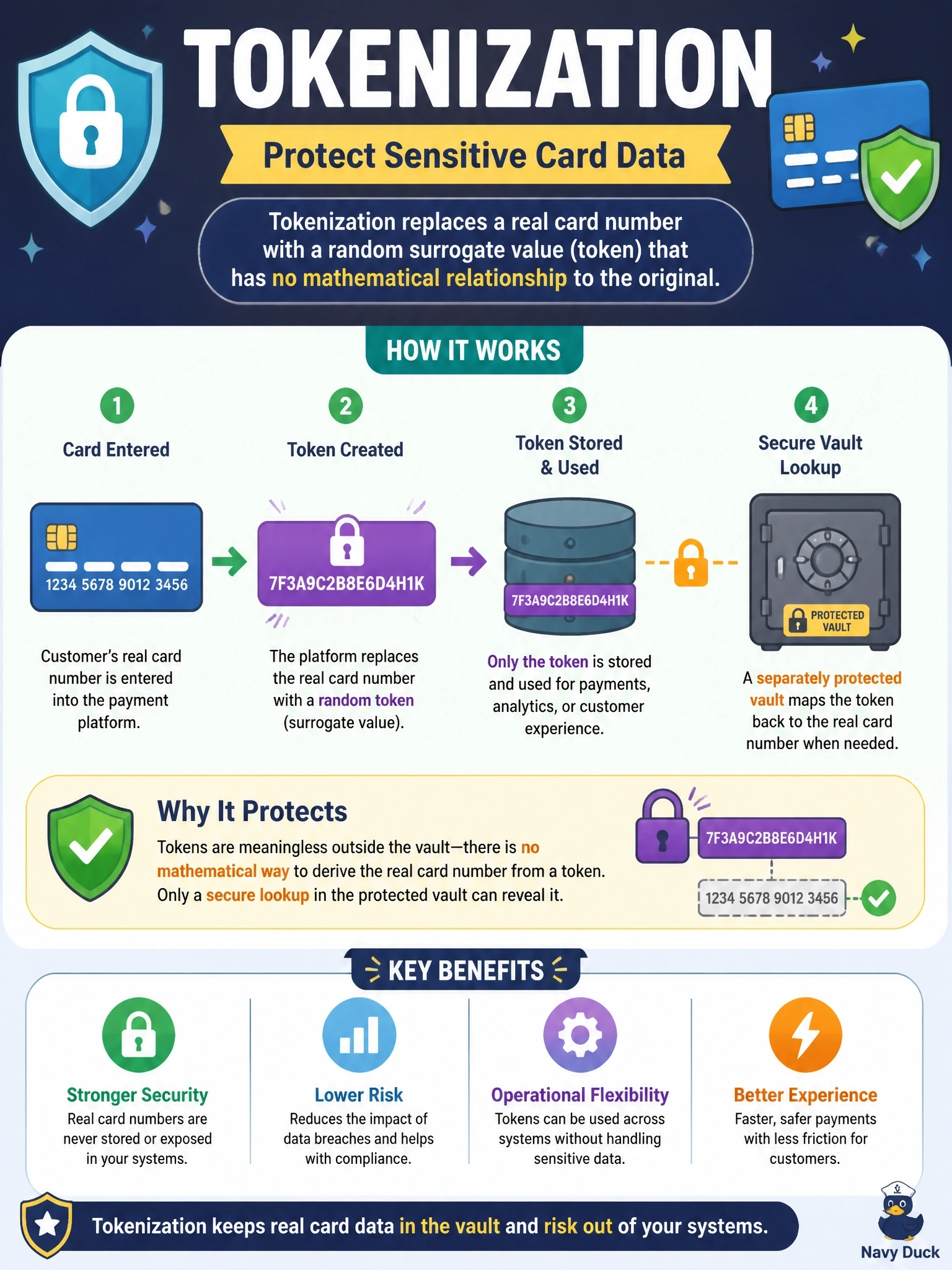
Think of a coat check: you hand over your coat and get a numbered ticket that means nothing on its own. Only the coat room can match the ticket back to your coat. That's tokenization, and the giveaway is 'no mathematical relationship', which rules out encryption and hashing.
Full Explanation
Tokenization substitutes a sensitive value with a token that is generated independently of the original, typically at random, and records the pairing in a secured token vault. Because no algorithm or key links the token to the card number, stealing tokens from application databases yields nothing usable, and systems that handle only tokens can often be removed from the scope of payment compliance assessments. Encryption also produces a substitute value, but that ciphertext is mathematically derived from the plaintext and can be reversed by anyone holding the key, which contradicts the stated lack of any mathematical relationship. Hashing is a one-way function whose output is computed from the input; it is not random, it is not reversed by a vault lookup, and recomputing a hash would never recover the card number for a refund or recurring charge. Masking only alters what is displayed, such as showing the last four digits, while the original value remains in the same data store, so it does not remove the real number from the system. Exam caveat: tokens may be format-preserving and look like card numbers, so the distinguishing feature is how they are generated and reversed, not their appearance. Operational check: confirm application tables contain only tokens, verify the vault is segmented with tightly restricted access, and test that detokenization requests are logged.