
A building's power fails. The electronic lock on an emergency exit door along an evacuation route and the perimeter firewall protecting the data center network are both affected. Which failure mode configuration is MOST appropriate for these two devices?
Select an answer to reveal the explanation.
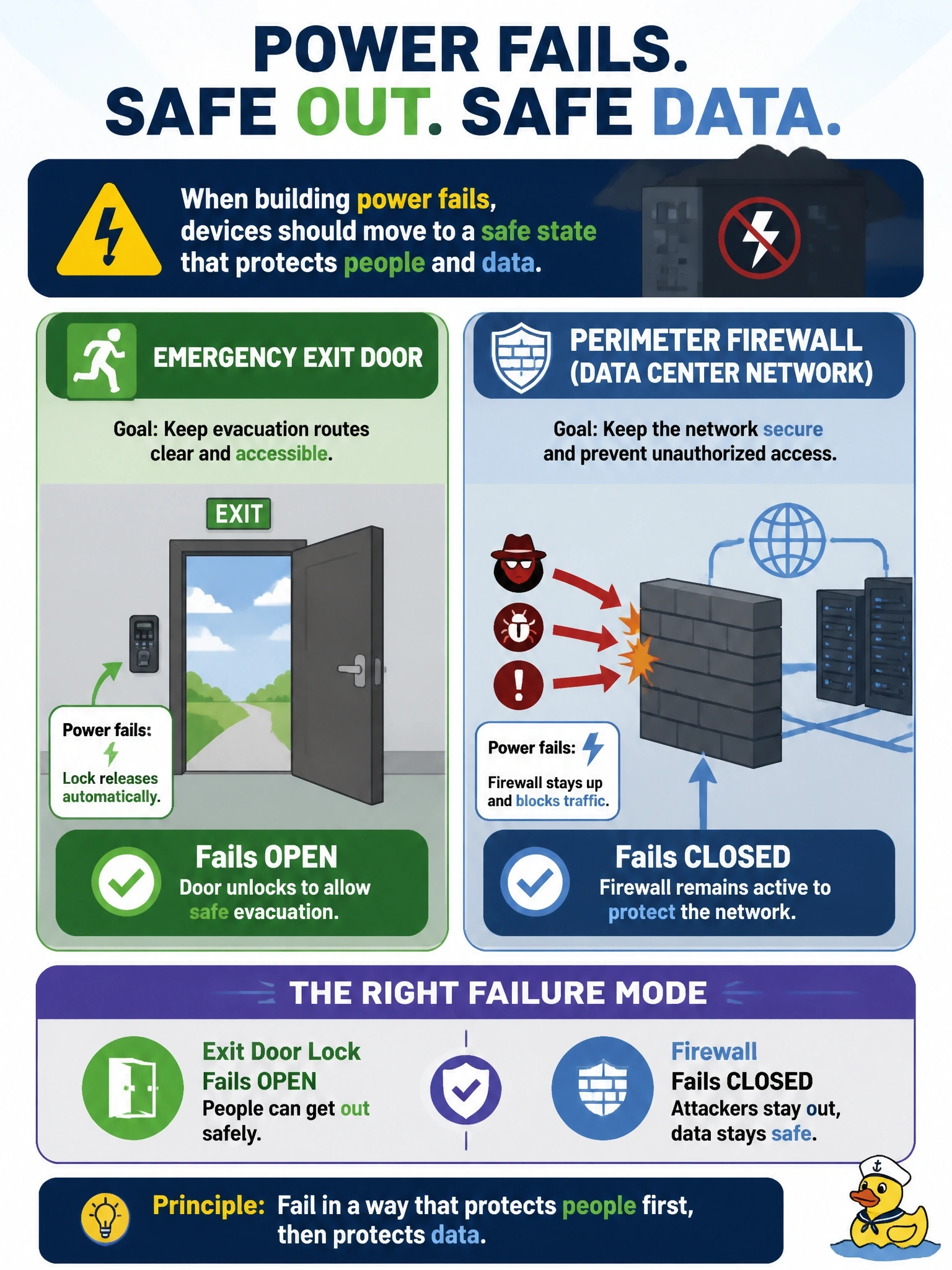
Short Explanation
When the lights go out, you need people to get out the door, but the bad guys shouldn't get into the network. So the exit door fails open for safety and the firewall fails closed for security. The trap is applying one rule to both; life safety always wins at a door on an evacuation route.
Full Explanation
Failure modes define how a device behaves when it loses power or malfunctions. Fail-open allows passage or traffic when the device fails, prioritizing availability or safety, while fail-closed blocks passage or traffic, prioritizing security. An electronic lock on an emergency exit along an evacuation route must fail open, because life safety requires that occupants be able to leave during a power failure, and building and fire codes generally require this for egress doors. A perimeter firewall should fail closed, because passing unfiltered traffic into the data center network would remove protection exactly when the organization may be least able to respond. Configuring both to fail closed protects the network but could trap people during an emergency, which is unacceptable for an egress door. Configuring both to fail open keeps exits usable but turns the firewall into an open path for attackers whenever it fails. Reversing the settings, with the door failing closed and the firewall failing open, gets both decisions wrong, endangering occupants while exposing the network. Exam caveat: life safety takes priority over security in physical controls, but a door protecting a sensitive room that is not an egress route may reasonably fail secure. Operational check: confirm the exit lock's power-loss behavior during a supervised test, verify the firewall's failure behavior and redundancy, and document both decisions in the architecture records.