
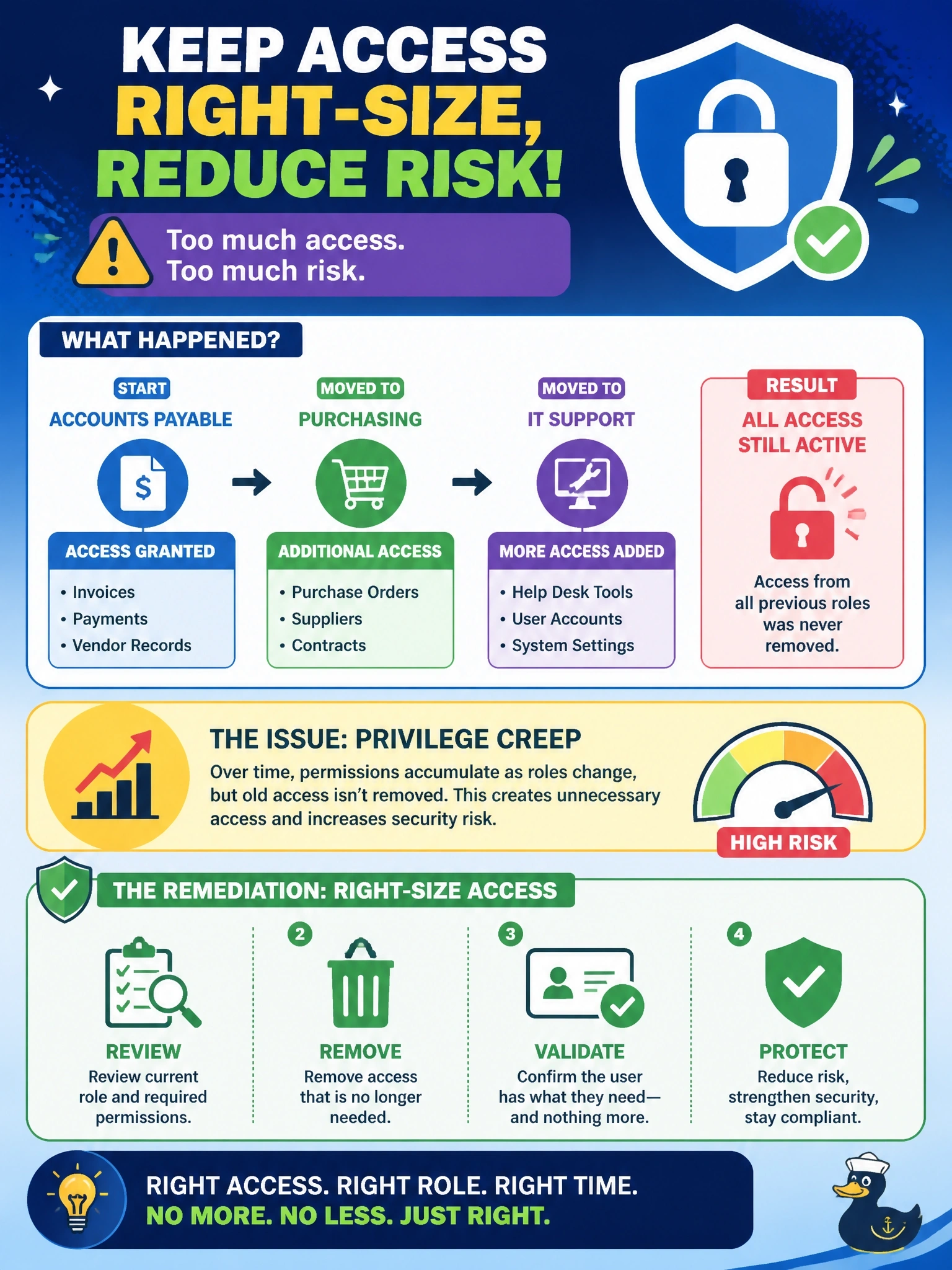
During a quarterly access review, an auditor finds that an employee who moved from accounts payable to purchasing and then to IT support still holds the permissions from all three roles. No permissions were removed at any transfer. Which issue does this BEST describe, and how should it be remediated?
Select an answer to reveal the explanation.
Short Explanation
Access is like keys on a keyring; if you never hand any back when you change jobs, you end up carrying keys to every office you've worked in. That's privilege creep, and the fix is trimming access to the current role. Don't confuse it with escalation; nobody hacked anything here, the access just piled up.
Full Explanation
Privilege creep is the gradual accumulation of access rights as a user changes roles or takes on temporary duties without previous permissions being removed. The employee now holds payables, purchasing, and support access together, which exceeds least privilege and can also create a separation-of-duties conflict, since the same person might initiate a purchase and approve its payment. The remedy is to compare current access with the requirements of the current role, remove everything else, and fix the transfer process so access is adjusted at each role change. Privilege escalation is an attack or exploit in which a user gains higher permissions than they were granted, typically through a vulnerability; these permissions were legitimately granted and simply never revoked, so there is nothing to patch. Shadow IT is the use of unapproved technology outside IT governance, which is unrelated to role-based entitlements accumulating in sanctioned systems. Stale credentials are accounts or secrets left active after they are no longer needed, such as accounts of departed employees, but this employee is still active and the account itself should remain enabled. Exam caveat: periodic access recertification catches creep, but prevention depends on role-based provisioning that changes access automatically during transfers. Operational check: have the employee's manager recertify access, remove the excess entitlements, and add a mover workflow that revokes old role access at each transfer.