
Executives want a messaging platform for board discussions with the requirement that the service provider itself must be unable to read message contents, even if its servers are compromised or it receives a legal demand. Which capability BEST satisfies this requirement?
Select an answer to reveal the explanation.
Short Explanation
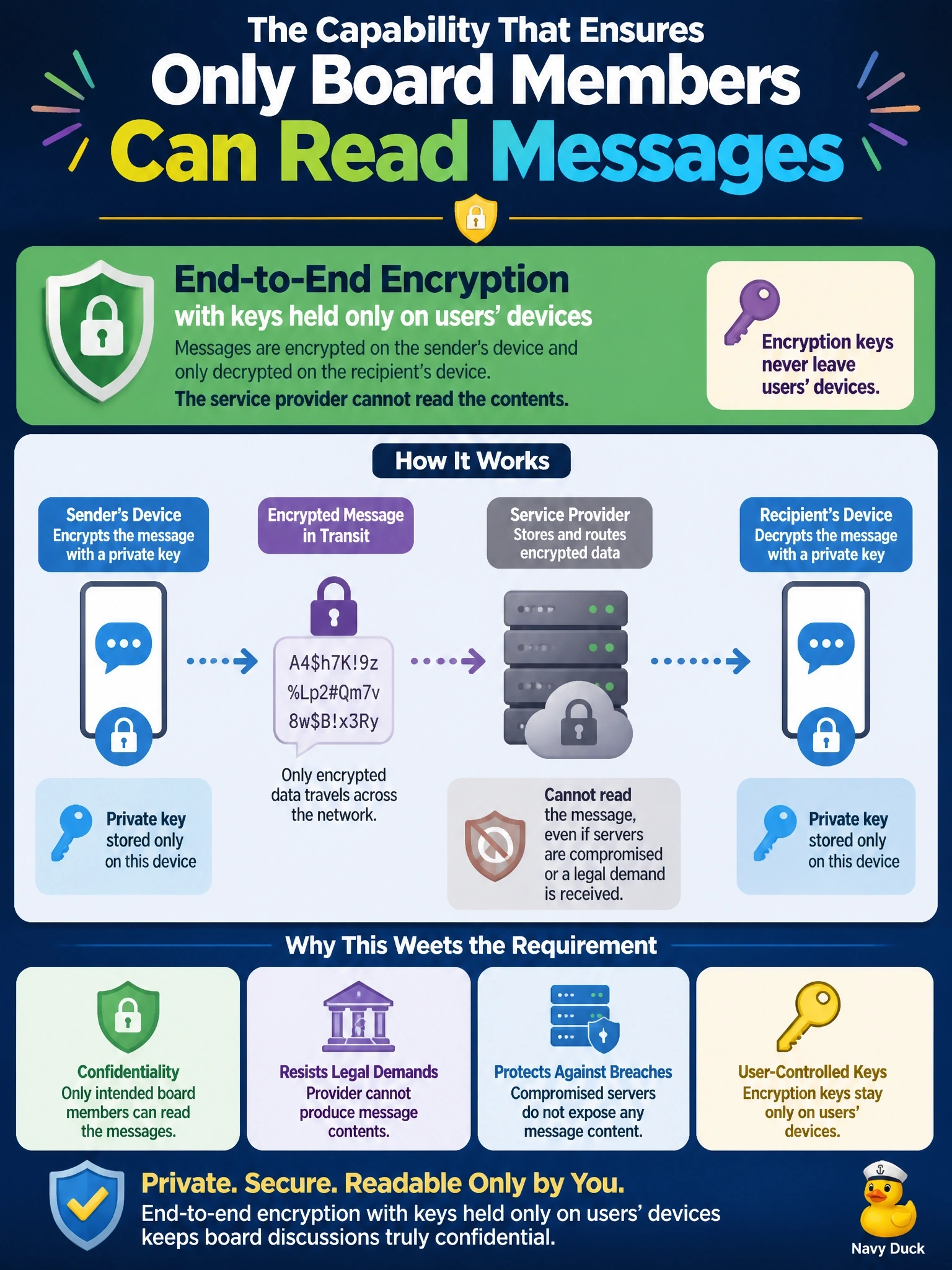
Transport encryption is a sealed envelope that the post office opens at the sorting center; end-to-end encryption means only you and the recipient have the letter opener. If the provider mustn't read it, the keys can't live with the provider. TLS is the trap; it protects the trip, not the stop in the middle.
Full Explanation
End-to-end encryption encrypts messages on the sender's device and decrypts them only on the recipients' devices, with the private keys generated and held on those endpoints. The provider relays and stores only ciphertext and has no key that can decrypt it, so neither a compromise of its servers nor a demand served on it exposes message content. That property is exactly what the executives require. TLS between each device and the provider protects messages in transit over the network, but the provider terminates the connection and handles the plaintext on its servers, so it can read messages. Provider-managed encryption at rest protects stored data if storage media are stolen, yet the provider controls the keys and can decrypt the data whenever its systems or staff need to, which also means an attacker who compromises the provider can potentially do the same. A VPN to the provider's network encrypts traffic in transit to the provider's edge, and like TLS it ends at infrastructure the provider controls. Exam caveat: end-to-end encryption protects message content but not necessarily metadata, such as who communicated with whom and when, and it shifts risk to the endpoints, which must be secured. Operational check: confirm the platform's key management keeps private keys on user devices, enable verification of contact keys, and enforce device security policies on executives' phones and laptops.