
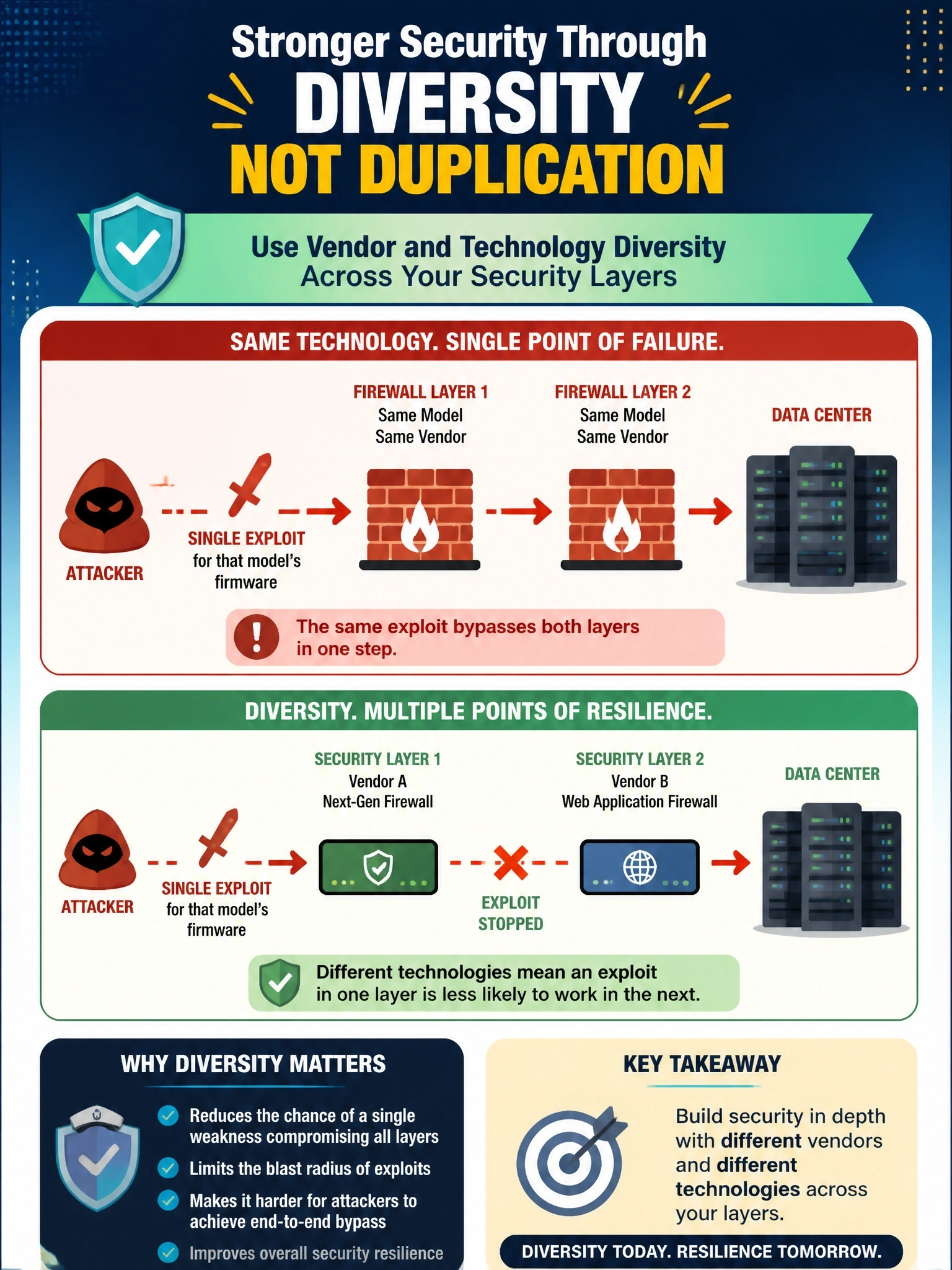
A company protects its data center with two layers of firewalls, both the same model from the same vendor. An attacker uses a single exploit for that model's firmware to bypass both layers in one step. Which architectural principle would MOST directly have reduced this risk?
Select an answer to reveal the explanation.
Short Explanation
If every lock in the house uses the same key, one stolen key opens them all. Mixing vendors means one exploit doesn't walk you through every layer. The trap is adding more of the same; three identical locks still share one weakness.
Full Explanation
Diversity is an infrastructure consideration in which an organization uses different vendors, products, or technologies across layers so that a single vulnerability or exploit cannot defeat every control at once. Defense in depth assumes that layers fail independently; identical devices share the same code base and the same flaws, so their failures are correlated and the second layer adds little against a model-specific exploit. Using a different vendor or technology for one of the layers would have forced the attacker to find and use a second, unrelated exploit. Adding a third firewall of the same model repeats the original problem, because the same exploit would bypass it as well. Consolidating to a single firewall simplifies patching but removes a layer entirely, so a single exploit would still give full access with even less resistance. Clustering the firewalls as a high-availability pair improves availability against hardware failure, but both members run the same software and present the same vulnerability, so the exploit affects the pair as a unit. Exam caveat: diversity increases operational cost and requires staff skilled in multiple platforms, so it is applied where independent failure is worth that cost. Operational check: identify layers that share a single vendor or code base, assess whether a common exploit could bypass them together, and introduce diversity at the most critical boundary.