
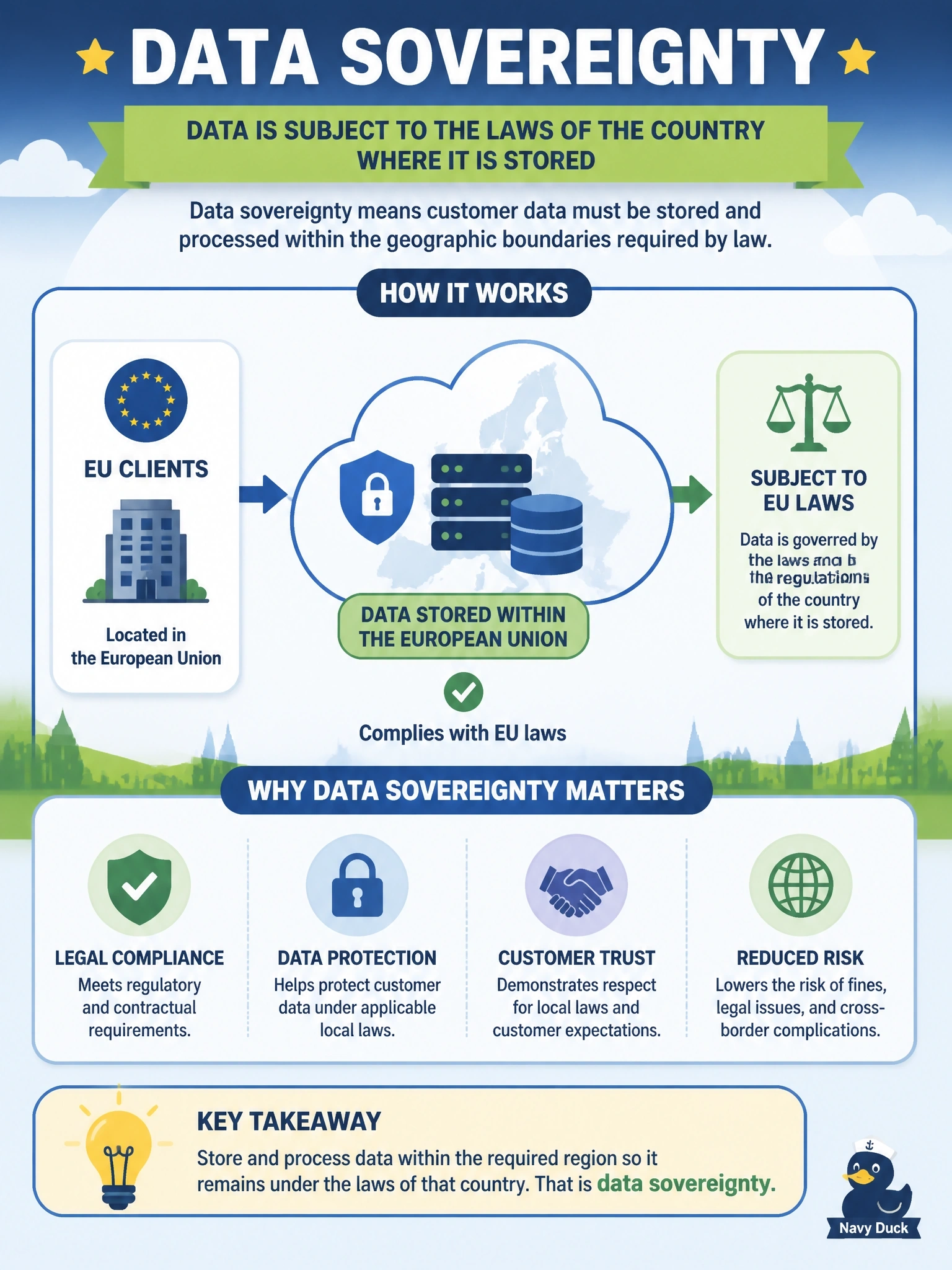
A software company plans to host customer data for European clients in a cloud platform. Its contracts require that this data remain within the European Union because it is subject to the laws of the country where it is stored. Which business consideration is driving this architectural constraint?
Select an answer to reveal the explanation.
Short Explanation
Data's like a traveler: wherever it's parked, that country's rules apply to it. When you're told the data has to stay inside a region because local law governs it there, that's data sovereignty. Ownership's the trap; who owns the data doesn't decide which country's law applies to it.
Full Explanation
Data sovereignty is the principle that data is subject to the laws and governmental authority of the jurisdiction in which it is physically stored. Organizations therefore constrain where data may reside to meet regulatory and contractual obligations, choosing cloud regions or facilities within the required jurisdiction and ensuring that backups, replicas, and support access do not move the data elsewhere. A requirement that European client data remain within the European Union because of the laws applying where it is stored is a direct expression of sovereignty. Scalability concerns the ability of an architecture to grow with demand; it can influence region choice for performance but does not create a legal obligation to keep data in a jurisdiction. Ownership identifies who holds rights and accountability for the data, such as the client or the company, and remains the same regardless of where the data is stored. Classification labels data by sensitivity to decide how it is handled, but a classification level does not by itself dictate which country's laws govern the data. Exam caveat: sovereignty constraints extend to replicas, disaster recovery sites, logs, and administrative access, which are often overlooked when only the primary storage location is checked. Operational check: pin storage and backup locations to approved regions, apply geographic restrictions in cloud policy, and verify where support personnel can access the data from.