
An online service runs entirely in one cloud region, spread across that region's availability zones. The business now requires the service to keep running and recover quickly even if the entire region becomes unavailable. Which architectural change BEST meets this requirement?
Select an answer to reveal the explanation.
Short Explanation
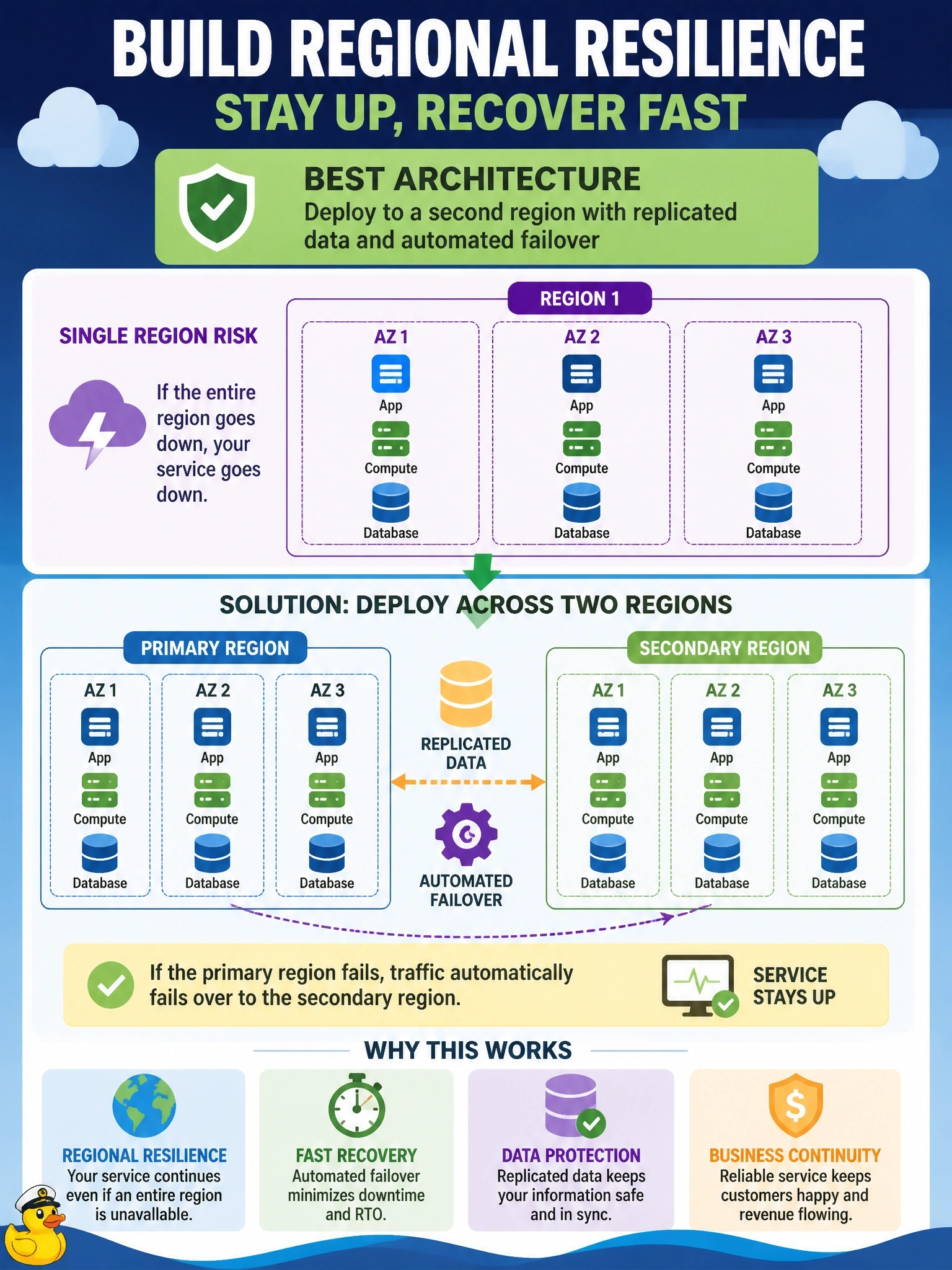
Spreading across zones is like putting your eggs in different cartons in the same fridge; if the fridge dies, so do the eggs. For a region-wide outage you need a second region with data already copied and failover ready. The zones answer is the trap, since it doesn't survive losing the whole region.
Full Explanation
Availability and ease of recovery are technical considerations that depend on the failure domain an architecture is designed to survive. Availability zones protect against the loss of an individual data center within a region, but they share regional dependencies. To tolerate the loss of an entire region, the service must run, or be able to start quickly, in a second region with data replicated there and an automated or well-rehearsed failover mechanism, which also keeps recovery time short. Adding more zones within the same region still leaves every component inside the failed region, so it does not address the stated failure scenario. Moving to larger instances increases compute capacity but does nothing for resilience; a bigger server in an unavailable region is still unavailable. Daily backups stored in the same region are lost or unreachable along with the region, and even if they were reachable, restoring from daily backups yields a long recovery time and up to a day of data loss. Exam caveat: multi-region designs raise cost and complexity, including data replication consistency and data sovereignty constraints, so the requirement must justify them. Operational check: define the target recovery time and recovery point, configure cross-region replication, and run a failover exercise that simulates the loss of the primary region.