
A security review finds that customer-service staff routinely paste full customer records, including names, account numbers, and support histories, into a free public AI chatbot to draft replies. The organization has no agreement with the chatbot provider. Which AI-related risk is MOST directly created by this practice?
Select an answer to reveal the explanation.
Short Explanation
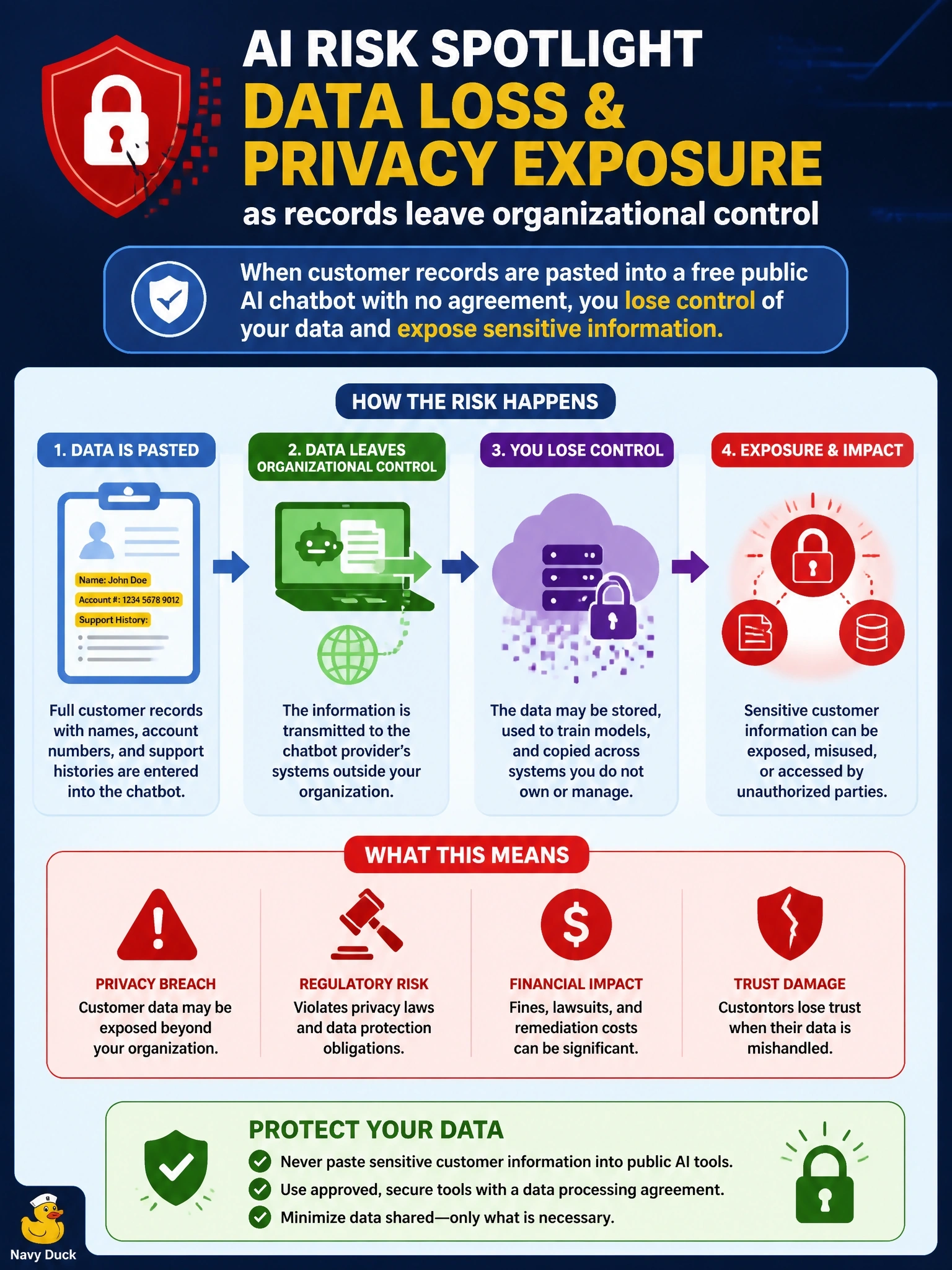
Once you paste customer data into somebody else's AI tool, you've basically mailed it to a stranger and hoped for the best. That's data loss and a privacy problem. Don't overthink it toward poisoning; the staff aren't attacking the model, they're leaking your data into it.
Full Explanation
Using a public AI service without a contractual agreement means submitted content leaves the organization's control. The provider may store prompts, use them to improve its models, or expose them through its own security failures, and the organization has no assurance about retention, location, or access. Pasting personal and account data therefore creates data loss and privacy exposure, potentially breaching privacy obligations and customer commitments. Poisoning requires corrupting training data with intent to alter model behavior; staff submitting ordinary records are not trying to manipulate the model, and the organization's harm comes from disclosure, not from the provider's model changing. Hallucination is a quality and accuracy risk in which the model invents content; it may affect the replies, but it is not the risk created by submitting the data. Bias concerns systematically unfair outputs toward particular groups, which is not indicated by anything in the scenario and is unrelated to where customer records end up. Exam caveat: this risk is primarily addressed through governance, including acceptable-use policy and approved enterprise AI services with contractual data protections, supported by technical controls rather than replaced by them. Operational check: block or monitor unapproved AI services with DLP and web filtering, provide an approved tool with data-handling terms, train staff, and assess whether disclosed records trigger notification duties.