
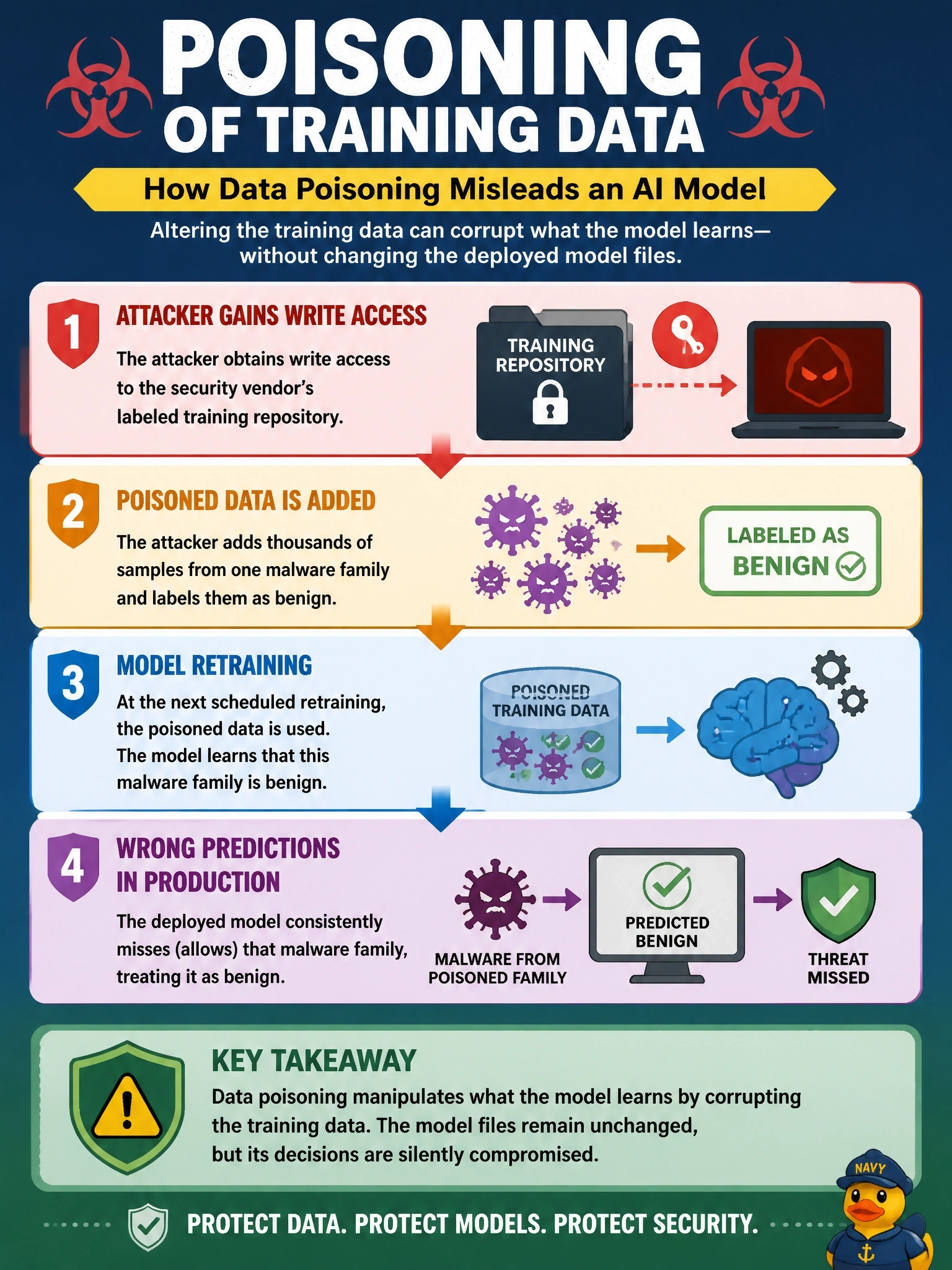
An attacker with write access to a security vendor's labeled training repository adds thousands of samples from one malware family labeled as benign. After the next scheduled retraining, the vendor's classifier consistently misses that family, although the deployed model files were never directly altered. Which AI threat occurred?
Select an answer to reveal the explanation.
Short Explanation
If you teach a guard dog that burglars are friends, don't be surprised when it wags at them. Slipping mislabeled samples into the training set is poisoning. Evasion's the tempting trap, but evasion tweaks the input at run time; it doesn't corrupt what the model learned.
Full Explanation
Poisoning attacks target the training pipeline: an adversary inserts or modifies training data so that the resulting model learns behavior the attacker wants. Mislabeling malware from one family as benign teaches the classifier to treat that family as safe, and the effect appears after retraining even though nobody touched the deployed model files directly. The attacker's foothold was write access to the labeled repository, which makes data integrity and provenance central controls. Evasion attacks leave the model and its training data untouched and instead modify individual inputs at inference time, such as altering a malware sample just enough to be misclassified; here the change happened upstream in the data. Prompt injection affects language models that follow natural-language instructions embedded in their input, and a binary malware classifier does not interpret instructions inside samples. Hallucination describes a generative model producing plausible but false content, which is unrelated to a classifier systematically missing a family because of corrupted labels. Exam caveat: poisoning can be subtle, affecting only a targeted class while overall accuracy metrics look normal, so aggregate testing may not reveal it. Operational check: restrict and audit write access to training repositories, validate label provenance, compare retrained model performance against a trusted holdout set per class, and retain known-good datasets for rollback.