
During an inspection at a fuel station, technicians find thin overlay devices fitted over the card readers at several pumps. The overlays read the magnetic stripe of each card inserted. Which physical attack is this?
Select an answer to reveal the explanation.
Short Explanation
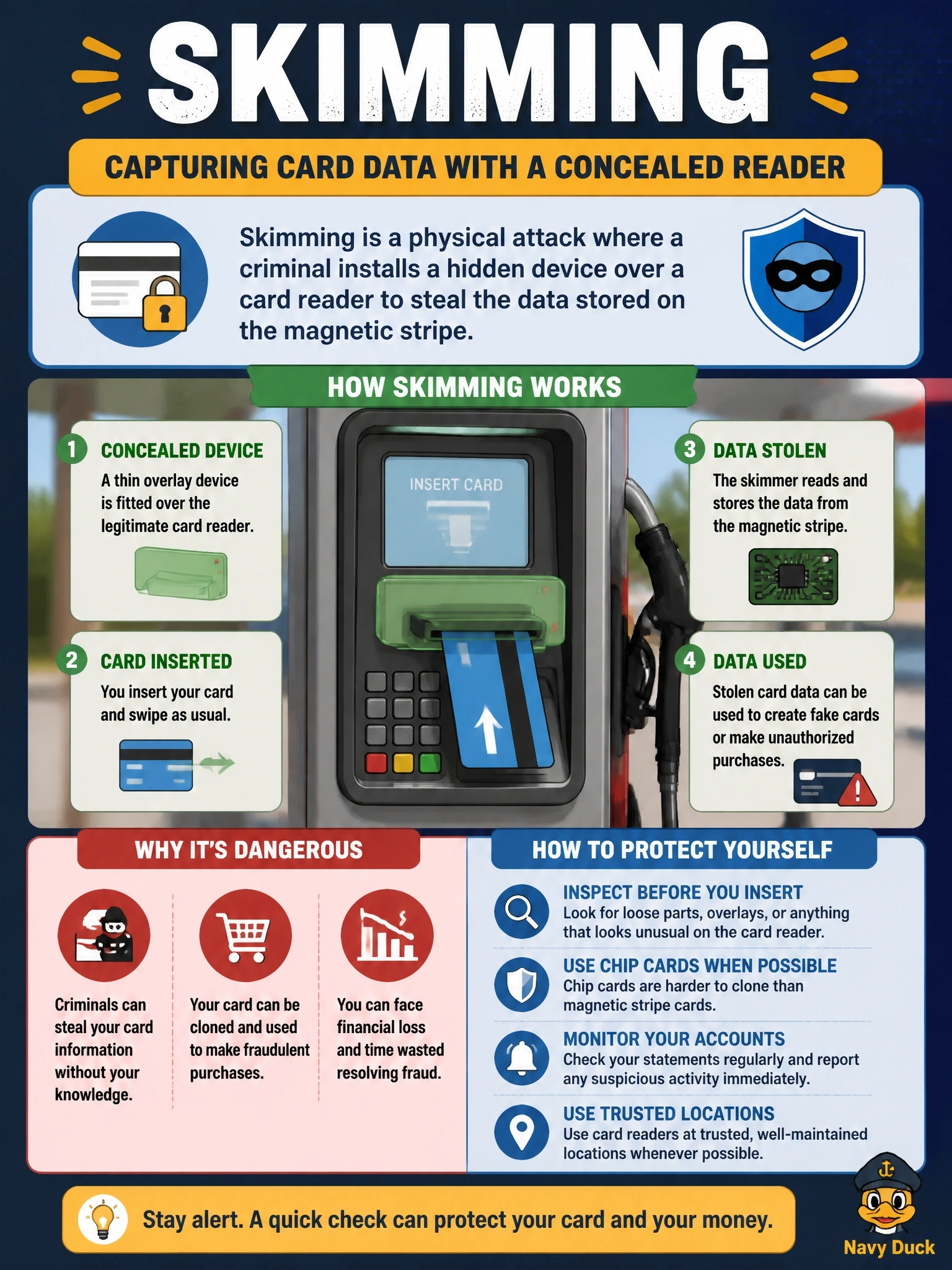
A skimmer is a fake front door bolted onto the real one -- you swipe your card, it reads a copy, then passes you through like nothing happened. Overlays on card readers are the giveaway. Don't confuse it with shoulder surfing, which is somebody just watching.
Full Explanation
Skimming is a physical attack in which a concealed device captures payment card data, typically by reading the magnetic stripe as the card passes through an overlay or an internal device fitted to a legitimate reader. Skimmers are commonly placed on unattended terminals such as fuel pumps and cash machines, and the captured data is used to create cloned cards or commit fraud. Tailgating is following an authorized person through a controlled entrance without using one's own credentials; it concerns physical access to a space, not data capture at a terminal. Shoulder surfing is observing someone's screen or keypad to learn information such as a PIN or password; it involves watching, not a device reading the card. Forced entry means breaking locks, doors or windows to gain access to a facility; while an attacker may need brief access to the pump to fit an overlay, the attack described is the data capture, not a break-in. Exam caveat: skimmers are often paired with a hidden camera or keypad overlay to capture the PIN, but the card-reading device itself is what defines skimming. Operational check: remove and preserve the overlays for law enforcement, inspect all pumps, apply tamper-evident seals, schedule regular physical inspections of terminals, and notify the card processor so it can monitor affected cards.