
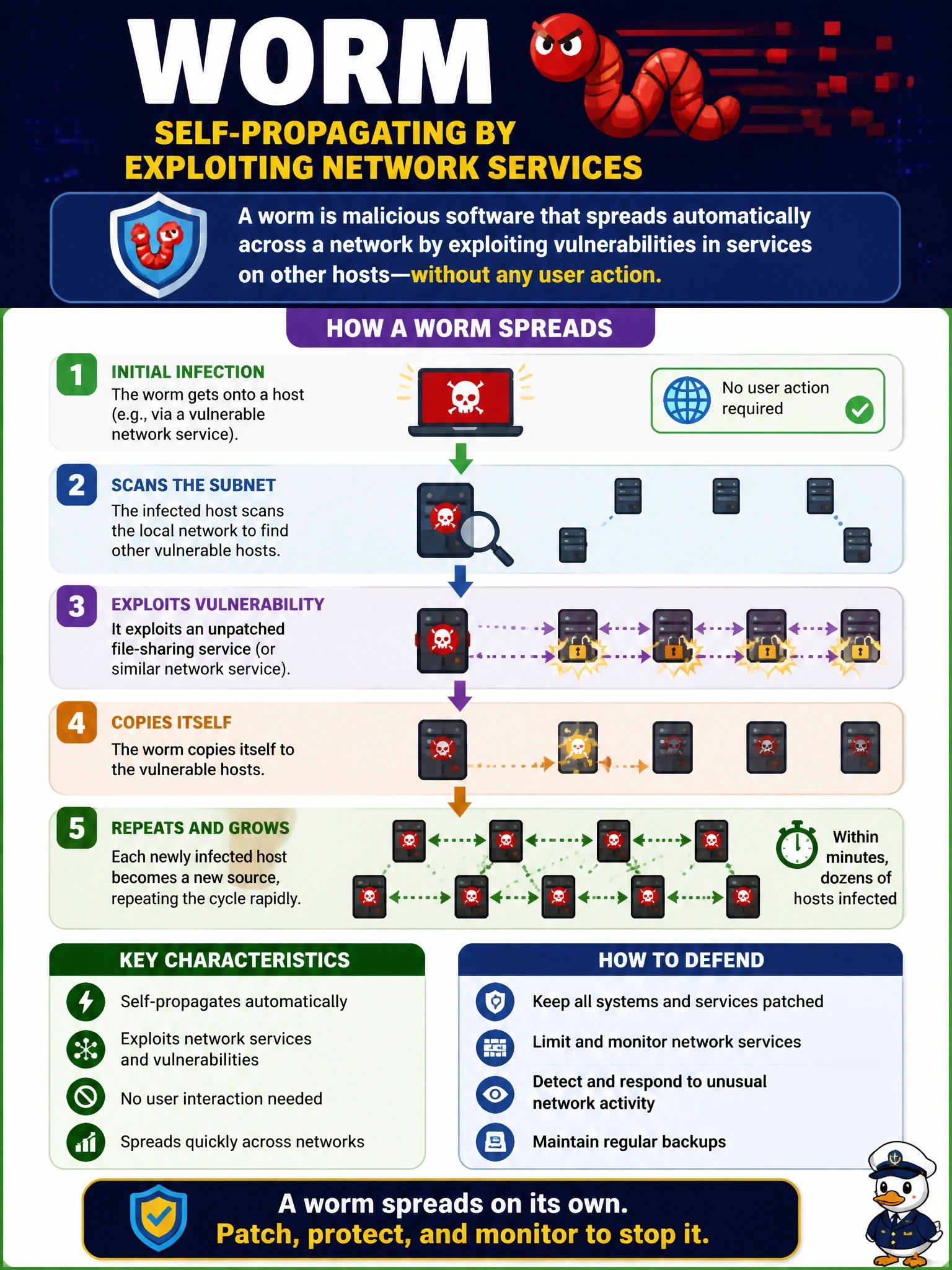
Within an hour, malware appears on dozens of servers. No user opened an attachment or ran a file. Each infected host scans its subnet and exploits an unpatched file-sharing service on other hosts to copy itself. Which malware type is this?
Select an answer to reveal the explanation.
Short Explanation
No clicks, no users, just machines infecting machines -- that's a worm. It brings its own legs: scan, exploit, copy, repeat. If you see spread with zero human help, rule out trojans and viruses, because both need somebody to run something.
Full Explanation
A worm is self-replicating malware that spreads without user interaction, typically by scanning for reachable systems and exploiting a vulnerable network service to copy itself onto them. Rapid spread across many hosts, subnet scanning from infected machines and exploitation of an unpatched service are its key indicators. A trojan disguises itself as legitimate software and depends on a user installing or running it; it does not normally replicate itself to other hosts, and the scenario states that no user ran anything. A virus attaches to files or programs and spreads when users execute or share infected files, which again requires user action that did not occur. Adware is distributed through bundled installers and displays unwanted advertising, so it neither spreads automatically nor exploits network services. Exam caveat: a single attack can combine types, for example a trojan that drops a worm, so identify the type from the behavior described. Operational check: isolate affected segments, block the exploited service's port between subnets, patch the vulnerable service on all remaining hosts, and use the scanning activity in network logs to identify every infected machine.