
A company connects an internal LLM assistant to its HR, finance and email systems so staff can ask questions across them. All of its applications also rely on a single identity provider for SSO. Which statement best describes how these choices affect the attack surface?
Select an answer to reveal the explanation.
Short Explanation
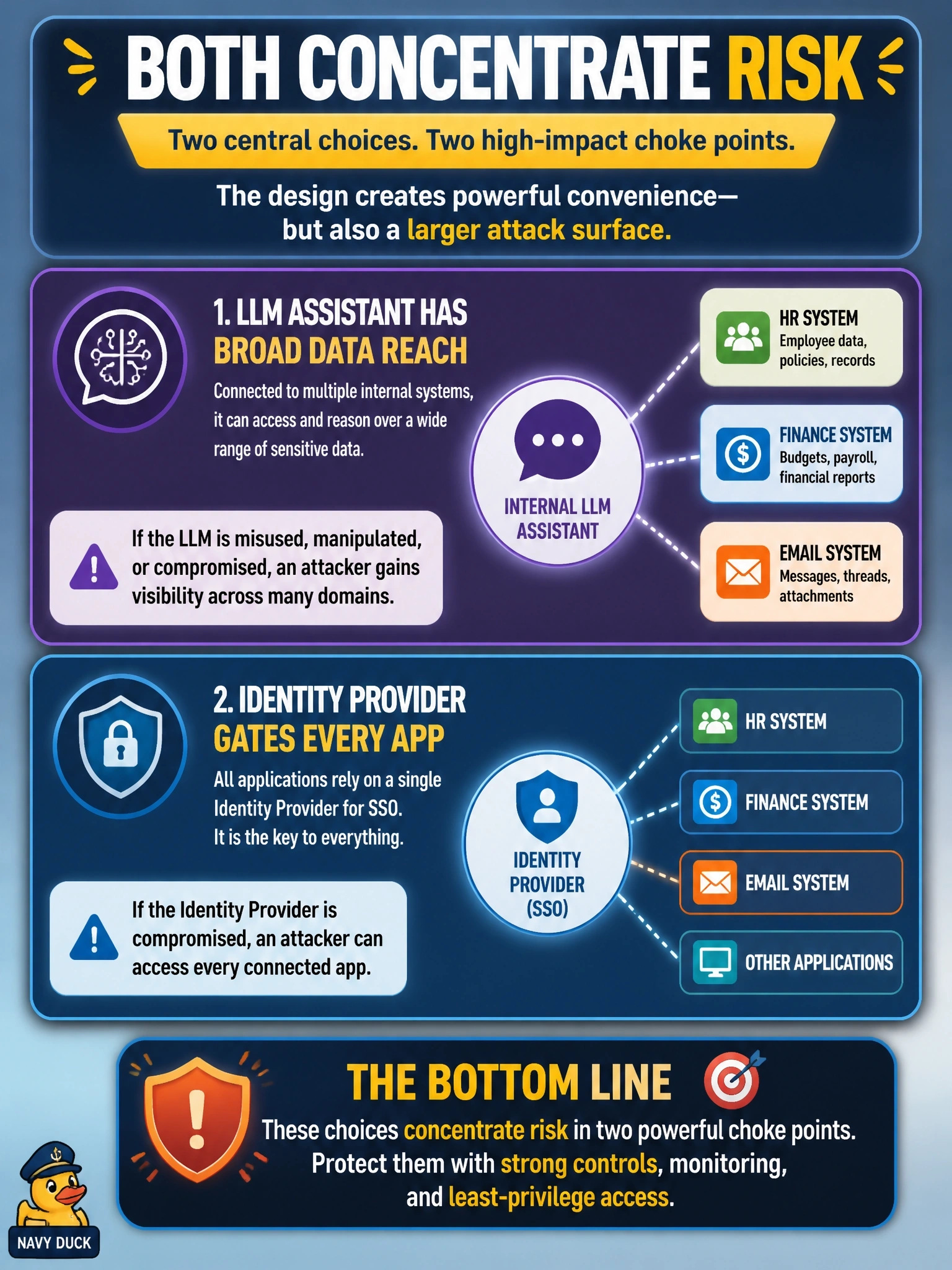
Think of both as master keys. An assistant wired into HR, finance and email can be tricked into fetching things it shouldn't, and one identity provider means one compromise unlocks everything. You don't avoid them -- you guard them like the crown jewels they've become.
Full Explanation
Large language models and identity providers are both listed as attack surfaces because each concentrates access. An LLM assistant connected to several business systems can retrieve and summarize data from all of them, so prompt injection, excessive permissions or weak output controls can expose information across HR, finance and email in a single interaction. An identity provider used for single sign-on authenticates users to every application, so its compromise, misconfiguration or abuse of its tokens grants access to everything that trusts it. Claiming neither adds risk because tools sit behind a perimeter firewall ignores insider misuse, compromised accounts and the fact that attackers target exactly these trusted internal components. Saying single sign-on removes credential attacks is incorrect; it reduces password sprawl but makes the identity provider credentials and session tokens more valuable. Saying an LLM cannot reach data it was not trained on overlooks connectors and retrieval features, which give the model live access to data that was never part of training. Exam caveat: concentration is acceptable when paired with strong controls; the aim is protection, not avoidance. Operational check: give the assistant least-privilege, per-user permissions on connected systems, enforce phishing-resistant MFA and conditional access on the identity provider, and monitor both for anomalous use.