
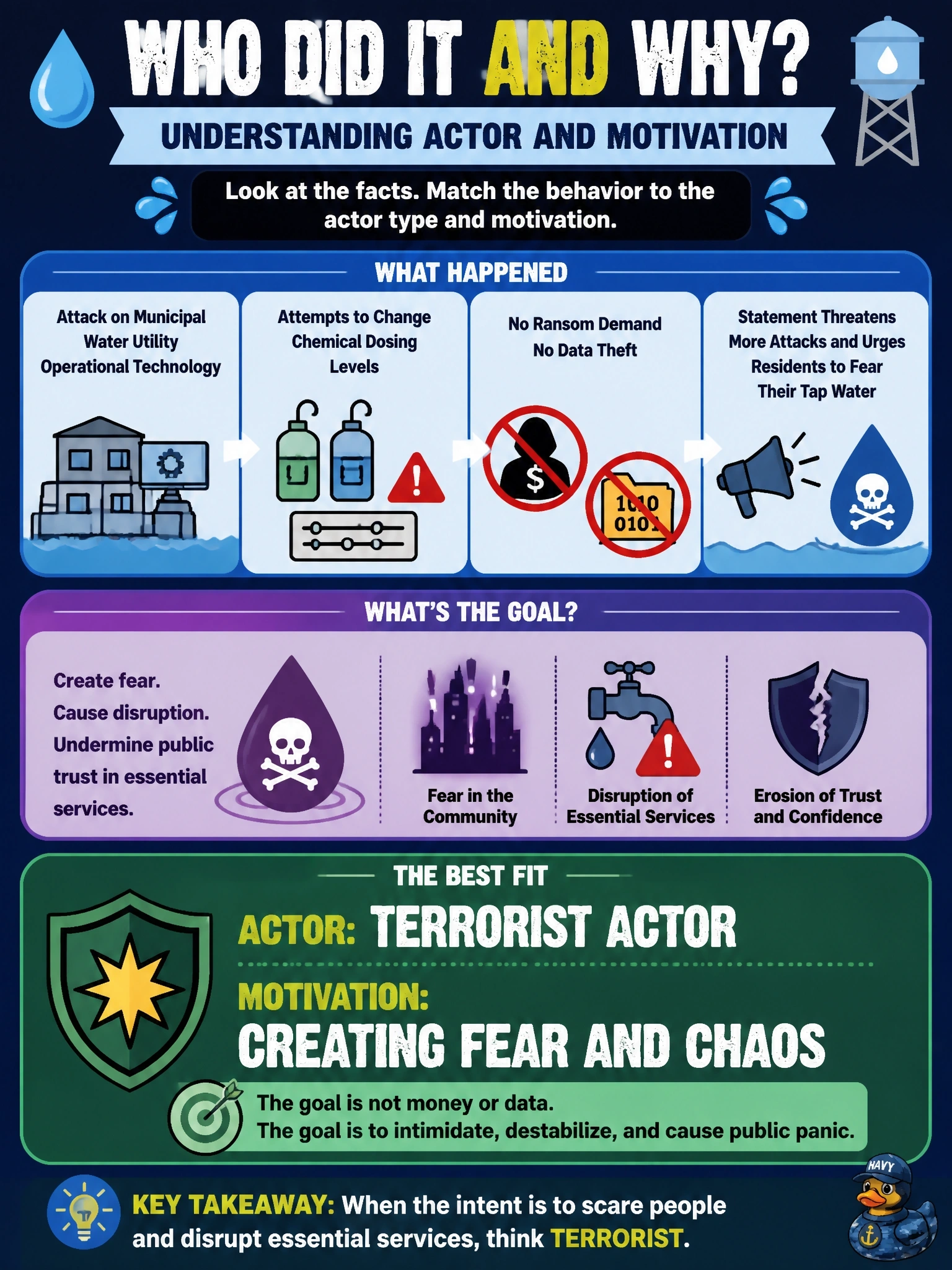
An attack on a municipal water utility's operational technology attempts to change chemical dosing levels. There is no ransom demand and no data theft. The group's statement threatens more attacks and urges residents to fear their tap water. Which actor and motivation best fit?
Select an answer to reveal the explanation.
Short Explanation
When the goal is scaring the public and the target can physically hurt people, you're not looking at a business deal. Messing with dosing levels and then threatening residents is about fear and chaos. That's the terrorist profile, and that's why OT security is a safety issue, not just an IT issue.
Full Explanation
Terrorist actors use violence or the threat of harm to create fear, disruption and pressure on the public or government. Attacks on operational technology at critical infrastructure such as water treatment can cause physical harm, which makes them attractive to actors seeking fear and chaos. The scenario combines a safety-relevant manipulation, no financial demand, no data theft and a public message intended to frighten residents, matching that actor and motivation. A crime syndicate seeks money, so it would pair disruption with a ransom demand or sell access; the absence of any payment request removes that fit. A competitor wants intellectual property or market advantage, and a public utility's attackers who take no data and threaten residents gain nothing commercial. An unskilled attacker driven by curiosity might stumble into an exposed control interface, but would not issue statements threatening further attacks to frighten the public. Exam caveat: hacktivists can also target infrastructure, but the stated intent to make residents fear for their safety points to fear and chaos rather than ideological messaging. Operational check: switch affected processes to manual control, verify chemical levels with independent sampling, isolate OT networks from remote access, and notify the authorities and sector reporting bodies.