
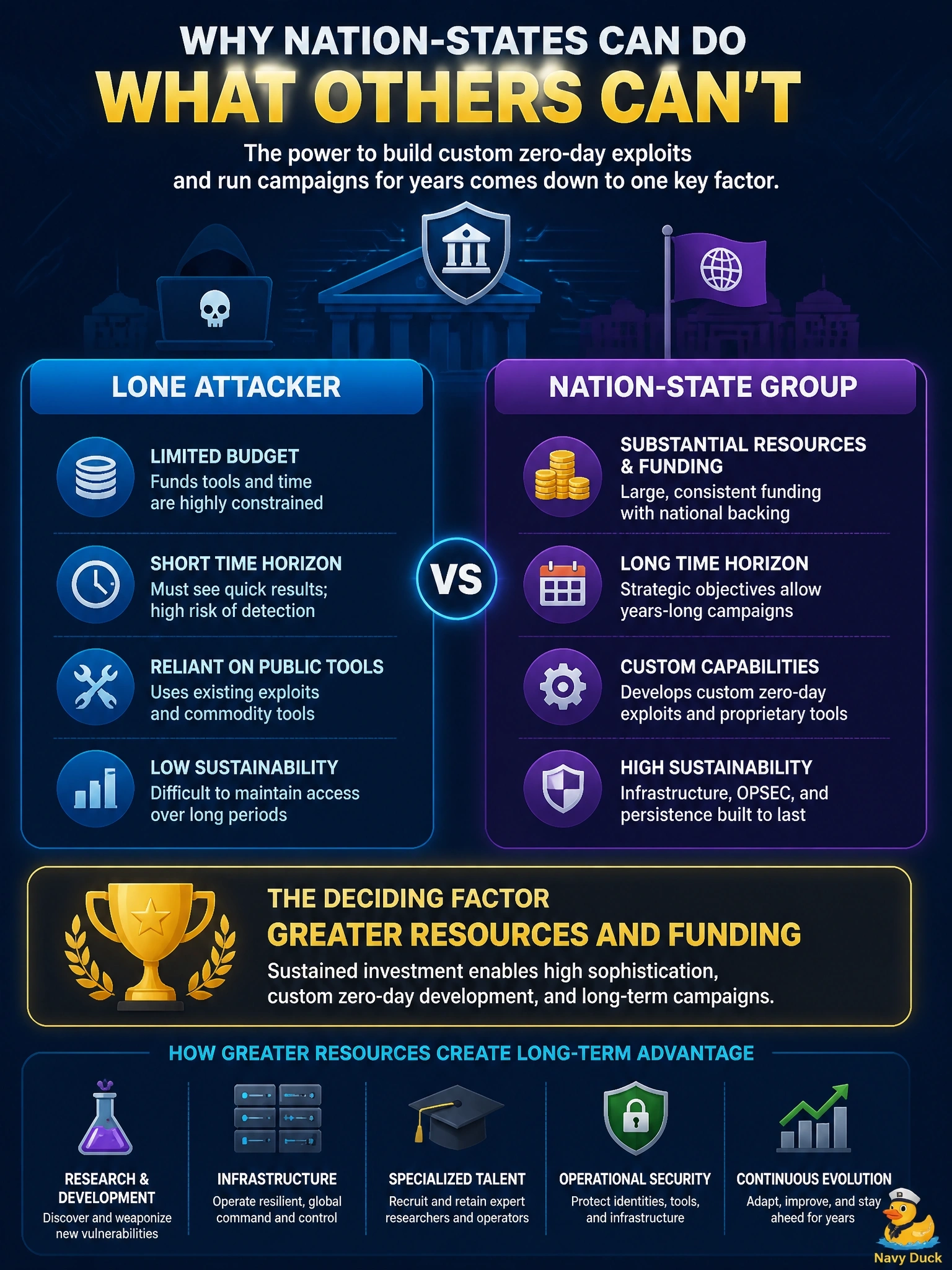
A bank's threat model compares a lone attacker with a nation-state group. Which actor attribute most directly explains why the nation-state can develop custom zero-day exploits and sustain a campaign for years?
Select an answer to reveal the explanation.
Short Explanation
Think of it like a garage tinkerer versus a funded research lab. Both might be clever, but only the lab can pay a team to hunt for new exploits and keep a project running for years. When you compare actors, remember that money and staff are what buy sophistication and staying power.
Full Explanation
Threat actors are commonly compared on three attributes: whether they are internal or external, the resources and funding available to them, and their level of sophistication and capability. Discovering or buying zero-day exploits, writing custom tooling and maintaining infrastructure over years requires substantial staff, time and money. A nation-state group has those resources, which is why it can sustain high sophistication across long campaigns, while a lone attacker is limited by personal time and budget. Internal position describes whether the actor already has authorized access; a foreign nation-state is normally an external actor, so that attribute does not explain its capability. Ethical motivation applies to actors such as authorized testers or researchers acting in good faith, which is a statement about motive, not about the capacity to fund a multi-year operation. General curiosity is a motivation associated with hobbyists and explains why someone might probe a system, not how they could develop and sustain advanced capabilities. Exam caveat: do not confuse attributes, which describe capability and position, with motivations, which describe why the actor attacks. Operational check: map each actor in the threat model to all three attributes and use them to calibrate which controls and detection depth are required.