
A developer minifies and renames the variables in a web app's client-side JavaScript to make it harder to reverse engineer. A manager then describes the code as encrypted. Which statement is accurate?
Select an answer to reveal the explanation.
Short Explanation
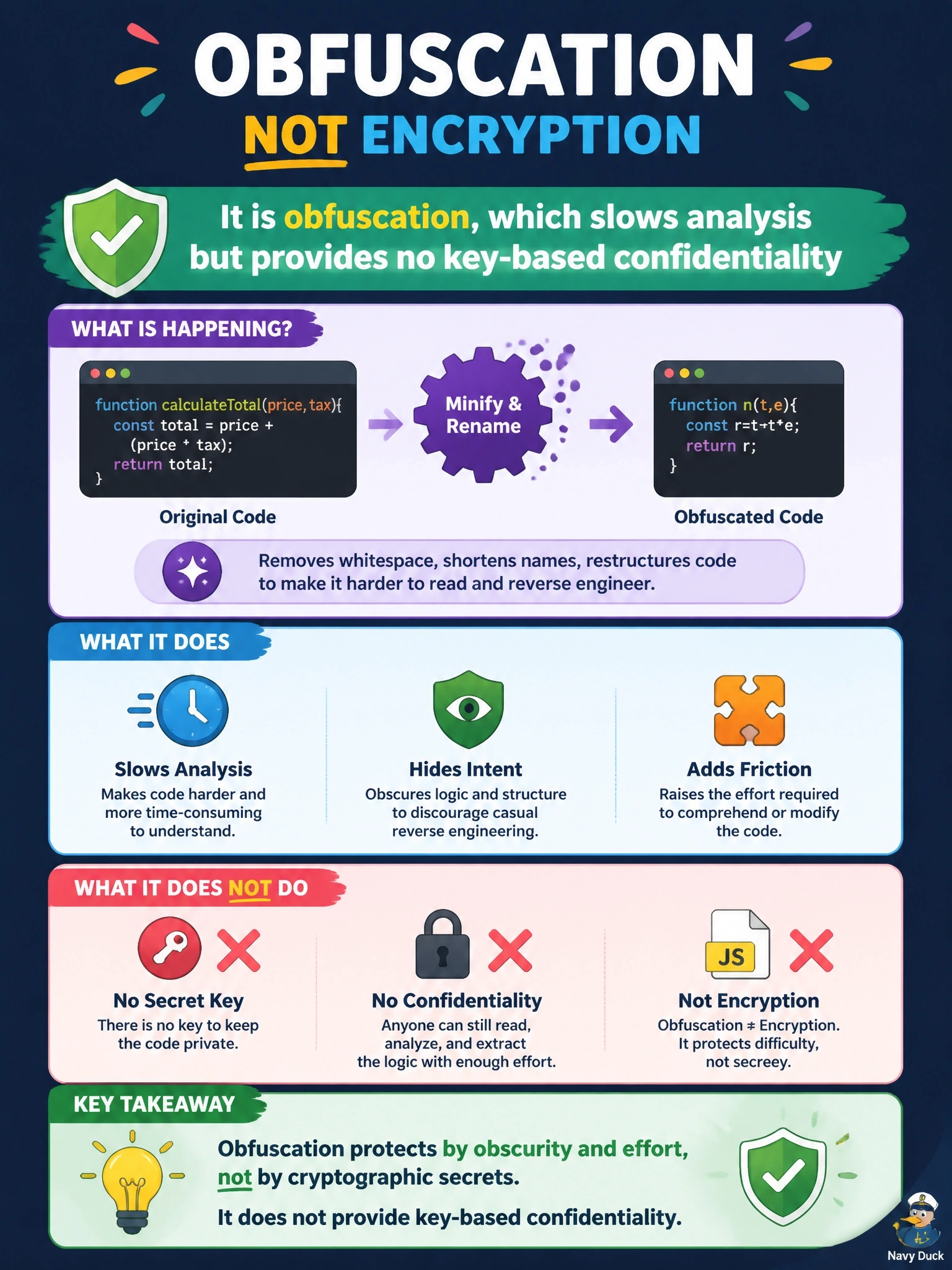
Obfuscation is like writing in messy handwriting. It slows a reader down, but anybody patient enough can still read it. There's no key involved, so if you hear somebody call it encryption, you know they've taken the bait.
Full Explanation
Obfuscation transforms code or data to make it harder for humans to understand while preserving its function. Minification, renaming variables, and restructuring logic all increase the effort needed to reverse engineer JavaScript, but the browser must still execute the code, so the logic remains fully available to anyone who studies it or uses deobfuscation tools. There is no secret key, and the original intent can be reconstructed. Encryption requires a key and produces ciphertext that cannot be executed or understood without decryption; client-side code delivered in encrypted form would be useless to the browser unless the key were also delivered, which would defeat the purpose. Hashing is one-way and produces a fixed-length digest; hashed code could not run at all, and minified code clearly still runs. Tokenization replaces sensitive data values with surrogate tokens mapped in a secure vault; it applies to data such as card numbers, not to program identifiers in source code. Exam caveat: obfuscation is a deterrent against casual analysis and should never be relied upon to protect secrets such as API keys embedded in client code. Operational check: scan client-side bundles for embedded secrets, move sensitive logic and credentials to the server, and treat any obfuscated client code as readable by attackers.