
Two systems that have never communicated before must agree on a symmetric session key over an untrusted network without ever transmitting the key itself. Which technique accomplishes this?
Select an answer to reveal the explanation.
Short Explanation
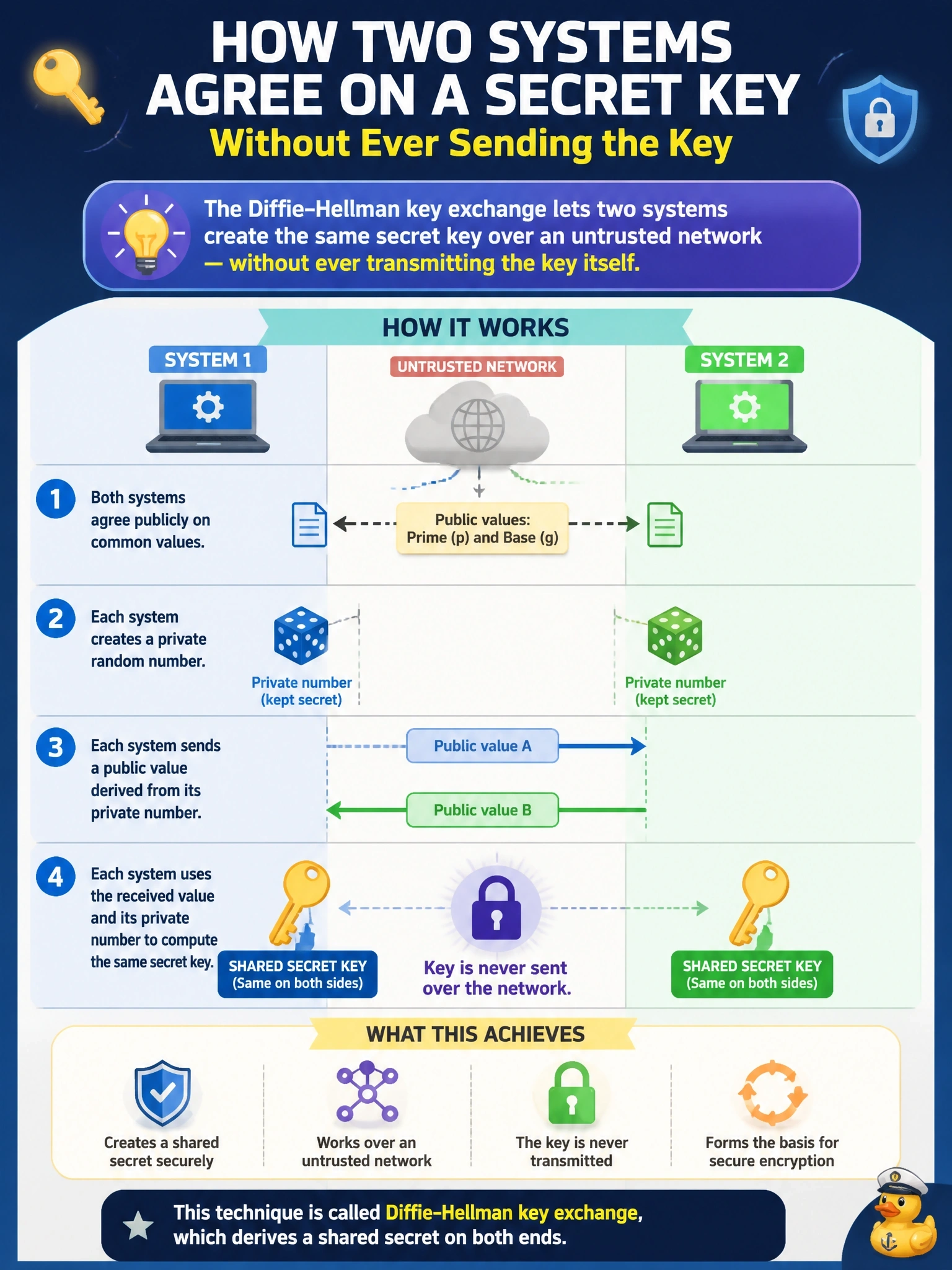
Diffie-Hellman is a neat trick: two people shout numbers across a crowded room, and somehow they both end up with the same secret nobody else heard. You never send the key itself. Hashing or self-encrypting it sounds clever, but neither works.
Full Explanation
Key exchange protocols allow two parties to establish a shared secret over an insecure channel. In Diffie-Hellman, each side generates a private value and sends a derived public value; combining its own private value with the other side's public value produces the same shared secret on both ends, while an eavesdropper who sees only the public values cannot feasibly compute it. The shared secret is then used to derive symmetric session keys. Modern protocols such as TLS use ephemeral variants so that each session has fresh keys, which supports forward secrecy. Hashing a key and sending the hash does not deliver a usable key; the receiver cannot reverse the hash, and if the receiver could derive the key some other way, the hash adds nothing. Encrypting a key with itself is circular, since the recipient needs the key to decrypt the very value that contains it. A salted hash of hostnames is predictable, because hostnames are public and the salt would also need to be shared, so an attacker could compute the same key. Exam caveat: asymmetric methods establish the key, and symmetric algorithms then protect the bulk traffic; expect questions that test this division. Operational check: confirm that TLS configurations prefer ephemeral key exchange suites, and review handshake details with a scanning tool to verify that static key exchange is disabled.