
An administrator must encrypt a very large nightly backup file quickly before sending it to an offsite storage provider. Which approach is MOST appropriate for encrypting the bulk data?
Select an answer to reveal the explanation.
Short Explanation
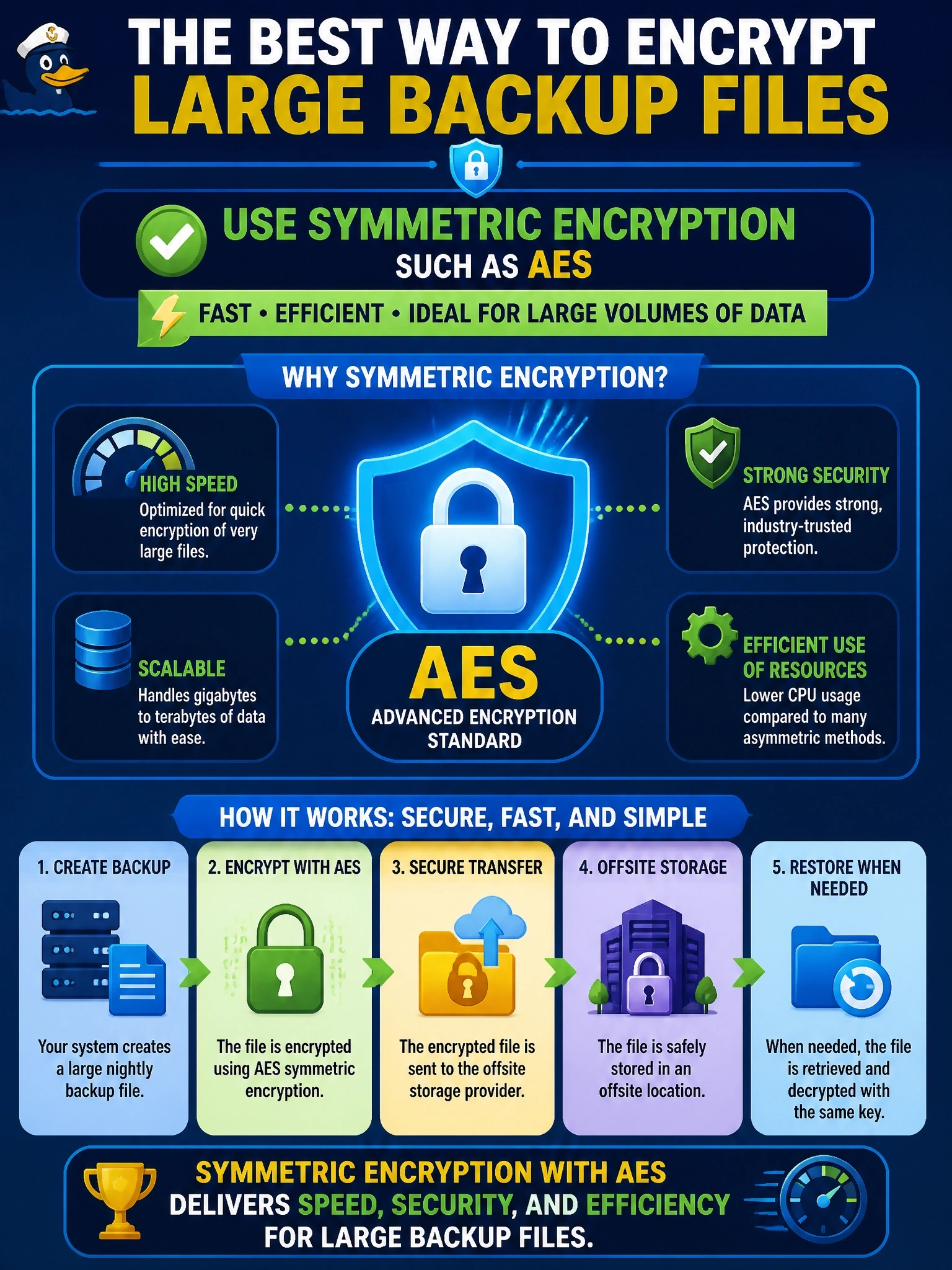
Symmetric encryption is the freight truck, and asymmetric is the armored car for small valuables. When you're hauling a huge backup, you take the truck. And don't let hashing or Base64 fool you; neither one is encryption.
Full Explanation
Symmetric algorithms such as AES use a single shared key for encryption and decryption and are designed for high throughput, often with hardware acceleration in modern processors. They are the standard choice for bulk data like backups, disk volumes, and network sessions. The symmetric key itself can then be protected with asymmetric encryption or stored in a key management system, which is how hybrid cryptosystems combine speed with convenient key distribution. Applying RSA directly to an entire file is impractical; asymmetric operations are far slower and are limited in how much data they can process at once, which is why they are used for key exchange and signatures rather than bulk encryption. Hashing produces a fixed-length digest that cannot be reversed to recover the original data, so it provides integrity checking, not confidentiality, and the backup would be unrecoverable. Base64 is an encoding scheme with no key; anyone can decode it instantly, so it offers no protection at all. Exam caveat: speed and bulk data point to symmetric encryption, while key exchange, digital signatures, and identity point to asymmetric. Operational check: confirm the backup software uses an approved symmetric cipher and key length, verify where the encryption key is stored and that it is not kept alongside the backup, and test that the encrypted backup can be restored.