
The change advisory board is reviewing a request to roll out a new endpoint agent to all workstations. Board members want evidence that the agent will not break line-of-business applications before they approve production deployment. What should the requester provide?
Select an answer to reveal the explanation.
Short Explanation
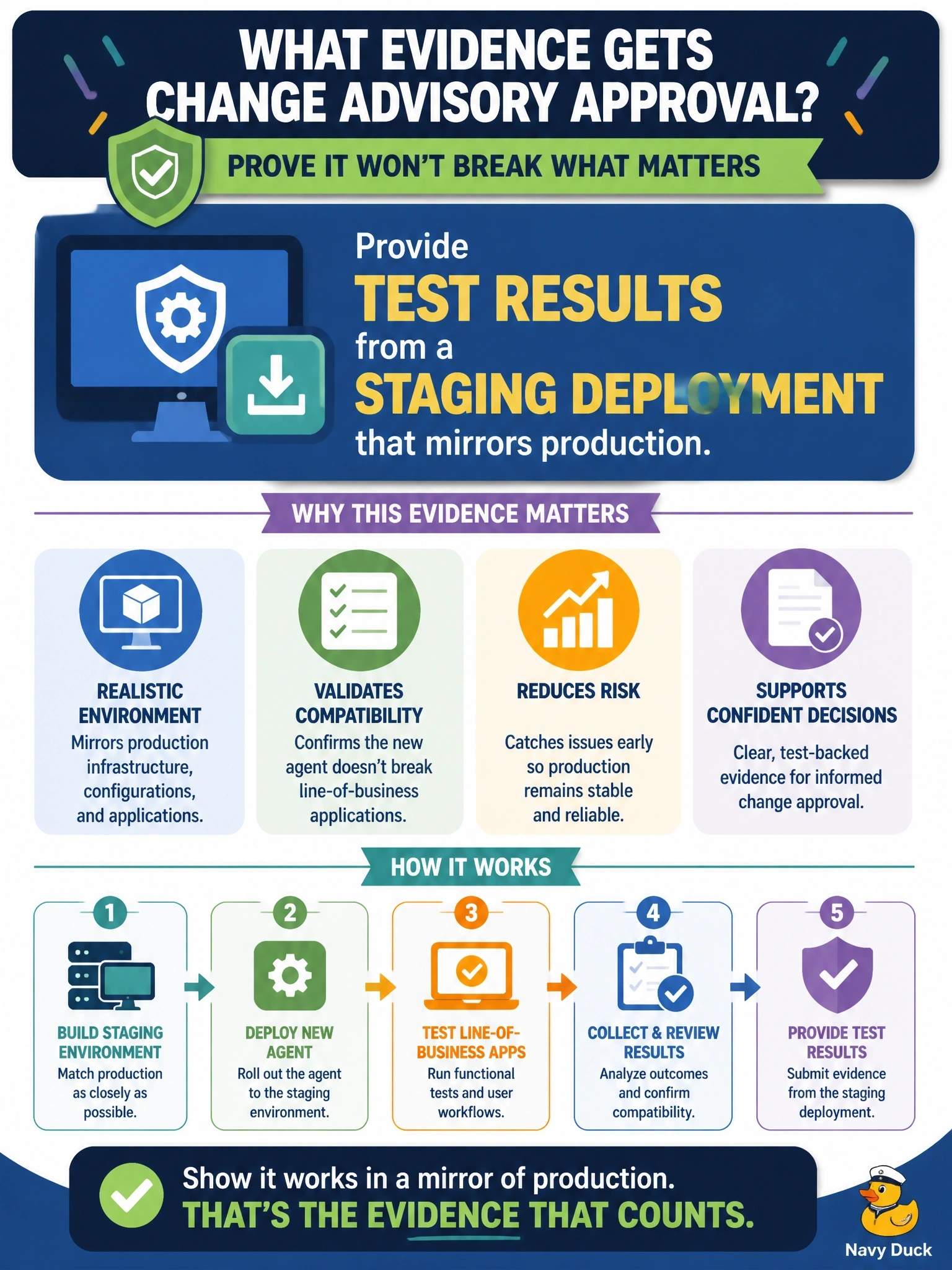
The board's basically saying, "Show me it works before you put it everywhere." Only real test results from a lookalike environment answer that. A backout plan is your parachute, and a parachute doesn't prove the plane flies.
Full Explanation
Test results provide evidence that a change behaves as intended and does not disrupt existing systems. Deploying the endpoint agent in a staging environment configured like production, with representative operating systems and line-of-business applications, lets the team observe conflicts, performance effects, and compatibility issues before approval. The CAB can then weigh actual outcomes rather than assumptions. A backout plan is required for most changes, but it explains how to recover if the agent causes problems; it does not demonstrate that problems will not occur. A vendor datasheet lists supported platforms in general terms and cannot account for the organization's specific application mix, custom software, or other security tools that may conflict. A maintenance window schedule defines when the rollout will happen and how downtime will be managed; timing does not prove compatibility. Exam caveat: test results, backout plans, and maintenance windows are all inputs to CAB approval, and stems usually emphasize one need, such as proof of success, recovery if it fails, or minimizing business disruption. Operational check: document the staging configuration, list the applications tested with pass or fail results, attach logs of any conflicts found and resolved, and consider a phased pilot group in production before full deployment.