
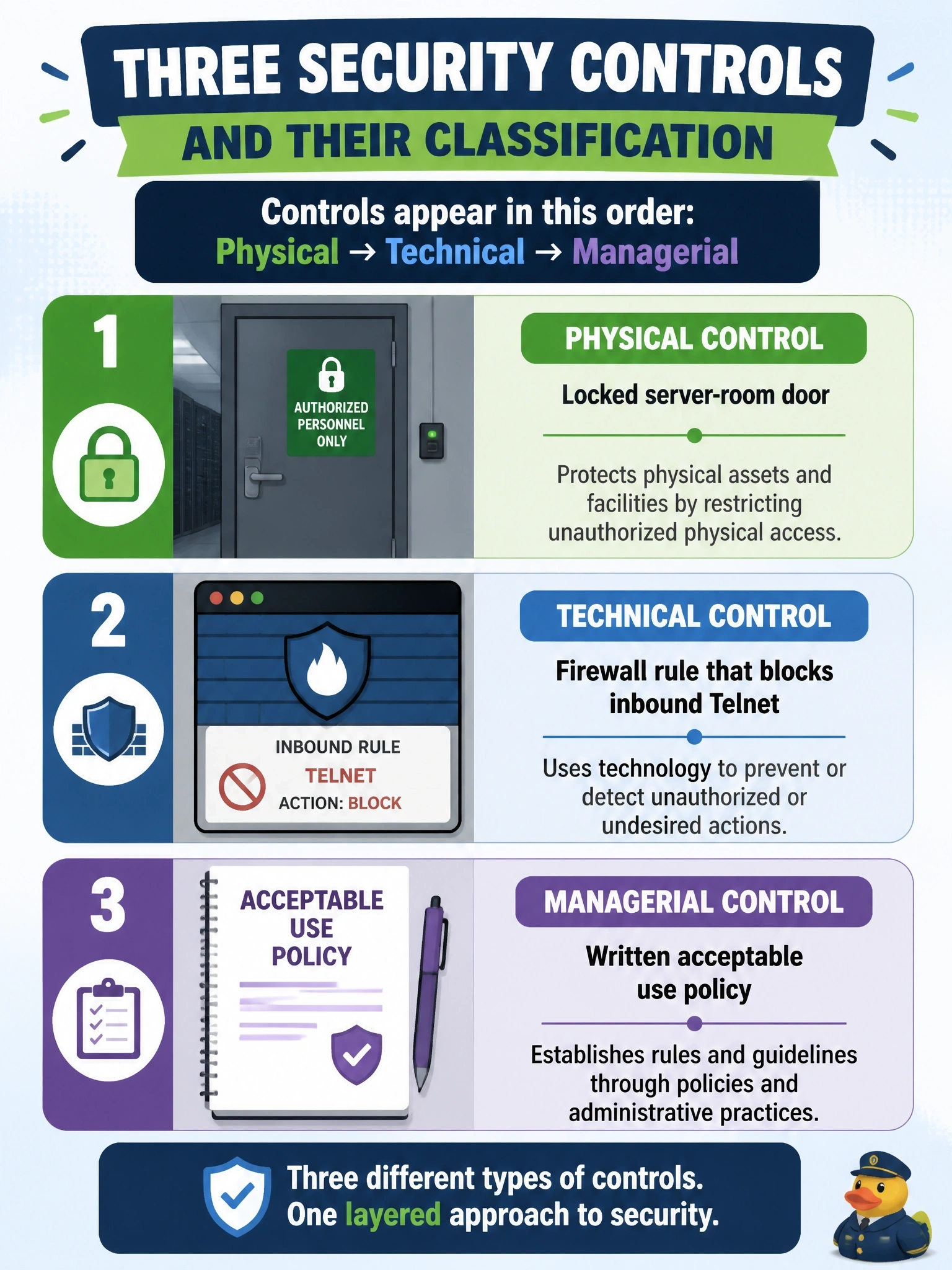
A security manager is cataloging three controls: a locked server-room door, a firewall rule that blocks inbound Telnet, and a written acceptable use policy. Which classification of these controls, in that order, is correct?
Select an answer to reveal the explanation.
Short Explanation
Ask yourself what each control is made of. A lock is something you can touch, a firewall rule lives in software, and a policy is a document managers write. Sort them that way and the distractors fall apart quickly.
Full Explanation
Control categories describe how a control is implemented. Physical (environmental) controls are tangible barriers such as doors, locks, and fences; a locked server-room door is therefore physical. Technical, also called logical, controls are implemented through hardware or software, such as firewall rules and encryption; a rule blocking inbound Telnet is technical. Managerial, also called administrative, controls set direction and oversight through documents and decisions, such as policies, risk assessments, and standards; an acceptable use policy is managerial. The classification beginning with operational misreads the door: operational controls are activities carried out by people, such as guards patrolling or staff performing procedures, while a lock is a physical object. The classification that labels the firewall rule operational confuses a software-enforced rule with a human-executed process, and it calls the policy technical even though it is a document. The ordering that starts with technical swaps the lock and firewall rule and labels the policy operational, again ignoring that policies are managerial. Exam caveat: categories (technical, managerial, operational, physical) are different from types (preventive, deterring, detective, corrective, compensating, directive), and each control has one of each. Operational check: when building a control inventory, record both the category and the type for every control so gaps in either dimension become visible.