
A retail chain wants every store to reach the data center, and stores must not have direct circuits to each other. A link between every pair of sites costs too much. Which topology fits?
Select an answer to reveal the explanation.
Short Explanation
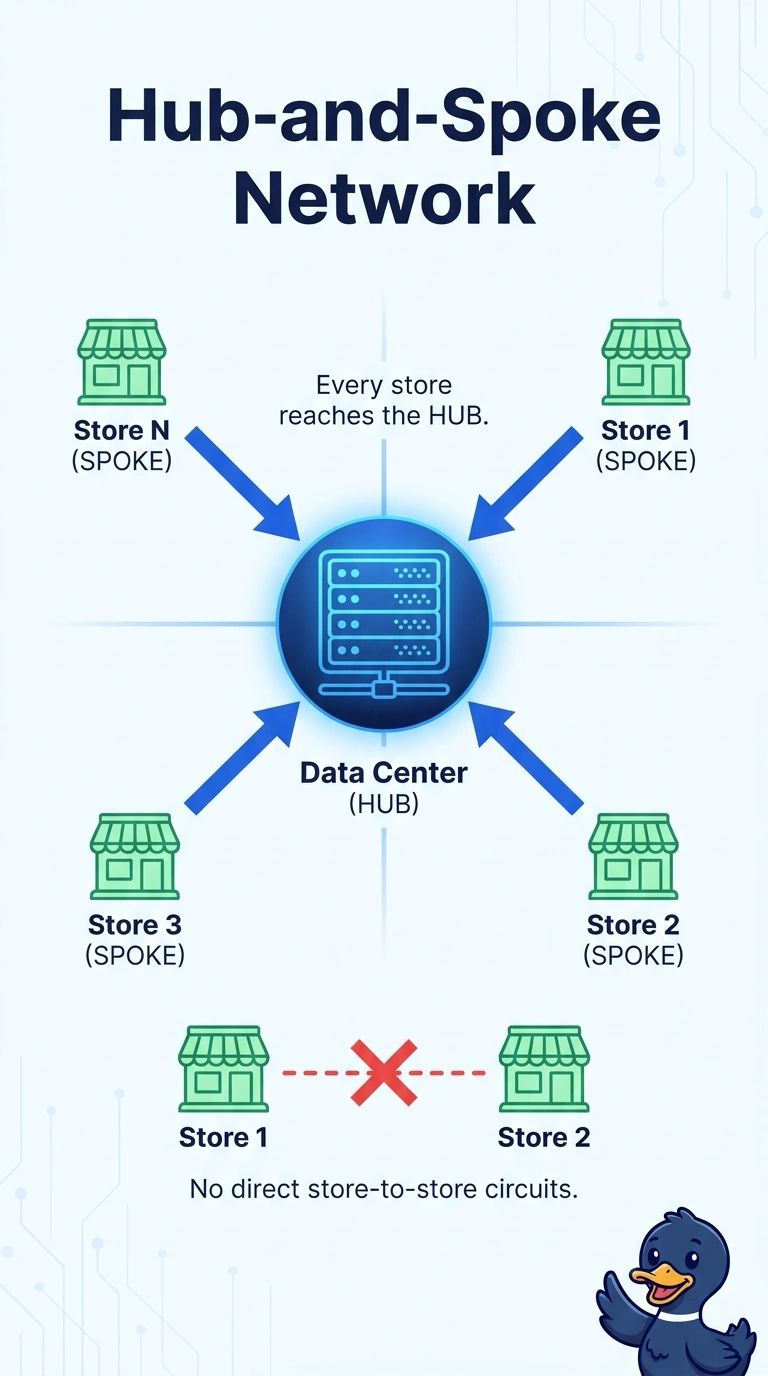
Each store gets one road to headquarters, and the stores do not get roads to each other. That pattern is hub-and-spoke, with the data center as the hub. A full mesh is the expensive web of roads you just ruled out, and a data-center leaf design or a laptop-to-laptop wireless network is the wrong picture for these stores.
Full Explanation
Hub-and-spoke connects each remote site to a central site and does not connect the remote sites directly to one another. Traffic from store to store, if it is allowed at all, passes through the hub. The chain wants every store to reach the data center, forbids direct store-to-store circuits, and will not pay for a link between every pair, so hub-and-spoke is the match. A full mesh gives every site a circuit to every other site. It is the design the chain rejected on cost, and it does not avoid store-to-store circuits. Spine-and-leaf is a data-center fabric that gives each leaf a short path to the other leaves. It is not the usual wide-area topology for a handful of stores. An ad hoc wireless network lets endpoints talk without an access point. It does not connect retail stores to a data center across a wide area. Exam caveat: hub-and-spoke makes the hub a single point of failure for store connectivity, so the hub circuit is often redundant even when the spokes are not meshed. Operational check: trace a route from a store to the data center and confirm there is no direct circuit in the provider order from one store to another.